What Is Raw Honey? How to Spot the Real Thing, and Why It Beats the Supermarket Jar

Walk down any supermarket aisle and almost every jar will simply say "honey". Yet the word hides an enormous range, from cheap, blended, heat-treated syrup to something genuinely alive with flavour. "Raw honey" is the term people reach for when they want the real thing, but it is used loosely and rarely explained. So let us clear it up: what raw honey actually is, how to recognise it, and why a naturally raw, cold-spun thyme honey tastes nothing like the squeezy bottle in the cupboard.
What "raw honey" actually means
Raw honey is honey that has not been heated or ultra-processed on its way from the hive to the jar. In practice, three things define it:
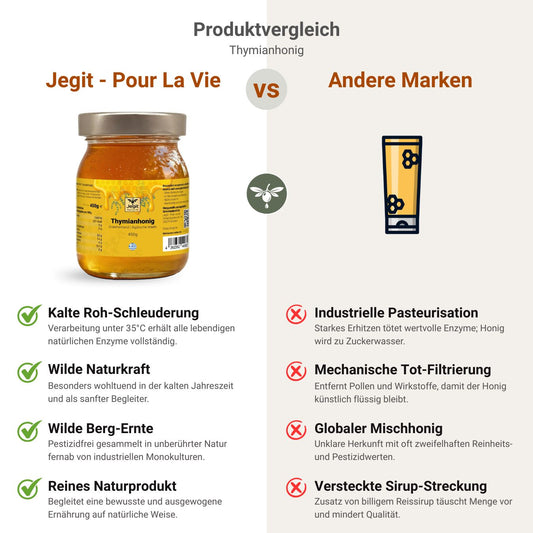
- Unheated. It is never pasteurised or blasted with high heat, so its natural enzymes and aromatic compounds stay intact.
- Cold-extracted. It is spun gently from the comb (cold-spun) rather than forced out with heat and pressure.
- Only gently filtered. Coarse bits of wax are removed, but the honey is not stripped down to a clear, characterless syrup.
That is exactly how our Greek thyme honey is made: naturally unprocessed, cold-spun by hand and gently filtered, so it stays rich in natural enzymes and keeps its intense Mediterranean aroma. If you have only ever had processed honey, this is the upgrade worth making.
Raw honey vs the supermarket jar
Most inexpensive honey is a blend from several countries, warmed so it pours fast on the production line and filtered until it is crystal clear and stays liquid for months. It is convenient, and it is sweet. But heat and heavy processing flatten the very things that make honey interesting: the aroma, the depth, the character of the flowers the bees actually visited.
Raw honey goes the other way. Because it is never cooked, it carries the unmistakable taste of its origin. Our thyme honey, gathered from wild Mediterranean thyme fields, is floral, intense and slightly peppery, the kind of flavour a blended syrup simply cannot fake. Taste them side by side and you will not need anyone to explain the difference. Try genuine raw thyme honey here.
Raw honey vs manuka: do you need the expensive jar?
Manuka honey is everywhere right now, and it is not cheap. Here is the honest, down-to-earth view: what makes any honey special in the kitchen is that it is raw, natural and full of genuine character, not a particular marketing label. A naturally raw, cold-spun thyme honey gives you exactly that, with a flavour many people love far more than manuka's, at a fraction of the price. If you are weighing it up, our deep dive on thyme honey vs manuka honey walks through it in detail.
How to spot genuine raw honey
A few simple signs separate the real thing from a processed jar:
- It crystallises over time. Natural, raw honey turns thick and grainy in the jar, especially when cool. That is a feature, not a fault, and a reassuring sign it has not been heavily processed.
- It names a single floral source. "Thyme honey" from a defined region tells you far more than an anonymous "blend of EU and non-EU honeys".
- It smells and tastes of something. Genuine raw honey has a distinct aroma and a long finish, not just flat sweetness.
- The label mentions cold extraction or gentle handling. Words like unheated, cold-spun and naturally unprocessed are what you are looking for.
Our thyme honey ticks every box: single-origin Greek thyme, cold-spun, naturally unprocessed and gently filtered. For more on choosing well, see our buyer's guide to Greek thyme honey. Secure your jar of real raw honey now.
How to use raw honey in the kitchen
Because raw honey keeps its full flavour, a little goes a long way. Stir it into warm (not boiling) herbal tea so you keep its character. Spoon it over thick Greek yoghurt, fresh goat's cheese or a slice of ripe pear. Whisk it into a sharp dressing to balance the acidity, or use it as a glaze brushed over roast chicken in the last minutes of cooking. It is also a lovely, aromatic swap for refined sugar in baking. For plenty more ideas, our guide to cooking with thyme honey is full of them.
One tip: to loosen crystallised honey, stand the jar in a bowl of warm water. Never microwave it or heat it hard, or you undo the very thing that makes it raw.
Frequently asked questions
Is raw honey the same as organic honey?
Not necessarily. "Raw" describes how the honey is handled (unheated and minimally processed), while "organic" describes how the bees are kept and foraged. A honey can be raw without carrying an organic label. What matters most for flavour is that it is genuinely unheated and single-origin, like our cold-spun thyme honey.
Why has my raw honey gone solid?
It has crystallised, which is completely natural for raw honey and a good sign it has not been over-processed. Stand the jar in warm water to bring it back to a pourable texture, and avoid strong heat so you keep its aroma and enzymes.
Is raw honey worth the extra over cheap honey?
If you care about flavour, yes. Cheap blended honey is mostly just sweet. Raw, single-origin thyme honey has aroma, depth and a long finish that transform everything from your morning tea to a cheese board. You simply use less of it.
Our product tip
Greek Thyme Honey (450 g)
Naturally unprocessed, cold-spun by hand and gently filtered, so it stays rich in natural enzymes with an intense Mediterranean aroma. Genuine raw honey, not a blended syrup.
Buy the thyme honey nowOnce you have tasted honey the way it is meant to be, pure, raw and full of character, the supermarket jar never tastes the same again. That is the whole idea behind what we do: natural, unprocessed, with a story in every jar. Taste real raw honey, Pour La Vie.

Olive Wood Antipasti Board: How to Choose One, Care for It, and Build a Mediterranean Grazing Board
How to choose, care for and serve on an olive wood antipasti board, plus how to build a Mediterranean grazing board that...

How to Spot the Best Aleppo Soap: A Buyer's Guide to Genuine, High-Quality Bars
How to choose the best Aleppo soap: the five quality markers (oil ratio, curing time, the cut-open colour test and more) that...

Mediterranean Corporate Christmas Gifts: Premium, Useful Hampers Your Team and Clients Will Actually Love
Looking for corporate Christmas gifts for employees and clients? Premium Mediterranean hampers with olive oil, olives and thyme honey, that get used...