Thyme Honey vs Manuka Honey: Which Is Really Worth It?

If you have walked down the honey aisle lately, you will have noticed manuka honey sitting in a locked cabinet with a price tag to match. It has become the honey everyone has heard of — the premium jar people buy as a wellness splurge. But is it actually worth it, and how does it compare to a classic Mediterranean honey like Greek thyme honey? Let's put thyme honey vs manuka honey side by side, honestly, so you can decide what belongs in your cupboard.
Here is the short version: for everyday eating, cooking and drizzling, there is a strong case that a pure, raw Greek thyme honey gives you far more pleasure per euro. See our Greek thyme honey here and read on to find out why.
What is manuka honey?
Manuka honey is produced by bees that forage on the manuka bush (Leptospermum scoparium), native to New Zealand and parts of Australia. What sets it apart is a naturally occurring compound called methylglyoxal (MGO), and most jars are graded by an MGO or UMF number printed on the label — the higher the number, the more concentrated that compound and, generally, the higher the price.
It has a distinctive taste, too: dark, earthy and quite medicinal, with a thick, almost ointment-like texture. Plenty of people enjoy that intensity; others find it an acquired taste. Because it is imported from the other side of the world and produced in limited quantities, manuka sits at the very top of the price scale — it is bought as a specialist product rather than an everyday table honey.
What is Greek thyme honey?
Thyme honey is one of the Mediterranean's great culinary treasures. In Greece, bees forage on the wild thyme that blankets sun-baked hillsides through the summer, and the result is an amber honey with an intense, captivating aroma — herbal and floral with a gentle, resinous, almost peppery finish. It is the honey Greeks drizzle over yoghurt, spoon onto fresh cheese and stir into everything from dressings to pastries.
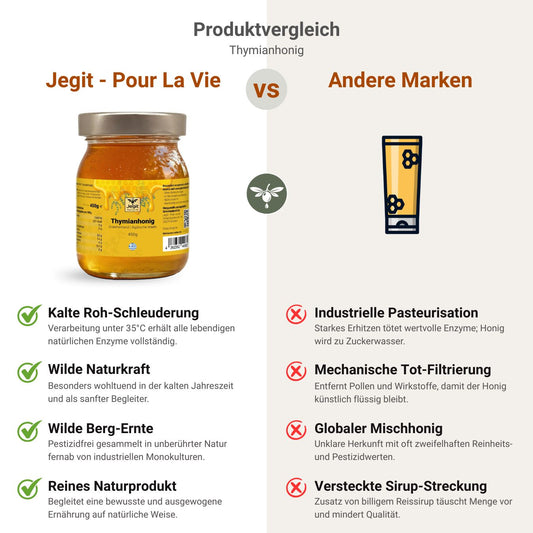
Our Thyme Honey 450g from Greece is pure and unprocessed, cold-spun and never heated, so its natural enzymes and aromatic compounds stay intact. It is gently handcrafted and sustainably harvested from wild thyme fields — nothing added, nothing taken away. Where manuka is a one-off splurge, this is a honey you will reach for every single day. Try Jegit thyme honey for yourself.
Taste and texture: the everyday difference
This is where the two honeys part ways most clearly. Manuka is bold, dark and medicinal — a flavour that can dominate a cup of tea or a slice of toast. Greek thyme honey is aromatic and layered but far more versatile: sweet and floral up front, with that herbal, peppery lift that makes it as good over a salad or a roast as it is on your morning porridge.
If you want a honey that genuinely makes food taste better — one you will happily eat every day rather than ration by the teaspoon — thyme honey wins comfortably. Taste the Mediterranean difference here.
Price and value: what are you really paying for?
There is no getting around it: manuka honey is expensive, often several times the price of an excellent European honey, and much of that cost reflects its rarity, its import journey and the marketing around its MGO rating. For a honey you will mostly keep in the cupboard and use sparingly, that is a lot to spend.
A premium Greek thyme honey, by contrast, gives you genuine artisan quality — raw, cold-spun, single-origin and full of character — at a price that makes everyday use a joy rather than a guilty indulgence. You are paying for purity and flavour, not air miles. If you know you will reach for it often, our 900g jar with a free olive-wood honey dipper is even better value. Compare the value for yourself.
How to use each one
If you have bought a jar of manuka, treat it as a specialist product and use it neat, by the spoonful. Thyme honey is the opposite — it is made to be used generously. Drizzle it over Greek yoghurt and fresh fruit, spoon it over warm feta or goat's cheese, whisk it into a honey-mustard dressing, glaze roasted vegetables or chicken, sweeten herbal teas, or simply enjoy it on good bread. One tip: add raw honey towards the end of cooking rather than over very high, prolonged heat, so you keep its delicate aroma.
For the way most of us actually eat, a jar of real thyme honey earns its place on the table in a way a locked-cabinet splurge never quite does. Stock up on Greek thyme honey here.
Our product tip
Thyme Honey 450g from Greece
Pure, raw and cold-spun — wild Greek thyme honey with an intense, captivating aroma and everyday value a trophy jar can't match.
Shop Greek Thyme HoneyThe verdict in one line: if you want a trophy jar to keep on a shelf, manuka has the name. If you want a pure, characterful honey you will genuinely love eating every day, Greek thyme honey wins on taste, purity and value. Shop Jegit Thyme Honey.
Frequently asked questions
Is thyme honey as good as manuka honey?
For everyday eating, cooking and drizzling, many people prefer it. Greek thyme honey offers a far more versatile, aromatic flavour and excellent value, while manuka is a specialist, premium-priced honey graded by its MGO content. It comes down to what you actually want a honey to do.
What does Greek thyme honey taste like?
It is aromatic and amber-coloured, with a herbal, floral sweetness and a gentle, almost peppery finish from the wild thyme the bees forage on. Our thyme honey is cold-spun and never heated, so that intense natural aroma stays intact.
Why is manuka honey so expensive?
Its price reflects its rarity, its import from New Zealand and Australia, and the MGO/UMF grading it is marketed on. A raw, single-origin European honey like Greek thyme honey delivers artisan quality at a far more everyday price.
Both honeys have their place — but only one is built to be loved every single day. Choose a pure, raw Greek thyme honey and bring a little of the Mediterranean to your table with every spoonful. Order your jar of Jegit thyme honey today — Pour La Vie.

Does Honey Go Bad? Shelf Life, Crystallisation and How to Store Thyme Honey
Does honey go bad? How long thyme honey lasts, why it crystallises, how to store it and gently re-liquify it — plus...

Aleppo Soap vs Curd Soap (Kernseife): Which Natural Bar Is Better for Skin, Hair and Home?
Aleppo soap or curd soap (Kernseife)? Compare how each natural bar cleans skin, hair and laundry — and why an olive-and-laurel Aleppo...

Is Aleppo Soap Vegan? The Honest Answer — and Why This Olive-and-Laurel Bar Belongs in a Vegan Routine
Is Aleppo soap vegan? Yes — ours is made from just olive oil and laurel oil, with no animal ingredients or additives....