How to Spot the Best Aleppo Soap: A Buyer's Guide to Genuine, High-Quality Bars

Walk through any drugstore and you will find bars labelled 'Aleppo soap' at every price point, from a couple of euros to premium artisan prices. They are not the same product. Genuine, traditionally made Aleppo soap is one of the oldest skincare recipes on earth, cured for years and made from just two oils. A lot of what is sold under the name is a rushed, additive-laden imitation. If you are going to buy one bar that you use every single day, it is worth knowing how to spot the best Aleppo soap from the pretenders.
This is your buyer's guide: what Aleppo soap actually is, the five quality markers that separate real from fake, and the simple checks you can do before and after you buy. By the end you will know exactly what to look for, and why our own traditional Aleppo soap is made the slow way.
What genuine Aleppo soap is made of
Real Aleppo soap has a remarkably short ingredient list: olive oil, laurel berry oil (Lorbeeröl), water and a natural alkali, saponified and then cured. That is it. No synthetic fragrance, no palm oil, no colourants, no hardening agents. The olive oil provides gentle, moisturising cleansing; the laurel oil gives the soap its distinctive earthy scent and its reputation for suiting demanding skin.
The ratio of those two oils is the first thing to check. A higher laurel-oil percentage means a richer, more prized (and more expensive) bar. Our soap is made with 60% olive oil and 40% laurel oil, a classic high-laurel ratio that balances everyday mildness with real character. If a label will not even tell you the ratio, that tells you something in itself. Curious what the laurel oil actually does? Our guide on laurel berry oil in Aleppo soap breaks it down.
Our product tip
Aleppo Soap - 40% Laurel Oil & 60% Olive Oil
Traditionally hand-cut, cured for at least 4 years, with no additives and nothing but olive and laurel oil. One honest bar for face, body, hair and shaving.
Shop genuine Aleppo soapThe 5 quality markers of a top Aleppo soap
1. Curing time of at least a year (ours is four)
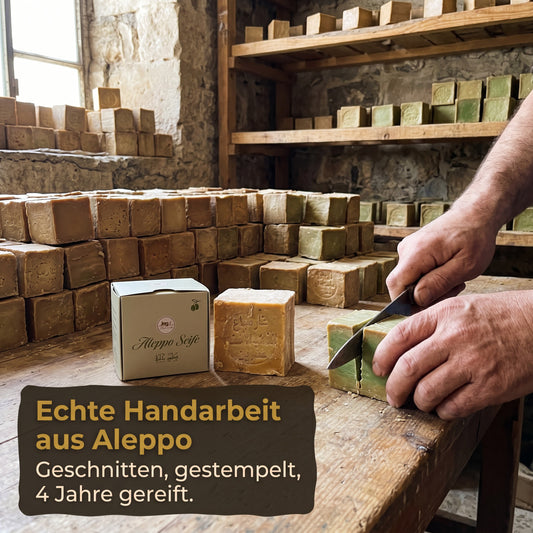
Traditional Aleppo soap is air-cured for a long time, which is what makes it so mild and long-lasting. The longer it rests, the gentler and harder the bar becomes. Mass-market versions are often sold after only weeks. Look for a stated curing time. Ours is matured for a minimum of four years before it ever reaches our range, and that patience is exactly what you feel on your skin.
2. The cut-open colour test
This is the single best check you can do. The outside of a genuine, aged bar is a dull, weathered khaki-green or brown, oxidised by years of air exposure. Cut it open and the inside should be a warm golden-green. A bar that is bright green all the way through usually owes its colour to added dye, not to laurel oil and time.
3. Hand-cut, not machine-perfect
Authentic Aleppo soap is poured, dried and then cut by hand, so each cube is slightly irregular and often carries a maker's stamp. Flawless, identical, shrink-wrapped bars are a sign of industrial production. Our soap is traditionally hand-cut, which is why each piece weighs roughly 200 g but varies naturally between about 180 and 220 g.
4. A short, honest ingredient list
Turn the pack over. You want to read olive oil, laurel oil, water and alkali, and little or nothing else. Palm oil, synthetic perfume (parfum), EDTA or added colour all point to a cheaper, modern reformulation. A genuine bar is naturally vegan and free of additives, which is also why it is gentle enough to use on the face, body and hair, and even for shaving and laundry. Our complete guide to using Aleppo soap shows just how versatile one honest bar can be.
5. It floats, and it lasts
A well-cured Aleppo bar is dense yet, thanks to its oil content, tends to float in water. More importantly, because it is hard and pure, it lasts far longer than a typical supermarket soap, so the price per wash is lower than it first looks. Store it somewhere it can drain between uses and a single bar will see you through months.
Tick those five boxes and you have found a soap worth keeping in every bathroom in the house. Our traditional Aleppo soap ticks all five, see it here.
Real vs fake: a quick checklist before you buy
- Named oil ratio? Genuine sellers state it (ours is 60% olive / 40% laurel). Vague labels hide cheap formulas.
- Stated curing time? Look for a year or more. Four years is exceptional.
- Dull outer, golden inner? That is age and real oils, not dye.
- Irregular, hand-cut shape? A good sign of traditional production.
- Four-ingredient label? Olive oil, laurel oil, water, alkali. No palm oil, perfume or colour.
Keep this list on your phone next time you shop, and you will never overpay for an imitation again.
Why buy from a specialist rather than a drugstore shelf
The trouble with grabbing Aleppo soap off a random shelf is that you cannot verify any of the five markers until you get home. Buying from a Mediterranean specialist who sources traditionally made, long-cured soap removes the guesswork. Every bar in our range is checked for purity and comes with its origin, oil ratio and curing time stated openly, so you know precisely what you are putting on your skin. That is the whole idea behind Jegit: natural, without additives, with a story you can trace. Choose a bar you can trust and order yours today.
Frequently asked questions
Is a higher laurel-oil percentage always better?
Higher laurel content makes a richer, more aromatic bar that many people with demanding or oily skin prefer, which is why high-laurel soaps cost more. But a very high percentage can feel intense for sensitive skin. A ratio like our 40% laurel to 60% olive oil is a well-balanced sweet spot: characterful but still gentle enough for daily use on the face. You can read more in our guide to Aleppo soap for the face.
How can I tell if my Aleppo soap is fake?
Cut it open. A genuine, aged bar is dull on the outside and golden-green inside. If it is vivid green throughout, smells strongly of synthetic perfume, or lists palm oil and colourants, it is very likely a modern imitation rather than traditional Aleppo soap.
Why is good Aleppo soap more expensive?
Because real quality takes time and pure ingredients. Years of air-curing, genuine laurel berry oil (which is costly to produce) and hand-cutting all add up. But a dense, long-cured bar lasts for months and replaces several products at once, so the cost per use is low.
One honest bar, chosen well
Aleppo soap is proof that the oldest recipes are often the best, but only when they are made properly. Check the oil ratio, the curing time, the cut-open colour and the ingredient list, and you will always end up with a bar worth its place by your sink. Start with our traditionally cured Aleppo soap and enjoy natural care, Pour La Vie.

Mediterranean Corporate Christmas Gifts: Premium, Useful Hampers Your Team and Clients Will Actually Love
Looking for corporate Christmas gifts for employees and clients? Premium Mediterranean hampers with olive oil, olives and thyme honey, that get used...

Mediterranean Secret Santa & Wichtel Gifts: Small, Edible Presents People Actually Love
Stuck for a Secret Santa or Wichtel gift under budget? These small, edible Mediterranean presents feel generous, never end up in a...

Olive Oil for Skin and Hair: The Simple, Natural Mediterranean Beauty Ritual
How to use extra virgin olive oil for skin and hair: a gentle, natural Mediterranean beauty ritual for face, body, hands and...