How to Choose the Best Greek Thyme Honey: A Buyer's Guide

Thyme honey is one of the great treasures of the Greek pantry — dense, aromatic and famously slow to crystallise. It is also one of the honeys most often imitated, blended or mislabelled, which makes knowing what to look for genuinely worthwhile. If you have ever searched for the best thyme honey and felt unsure how to judge one jar against another, this guide walks you through exactly what separates a real Greek thyme honey from an ordinary one, and how to use it once you have found it.
What is thyme honey?
Thyme honey is a monofloral honey, meaning the bees have foraged predominantly on the blossom of wild thyme (Thymbra capitata and related species). Greece is one of the world's most important sources: its dry, sun-baked hillsides — especially across the islands and the southern mainland — are covered in wild thyme that flowers in the height of summer. Bees work these slopes for only a few short weeks, which is part of why genuine thyme honey is limited in supply and prized accordingly.
The result is a honey with a deep amber colour, an intense herbal-floral aroma and a warm, lingering, slightly peppery sweetness. It is bolder and more complex than a mild blossom or acacia honey, and that character is precisely what you are paying for.
How to recognise genuine Greek thyme honey
You do not need laboratory equipment to judge honey well. A handful of practical checks will tell you most of what you need to know.
1. Read the origin on the label
Look for a clear country of origin — ideally a single one, such as ‘Product of Greece’, rather than the vague ‘blend of EU and non-EU honeys’ you often see on supermarket jars. A named region is an even better sign. Genuine monofloral honey should also state the floral source (thyme) rather than simply ‘mixed flower honey’.
2. Trust your nose and palate
Real thyme honey has an unmistakable, powerful aroma — herbal and floral with a resinous, almost savoury edge. The taste is rich and persistent, with a gentle peppery warmth at the back of the throat. A honey that smells faint or tastes only of flat, one-note sweetness is unlikely to be a true thyme honey.
3. Look at the colour and clarity
Thyme honey is typically a rich golden to deep amber. Raw, unfiltered honey may look slightly hazy rather than glassy-clear, because it still contains tiny particles of pollen and wax — that is a mark of minimal processing, not a fault.
4. Understand crystallisation
This is one of the most useful signs of all. Thyme honey is naturally high in fructose, so it crystallises very slowly and stays liquid far longer than most honeys. If a honey sets rock-hard within weeks, it is probably not a true thyme honey. Equally, remember that crystallisation itself is never a sign of a bad honey — all raw honey will eventually granulate, and gently warming the jar in warm (not hot) water returns it to a pour.
5. Consider the price and the beekeeper
Real monofloral thyme honey is labour-intensive and seasonal, so it is never the cheapest jar on the shelf. A suspiciously low price is a red flag for blending or adulteration with syrups. Honey from a named producer or a small apiary, harvested and bottled with care, is worth the difference.
Why Greek thyme honey stands apart
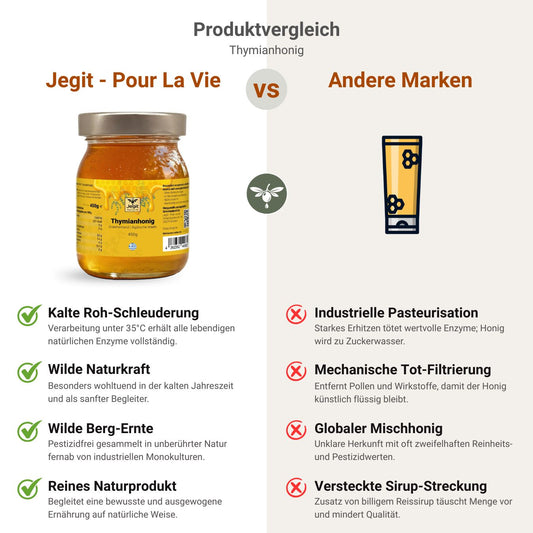
Geography does a great deal of the work. The Greek climate — hot, dry summers and hillsides thick with wild aromatic herbs — produces thyme with a concentrated, resinous nectar, and honey that reflects it. Traditional beekeeping practices matter too: honey that is cold-extracted and left unpasteurised keeps its natural enzymes, aromas and full flavour, whereas heavy heating and fine filtering strip much of the personality out of a honey to make it look uniform and pour easily.
Our Greek thyme honey is a pure, single-origin honey, gently harvested by hand and left unpasteurised so that its aroma and natural enzymes are preserved — exactly the qualities the checks above are designed to find.
Our product tip
Thyme Honey 400g from Greece
Pure, single-origin and unpasteurised — an intensely aromatic Greek thyme honey harvested gently by hand.
Shop the thyme honeyHow to use thyme honey
Its bold, resinous character makes thyme honey as much a savoury ingredient as a sweet one. A few favourite ways to enjoy it:
- Over cheese. Drizzle it across fresh feta, creamy goat's cheese or fried saganaki — the classic Greek pairing of salty cheese and floral honey is hard to beat.
- As a glaze. Brush it over roast chicken, pork or root vegetables in the last minutes of cooking for a burnished, aromatic finish.
- Spooned into breakfast. Stir it through thick Greek yoghurt, porridge or granola.
- In dressings and drinks. Whisk a little into a lemon-and-olive-oil dressing, or stir it into herbal tea and warm water.
- Straight from the spoon. On good bread with a little butter, it needs nothing else.
To keep its character, store thyme honey in a sealed jar at room temperature, away from direct sunlight, and use a dry spoon each time. There is no need to refrigerate it — cool storage only speeds up crystallisation.
Frequently asked questions
Why is my thyme honey still liquid after months?
Because that is normal for thyme honey. Its naturally high fructose content means it crystallises far more slowly than most honeys and can stay liquid for a long time. Staying liquid is a characteristic of the honey, not a sign that anything has been added.
How can I tell if thyme honey is pure at home?
No home test is definitive, but the best guides are aroma, taste, origin labelling and price. A powerful herbal scent, a rich and lasting flavour, a clearly stated single origin and a fair (not bargain) price together give you strong confidence. For certainty, buy from a producer who is transparent about where and how the honey was made.
Does thyme honey ever go off?
Stored properly in a sealed jar, honey keeps for a very long time thanks to its low moisture and natural composition. If it crystallises, simply stand the jar in warm water and stir gently until it turns liquid again — avoid boiling or microwaving, which harms the aroma and natural enzymes.
Pour La Vie
Choosing a good thyme honey comes down to a few honest signals: a clear origin, a powerful aroma, a slow crystallisation and a producer you can trust. Find a jar that ticks those boxes and you have one of the most versatile, characterful ingredients in the Mediterranean kitchen — to spoon, drizzle and share. Pour La Vie.

Can You Wash Your Hair with Aleppo Soap? A Natural Hair-Washing Guide (and How to Avoid the Waxy Feeling)
Yes, you can wash your hair with Aleppo soap. Here's how to do it right, why hair can feel waxy, and the...

Can You Eat Olives Straight From the Tree? Why Raw Olives Are So Bitter — and How They Become the Olives You Love
Can you eat olives straight off the tree? Here is why raw olives are so bitter, whether they are safe, and how...

Thyme Honey vs Manuka Honey: Which Is Really Worth It?
Thyme honey vs manuka honey compared: taste, MGO, purity and price. Why pure Greek thyme honey is the everyday Mediterranean honey worth...