Does Olive Oil Go Bad? Shelf Life, Rancidity and How to Tell If Your Extra Virgin Has Turned

You find a half-forgotten bottle of olive oil at the back of the cupboard and the question hits you: is this still good, or has it quietly gone off? It is one of the most-searched kitchen questions in autumn, and the honest answer is that yes, olive oil does go bad — but not in the way milk does. It will not make you ill. It simply fades, dulls and eventually turns rancid, losing the very flavour and character you paid for. Here is exactly how long extra virgin olive oil lasts, how to tell when yours has turned, and why the freshness of your oil is decided long before you ever twist off the cap. If you want to skip the guesswork, start with a fresh, lab-tested extra virgin from the Peloponnese.
Does olive oil actually expire?
Olive oil does not "expire" like a dated dairy product, but it is a fresh juice — pressed from a fruit — and it ages from the day it is made. Exposure to oxygen, light, heat and time slowly break down its flavour compounds and natural antioxidants. The result is not dangerous, but it is disappointing: the peppery, grassy, buttery notes flatten out, and eventually the oil develops the stale, waxy, crayon-like taste we call rancid. In other words, the real enemy is not a date on a label — it is time and bad storage. The fresher the oil when you buy it, and the better you keep it, the longer that window of real flavour stays open.
How long does extra virgin olive oil last?
As a rule of thumb, a good extra virgin olive oil is at its best within about 18 to 24 months of harvest, and within 1 to 3 months once opened. A few practical markers:
- Unopened: stored cool and dark, expect roughly 18–24 months from the harvest date. Note that this is the harvest date, not the bottling date — which is exactly why harvest transparency matters.
- Opened: aim to use it within 1–3 months for peak flavour. It will still be safe beyond that, but the vividness fades fast once air gets in.
- The polyphenol factor: oils naturally richer in polyphenols — the compounds behind that pleasant peppery bite — tend to hold their character for longer, because those same compounds act as natural antioxidants that slow the ageing of the oil.
This is where buying well genuinely pays off. Our Peloponnese extra virgin olive oil is hand-harvested and lab-tested for low acidity and a high polyphenol content, so it reaches you fresh and built to last. Order a fresh bottle here and you start the clock from a far better place than a bottle that has already spent a year on a supermarket shelf.
How to tell if your olive oil has gone rancid
You do not need a laboratory — your nose and tongue are the best tools you have. Pour a little into a spoon and check for these signs:
- Smell: fresh oil smells green, fruity, almost like cut grass or ripe olives. Rancid oil smells flat, waxy, or like old crayons, putty or stale nuts.
- Taste: a good oil is lively — fruity up front, often with a peppery catch at the back of the throat. Rancid oil tastes dull, greasy and faintly bitter in an unpleasant, cardboard way.
- Feel and look: gone-off oil can seem thicker and greasy on the palate. Cloudiness alone, however, is not a fault — naturally unfiltered oils like ours are meant to look cloudy, and chilling can make any oil turn thick and hazy without meaning it has spoiled.
If it smells of nothing and tastes of nothing, it is past its best. It will not harm you, but it is doing nothing for your cooking either. That is the moment to replace it with a fresh, flavour-packed bottle.
Why freshness is decided before you open the bottle
Here is the truth the big brands rarely advertise: much of the olive oil on supermarket shelves is a blend, often bottled many months after harvest and stored in clear glass under bright lights. By the time it reaches your kitchen, a good part of its life is already spent. You can store it perfectly and still be starting from a tired oil.
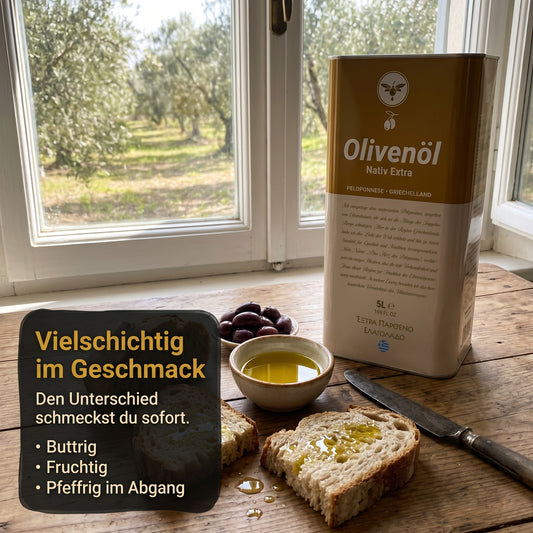
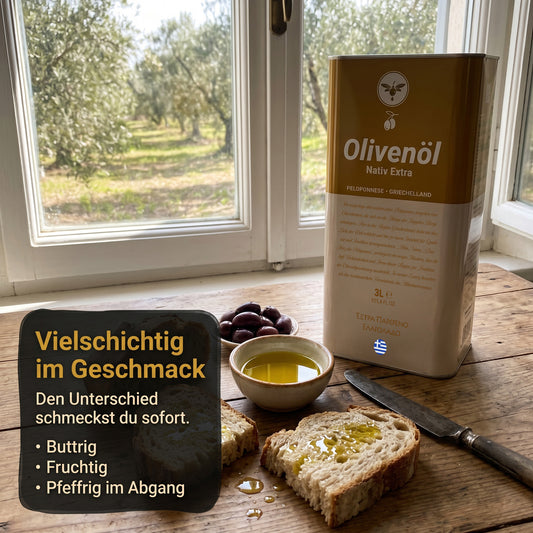
Freshness, in other words, begins at the source. Our extra virgin olive oil comes from a single origin in the Peloponnese, is traditionally hand-harvested and cold-extracted by mechanical means only, and is lab-tested to confirm low acidity, a rich polyphenol content and no mineral-oil residues. Naturally cloudy and unfiltered, it keeps the full spectrum of flavour — and because it is stable up to 180°C, you can cook and roast with it as confidently as you drizzle it. That combination of genuine freshness and robustness is what keeps it tasting the way great olive oil should. Taste the difference for yourself.
How to store olive oil so it lasts
Once you have a good bottle, protect it. Keep it in a cool, dark cupboard — never beside the hob or on a sunny windowsill, where heat and light age it fastest. Keep the cap tightly closed to limit contact with air, and choose dark glass or stoneware over clear bottles. Buy a size you will realistically finish within a few months rather than an enormous tin that sits open for half a year. A dedicated stoneware pouring bottle shields the oil from light on the countertop while keeping it to hand for everyday use.
Our product tip
Extra Virgin Olive Oil 500ml from the Peloponnese
Hand-harvested, naturally cloudy and lab-tested — low in acidity, rich in polyphenols and bottled fresh so you taste it at its peak.
Buy fresh nowFrequently asked questions
Is it safe to use olive oil after its best-before date?
Rancid olive oil will not make you ill, so using slightly older oil is not a safety risk in the way spoiled meat or dairy would be. The issue is purely flavour and quality: once an oil has turned, it tastes flat or stale and adds nothing to your food. If it still smells fresh and fruity, use it; if it smells waxy or of old crayons, replace it.
Does cloudy olive oil mean it has gone bad?
Not at all. Naturally unfiltered extra virgin olive oil, like our Peloponnese oil, is meant to look cloudy because it still carries fine fruit particles. Oil also turns thick and hazy in the fridge or a cold kitchen and clears again at room temperature. Judge by smell and taste, never by cloudiness alone.
Should I keep olive oil in the fridge?
You do not need to. A cool, dark cupboard away from the hob is ideal. The fridge will not harm the oil but makes it solidify and awkward to pour, and it offers no real benefit over a sensible cupboard and a tightly closed, dark bottle.
The takeaway is simple: olive oil does go off, but freshness is something you buy before you store. Start with a genuinely fresh, lab-tested oil, keep it cool and dark, and finish it while it is lively. Order your fresh Peloponnese extra virgin olive oil now and taste what olive oil is supposed to be. Pour La Vie.

When Are Olives Harvested? Olive Harvest Season and Why Early, Hand-Picked Oil Tastes Better
Discover when olives are harvested, how the olive harvest season works, and why early, hand-picked Peloponnese oil tastes fresher, greener and better.

Can You Cook and Fry with Extra Virgin Olive Oil? Smoke Point and Heat Explained
Can you fry and cook with extra virgin olive oil? Yes. Here's what smoke point really means and how to use a...

Olive Wood Serving Board: How to Build the Perfect Mediterranean Antipasti Platter
How to build a showstopping Mediterranean antipasti platter on an olive wood serving board: what to pile on, how to arrange it,...