Flammkuchen with Goat's Cheese and Thyme Honey: An Alsatian Tarte Flambée with a Sweet-Savoury Twist

There is a moment, just as the flammkuchen slides out of the oven, when the whole kitchen fills with the smell of caramelised onion, bubbling crème fraîche and warm honey. That smell is the entire point of this dish. A proper Alsatian tarte flambée is wafer-thin and blistered at the edges, and here we top it with tangy goat's cheese and a slow drizzle of Greek thyme honey — the sweet-and-savoury contrast that turns a humble flatbread into the thing everyone reaches for first.
Here is the part most recipes gloss over: the honey is not an optional garnish. A cheap, pasteurised blossom honey tastes flatly sweet and simply vanishes under the cheese. Jegit's cold-spun Greek thyme honey does the opposite — it is herbal, resinous and genuinely intense, so a thin thread of it cuts cleanly through the goat's cheese rather than drowning in it. If you want the version your guests ask you to make again and again, that is where it starts. Secure a jar here and let's build the perfect flammkuchen.
What exactly is flammkuchen?
Flammkuchen — tarte flambée in French — comes from Alsace, the region straddling the French–German border. Traditionally it was the baker's test bake: a thin round of bread dough slid into the wood-fired oven to gauge the heat before the loaves went in. It was topped simply with crème fraîche, onions and lardons, baked in a blast of heat until the edges charred, and torn apart by hand.
The classic is wonderful, but the sweet-savoury version — goat's cheese and honey — has quietly become the one people search for most. It keeps everything that makes flammkuchen brilliant (the shatter-thin base, the cool crème fraîche, the sweet onion) and adds a grown-up finish. Getting it right is almost entirely about the quality of two ingredients: the cheese, and above all the honey.
The ingredient that does the heavy lifting
You could make this with any honey. You shouldn't. The difference between “nice” and “unforgettable” is in the jar.
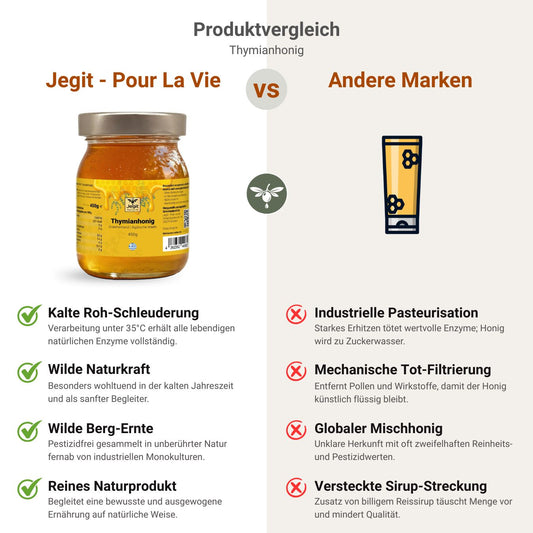
Greek thyme honey is prized across the Mediterranean because the bees forage on wild thyme growing on sun-baked hillsides. The result is a honey with a deep amber colour and a savoury, almost herbal edge — the perfect foil for salty goat's cheese. Our Greek thyme honey is:
- Cold-spun and never heated, so the natural enzymes and the full aroma survive the journey from hive to jar.
- Naturally sourced from Greek beekeepers whose hives sit among wild Mediterranean thyme.
- Intense and herby rather than one-note sweet — exactly why it works drizzled over cheese.
- Completely natural, with nothing added. (Honey can crystallise over time — a sign of the real thing, not a fault.)
Use a flat, flavourless supermarket honey and the flammkuchen tastes fine. Use a proper thyme honey and it tastes like something from a bistro in Strasbourg. Taste the difference for yourself.
Ingredients
Makes 2 flammkuchen (serves 2 as a main, 4 as a starter). Prep 15 minutes, bake 12–15 minutes.
For the base
- 250 g plain flour, plus extra for dusting
- 120 ml lukewarm water
- 2 tbsp extra virgin olive oil, plus a little for brushing
- ½ tsp salt
(Short on time? A ready-rolled thin pizza or flammkuchen base works beautifully.)
For the topping
- 200 g crème fraîche
- 1 large red onion, very thinly sliced
- 150 g soft goat's cheese (a log or a creamy chèvre)
- 3–4 tbsp Greek thyme honey
- Fresh thyme leaves
- Salt and freshly ground black pepper
- A final drizzle of extra virgin olive oil
Method
- Heat the oven as high as it will go — 250°C (fan 230°C) — with a baking tray or pizza stone inside. Flammkuchen lives and dies by heat; you want the base crisp, not soft.
- Make the dough. Mix the flour and salt, add the water and olive oil, and bring together into a smooth dough. Knead for two minutes, divide in two and roll each piece out as thinly as you possibly can on baking paper — almost see-through.
- Spread the base. Season the crème fraîche with a little salt and pepper and spread it thinly over the dough, leaving a 1 cm border.
- Add the toppings. Scatter over the thinly sliced red onion, then dot with rounds of goat's cheese. Don't overload it — flammkuchen is about restraint.
- Bake hot and fast. Slide onto the hot tray and bake for 12–15 minutes, until the edges are deep golden and the cheese is just starting to colour.
- Finish with the honey — this is the moment. The second it comes out of the oven, drizzle generously with thyme honey so it melts into the warm cheese, scatter with fresh thyme, add a grind of pepper and a final thread of olive oil. Slice and serve immediately.
That warm-honey-meets-salty-cheese first bite is the whole reason to make this. Make sure you've got a jar of real thyme honey in the cupboard before you start — it's the one thing you can't fake.
Make it your own
Once you've nailed the basic version, scatter a handful of rocket over the top after baking, or add thin slices of pear alongside the goat's cheese for an autumn twist. A few onions cooked slowly in olive oil beforehand push it even further. Whatever you add, keep the honey drizzle — it's the signature.
Ready to cook? Grab your thyme honey here and you're ten minutes from the best flammkuchen you've made.
Our product tip
Greek Thyme Honey 900 g + free olive-wood honey dipper
Cold-spun and unheated, so the natural enzymes and the intense, herby aroma survive — the drizzle that makes this flammkuchen unforgettable.
Taste the thyme honeyFrequently asked questions
Can I use ordinary honey instead of thyme honey?
You can, but it's a real downgrade. Standard blossom honey is simply sweet and tends to disappear under the goat's cheese. Thyme honey is herbal and intense, so it holds its own and balances the saltiness. For a dish this simple, the honey does half the work — it's worth using the good stuff. This is the one we use.
What cheese works best?
A soft goat's cheese (chèvre) is the classic partner for honey — its tang is exactly what the sweetness needs. If goat's cheese isn't for you, a creamy blue or a mild feta also pair well with thyme honey, though the flavour will change.
How do I get the base really crisp?
Three things: roll the dough as thin as you can, preheat your tray or stone until it's screaming hot, and don't overload the topping. A wet, heavy flammkuchen never crisps; a thin base on a hot surface blisters in minutes.
Flammkuchen is proof that the simplest dishes ask the most of their ingredients. Get a thin base, a hot oven and a truly good honey, and you have something far greater than the sum of its parts. Start with the jar that makes it sing — Jegit's Greek thyme honey, cold-spun and bottled with a free olive-wood dipper. Pour La Vie.

Bacalhau à Lagareiro: Portuguese Olive-Oil-Roasted Cod Where the Oil Is the Whole Dish
Authentic Portuguese bacalhau à lagareiro: olive-oil-roasted cod with smashed potatoes and sweet garlic — the dish where great extra virgin olive oil...

Menemen: The Turkish Breakfast Eggs Soft-Scrambled in Olive Oil
Authentic Turkish menemen: soft eggs, peppers and tomatoes cooked in peppery Greek extra virgin olive oil. The one-pan breakfast that lives or...

Roasted Pumpkin with Feta and Thyme Honey: A Mediterranean Autumn Traybake
Roasted pumpkin with feta and a drizzle of Greek thyme honey: a 10-minute Mediterranean autumn traybake that lives or dies by the...