What Does Greek Thyme Honey Taste Like — and How to Use It

Pick up a jar of real Greek thyme honey, lift the lid, and the first thing that hits you isn't sweetness — it's the aroma. Warm, herbal, almost resinous, like a hillside in the Mediterranean sun. That scent is your first clue that this is not the mild, one-note honey most people grow up with. If you have ever wondered what thyme honey actually tastes like, and why anyone would pay more for it, this guide is for you — and by the end you will know exactly how to spot the real thing and what to do with it. You can taste our Greek thyme honey for yourself here — but first, let's talk flavour.
What does Greek thyme honey actually taste like?
Thyme honey has one of the most distinctive flavours in the honey world. It is less sugary-sweet than clover or blossom honey and far more aromatic. Expect a deep amber colour, a thick, slow pour, and a flavour that unfolds in stages: an initial floral sweetness, then a savoury, herbal middle that tastes faintly of wild thyme and warm earth, and finally a gentle, lingering peppery note on the back of the tongue. It is complex in a way that makes ordinary honey taste one-dimensional once you have tried it.
That intensity is exactly why it has become a quiet obsession among food lovers — and why searches for genuine Greek thyme honey keep climbing. Once you taste a spoonful of the real thing, a jar of generic supermarket honey feels like a missed opportunity. Our naturally harvested Greek thyme honey captures that full aromatic range because it is left exactly as the bees made it.
Why real thyme honey is worth it — and how to tell it apart
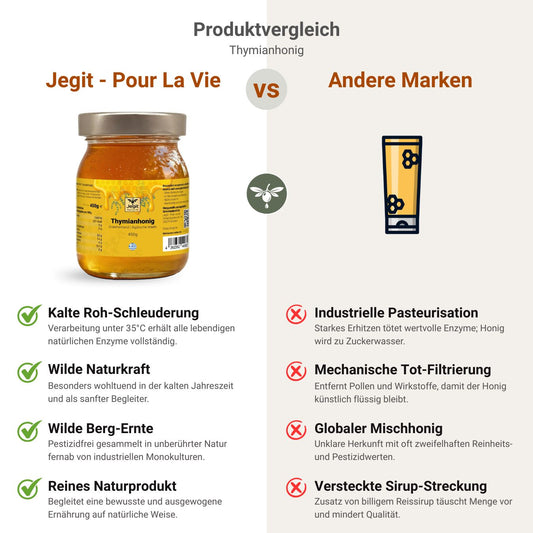
Here is where it pays to know what you are buying. A lot of honey sold as "thyme" is blended, heated to make it pour faster and look clearer, or cut with cheaper honeys. Heating and heavy filtering strip out the very aromatics and natural enzymes that give thyme honey its character. You end up paying for the name and getting none of the magic.
So what should you look for?
- Unheated (raw). Gentle, heat-free handling keeps the aroma and the natural enzymes intact. Our thyme honey is cold-handled and never heated — which is exactly why it smells and tastes so alive.
- Pure and unadulterated. One ingredient: honey. No blends, no added syrups, no "flavourings".
- A genuine Greek origin. Greece's wild thyme hillsides — Crete above all — are famous for this honey for a reason. The flora is the flavour.
- Natural crystallisation over time. Real raw honey will gradually set or crystallise. That is a feature, not a fault — a sign it hasn't been processed into permanent syrupy clarity.
- A strong, honest aroma. Open the jar. If it smells boldly herbal and warm, you're holding the real thing.
Judge a honey by those five things and you will never overpay for a watered-down jar again. If you would rather skip the detective work, our Greek thyme honey ticks every box on that list: pure, unheated, hand-crafted and sustainably harvested from wild blooming thyme.
Our product tip
Thyme Honey 450 g from Greece
Pure, unheated and rich in natural enzymes, with an intense Mediterranean aroma — hand-crafted from wild Greek thyme and jarred just as the bees made it.
Buy Greek thyme honey nowHow to use thyme honey in your kitchen
Because its flavour is savoury as well as sweet, thyme honey is far more versatile than ordinary honey. It shines in places where a bland honey would simply vanish. Here is where to start.
With cheese — the pairing it was born for
This is the one to try first. A spoonful of thyme honey over soft goat cheese, salty feta or a sharp aged cheese is a revelation — the herbal, peppery notes cut through the richness and the two flavours lift each other. Build a simple cheese board with a drizzle of thyme honey and a handful of olives and you have an effortless starter that tastes like a restaurant made it.
Drizzled, not just stirred
Spoon it over thick Greek yoghurt for breakfast, over warm porridge, or across a slice of toasted sourdough with a little butter. Try it over roasted figs or pears, or over a scoop of vanilla ice cream with a few toasted breadcrumbs. Because the flavour is so pronounced, a little goes a long way — a thin thread of it does more than a heavy pour of something bland.
In savoury cooking and glazes
Thyme honey makes a beautiful glaze for roasted chicken, pork or root vegetables — brush it on in the last few minutes so it caramelises without scorching. Whisk it into a dressing with good olive oil, lemon and mustard for a sharp, grown-up vinaigrette, or stir a teaspoon into a tomato-based braise to round out the acidity. Its savoury backbone means it belongs on the dinner table as much as the breakfast one.
In drinks
Stir it into herbal or black tea, or into a warm lemon-and-water on a cold morning. It dissolves into a gentle sweetness with that unmistakable herbal perfume underneath — a world away from a spoon of plain sugar. Keep a jar within reach and you will find yourself reaching for it daily; a single 450 g jar of our thyme honey goes a surprisingly long way.
Why cheap honey falls flat
The reason mass-market honey tastes forgettable is that so much of its personality has been processed out before it reaches the shelf. Heat and aggressive filtering make honey cheaper to bottle and prettier to look at, but they flatten the aroma and strip the natural enzymes. Thyme honey has more to lose than most, because its entire appeal is that bold, layered aroma. Treat it gently — as we do — and it stays vivid, herbal and alive in the jar. That is the whole point of choosing a real one.
Frequently asked questions
What does thyme honey taste like compared to normal honey?
It is noticeably less sugary and much more aromatic. Where ordinary honey is simply sweet, thyme honey delivers a floral opening, a savoury, herbal middle and a gentle peppery finish. It is richer and more complex, which is why it stands up so well to cheese and savoury cooking.
Why has my thyme honey started to crystallise?
Crystallisation is completely natural and a good sign with raw, unheated honey — it means the honey hasn't been processed into permanent clarity. The flavour is unaffected. If you prefer it runny again, stand the jar in a bowl of warm (not hot) water and it will soften back to a pourable texture.
Is Greek thyme honey better than ordinary blossom honey?
"Better" depends on what you want. For spreading quietly on toast, any honey will do. But if you want genuine character — a honey you can pair with cheese, build a dish around or taste properly on a spoon — thyme honey is in a different league. Its intense aroma and savoury depth are what set authentic Greek thyme honey apart.
Taste the difference a real jar makes
Thyme honey is one of those simple pleasures that quietly upgrades your whole kitchen — a better breakfast, a smarter cheese board, a more interesting glaze, all from one jar. The only thing that matters is choosing a genuine, unheated one so you actually get that famous aroma. Try our Greek thyme honey, pure and just as nature intended, and taste what honey is supposed to be. Pour La Vie.

Naturally Cloudy, Unfiltered Olive Oil: What It Means — and Is It Actually Better?
Is cloudy olive oil bad? No — naturally cloudy, unfiltered extra virgin keeps more flavour, aroma and polyphenols. Here's what naturtrüb really...

Can You Fry With Olive Oil? The Truth About Heat, Smoke Point and Extra Virgin
Can you fry with extra virgin olive oil? The truth about smoke point, heat stability and why a quality Peloponnese oil belongs...

Koroneiki Olives: The Greek Variety Behind Your Extra Virgin Olive Oil
What are Koroneiki olives, why do they make Greece's finest extra virgin olive oil, and how do you buy the real thing?...