Can You Cook and Fry with Extra Virgin Olive Oil? The Truth About Smoke Point and Heat

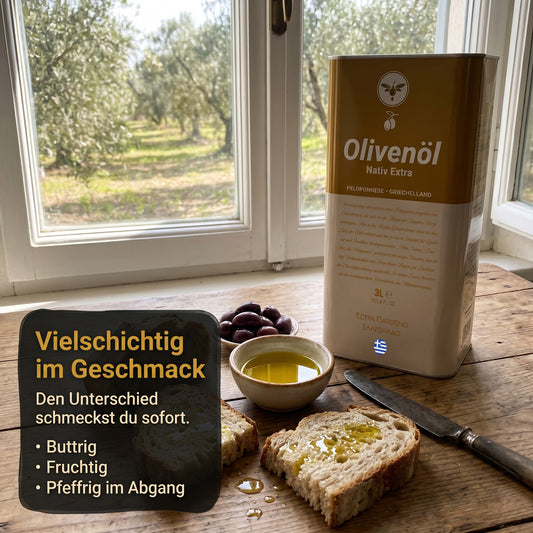
Few kitchen questions start more arguments than this one: can you actually cook with extra virgin olive oil, or should you save it for salads and fry in something else? You have probably heard that heating it is wasteful, or even that it becomes harmful in the pan. It is one of the most repeated myths in home cooking, and it is wrong. The truth is that a good extra virgin olive oil is one of the most reliable cooking fats you can own, provided you understand two things: what a smoke point really is, and why the quality of the oil decides how it behaves over heat. Start with a genuine extra virgin olive oil from the Peloponnese and most of the worry disappears before the pan is even hot.
Can you really cook with extra virgin olive oil?
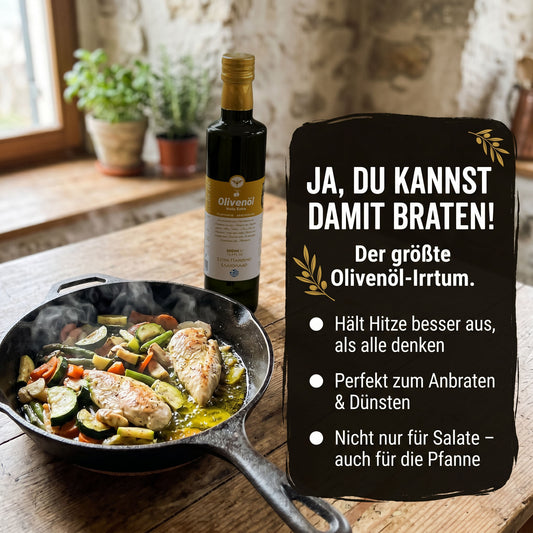
Yes. People across the Mediterranean have fried, roasted and braised in extra virgin olive oil for centuries, and they did not switch to neutral oils when the stove got hot. The myth that extra virgin "can't take heat" comes from confusing two different things: the smoke point, and oxidative stability. Cheap, highly refined oils can have a higher smoke point on paper, but they are stripped of the very compounds that make olive oil resistant to breaking down. A real extra virgin olive oil is naturally rich in antioxidants and monounsaturated fats, which is exactly what helps it stay stable in everyday cooking. Jegit's Peloponnese oil is heat-resistant up to 180°C without forming trans fats, which comfortably covers pan-frying, sautéing, roasting and baking.
What a smoke point actually is
The smoke point is simply the temperature at which an oil starts to visibly smoke and its flavour begins to degrade. For a good extra virgin olive oil it typically sits somewhere around 190 to 210°C, depending on freshness and acidity. Here is the part most people miss: almost all everyday home cooking happens well below that. A gentle sauté runs at roughly 120 to 150°C. Standard pan-frying and roasting sit around 160 to 180°C. You only approach an oil's limit when you are deep-frying hard or searing a dry pan until it is screaming hot. For the vast majority of what you cook, a quality extra virgin oil has a generous margin to spare. If you want the detail on why this oil holds up, our guide to high-polyphenol olive oil and why the peppery kick matters explains the chemistry in plain language.
The flip side is honesty: if you deliberately overheat any oil past its smoke point, it will degrade, and that is true of sunflower, rapeseed and everything else. The skill is not avoiding olive oil. It is not scorching it. Keep a bottle of lab-tested Peloponnese olive oil by the stove and use it with a little attention rather than a lot of fear.
There is a simple visual cue, too. Add your oil to the pan, let it shimmer, and start cooking as soon as it moves like water and sends up the faintest wisp of heat. If it is sending up blue smoke, it is already too hot: take the pan off the heat for a moment and let it settle. Cooking is about control, not courage, and a good oil gives you a wide, forgiving window to work in.
Why quality decides how an oil behaves in the pan
Two bottles both labelled "extra virgin" can perform completely differently over heat, and the reason is what is inside. An oil that is low in acidity, rich in polyphenols and free from mineral oil residues resists oxidation far better than a tired, poorly stored oil that was already half spoiled on the shelf. Jegit's olive oil is hand-harvested, cold mechanically extracted and lab-tested, with low acidity, a high polyphenol content and no mineral oil residues detected. Those are not marketing words; they are the exact properties that make an oil dependable in cooking. A fresher, more robust oil also carries more flavour into the dish, so you cook and season in one step. Taste the difference a lab-tested oil makes the next time you sear vegetables or finish a roast.
Which oil for which heat
- Finishing and dressings (no heat): This is where a peppery, naturally cloudy extra virgin shines brightest. Drizzle it raw over soup, bread, grilled fish or salad to keep every aromatic compound intact.
- Sautéing and sweating (120 to 150°C): Onions, garlic and vegetables. Extra virgin olive oil is ideal here and lends a savoury backbone the dish keeps.
- Pan-frying and roasting (160 to 180°C): Fish, chicken, roast vegetables, traybakes. A quality extra virgin that is heat-stable to 180°C is right at home.
- Hard searing and deep-frying (above 190°C): Possible with a fresh, robust oil, but you are near the limit, so watch for smoke and do not reuse the oil repeatedly.
Notice that four out of five everyday jobs fall comfortably inside the range of a good extra virgin. That is why a single, trustworthy bottle can do almost everything in a home kitchen. Order your Peloponnese extra virgin now and simplify your whole oil shelf.
How to choose an oil that cooks well
Look for three things. First, a clear quality grade: real extra virgin, not a vague "olive oil" blend, which you can read more about in our explainer on what extra virgin and the grades really mean. Second, evidence of freshness and purity, ideally lab testing for acidity and polyphenols. Third, proper storage in dark glass or stoneware, because light and heat spoil oil long before the pan ever does. An oil that has already gone rancid will smoke sooner and taste bitter, so it pays to know the signs, which we cover in our guide to whether olive oil goes bad and how to store it. Buy fresh, store it well, and a good extra virgin will reward you from the salad bowl to the hot pan.
Our product tip
Extra Virgin Olive Oil 500ml from the Peloponnese
Hand-harvested and lab-tested, low in acidity and rich in polyphenols, heat-stable up to 180°C: one dependable bottle for drizzling, sautéing, frying and roasting.
Shop Peloponnese Olive OilFrequently asked questions
Does extra virgin olive oil become harmful when heated?
No, not within normal cooking temperatures. Like any fat, any oil degrades if you push it far past its smoke point, but a fresh, quality extra virgin olive oil is stable through everyday sautéing, frying and roasting. Jegit's Peloponnese oil is heat-resistant up to 180°C without forming trans fats, which covers almost all home cooking.
What is the smoke point of extra virgin olive oil?
For a good extra virgin olive oil it typically sits around 190 to 210°C, depending on freshness and acidity. Most home cooking happens between 120 and 180°C, so you stay comfortably below the limit for sautéing, pan-frying and roasting.
Can I deep-fry in olive oil?
You can, with a fresh, robust extra virgin, but you are working near the top of its range. Keep the temperature controlled, do not let it smoke, and avoid reusing the same oil many times. For everyday frying and roasting below 180°C, a quality extra virgin is an excellent choice.
The idea that extra virgin olive oil is "too good to cook with" has it backwards. Its antioxidants, low acidity and natural stability are precisely what make it a dependable everyday fat, not a fragile one. Choose a fresh, lab-tested oil, keep it below its smoke point, and one bottle will carry you from a raw drizzle to a sizzling pan. Order your Peloponnese extra virgin olive oil today and cook Pour La Vie.

How Are Olives Harvested? Hand-Picking vs Machine, and Why It Changes What Ends Up in Your Bottle and Jar
How are olives harvested? Hand-picking vs machine, when the olive harvest happens, and why the method quietly decides the quality of your...

Cooking with Thyme Honey: In Your Tea, as a Sugar Swap and for Baking
How to cook with thyme honey: stirring it into tea, swapping it for sugar and baking with it. Ratios, timings and pairings...

How to Use Aleppo Soap: The Complete Guide to Face, Body, Hair, Shaving — Even Laundry
From face and body to hair, shaving and even laundry — the complete guide to using traditional Aleppo soap, and how to...