What Are Kalamata Olives? Kalamon vs Kalamata, Taste and How to Use Them

You've seen them glistening in a Greek salad, studded through a slow-braised stew, or piled high on a meze board: deep, purple-black, almond-shaped olives with a flavour that's at once fruity, winey and savoury. These are Kalamata olives — and they are, quite simply, the most prized table olive Greece produces. But what actually makes a Kalamata a Kalamata? Is "Kalamon" the same thing? And how do you choose a genuinely good one? Here's everything worth knowing, plus the single most important rule for buying them. If you'd rather skip straight to the real thing, taste Jegit's authentic Black Kalamata Olives here.
What are Kalamata olives?
Kalamata olives are a specific variety of large, dark olive named after the city and region of Kalamata in the southern Peloponnese of Greece. They're instantly recognisable: bigger than most black olives, with a distinctive elongated, almond-like shape, smooth skin and a deep aubergine-to-black colour. Unlike the bland, uniformly jet-black olives you often find in tins, a true Kalamata is naturally cured and keeps its rich reddish-purple-black tone.
The flavour is the real draw — meaty and firm, with a fruity, almost red-wine tang and a satisfying savoury finish. That complexity is why they're the olive of choice for a classic horiatiki salad and countless Mediterranean dishes. Want to experience it for yourself? Our naturally cured Black Kalamata Olives deliver exactly that character, straight from sun-drenched Greek soil.
Kalamon vs Kalamata: is there a difference?
This trips a lot of people up. "Kalamon" and "Kalamata" refer to the same olive variety — the difference is mostly a matter of naming and regulation. "Kalamata" is a protected designation of origin (PDO) tied to the Kalamata region, so strictly speaking only olives grown there can legally carry the name in the EU. The identical variety grown elsewhere in Greece is often sold as "Kalamon". In the glass, on your plate and on your palate, you're getting the same celebrated olive: same shape, same deep colour, same winey depth. So if you spot "Kalamon" on a label, there's no need to hesitate — it's the Kalamata olive you know and love. For a reliably authentic jar, start with ours here.
Kalamata vs ordinary black olives: why they're not the same
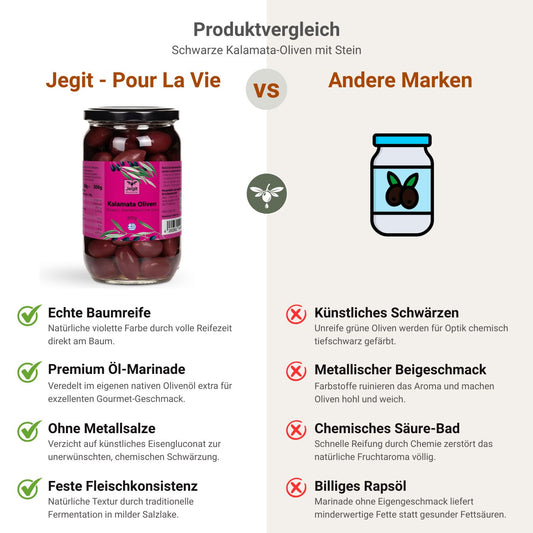
Here's where it pays to look closely. Many cheap "black olives" are actually unripe green olives that have been chemically darkened and dyed jet-black with an additive (ferrous gluconate), then packed in brine. They're uniform, soft and taste of very little.
A genuine Kalamata is the opposite story. It's left to ripen fully on the tree and then naturally cured — no artificial colourants, no shortcuts. That's why the colour varies naturally from deep purple to black, and why the flavour has real depth. Jegit's Black Kalamata Olives are traditionally hand-picked and free from artificial additives and colourants — authentic olives, exactly as the Mediterranean intended. If you care about what you're actually eating, choose naturally cured over dyed every time.
How to tell a quality Kalamata olive
A few simple signs separate the real deal from the mass-produced imitation:
- Colour variation. Natural purple-to-black tones, not a flat, identical black. Uniform jet-black usually means dyed.
- Shape. Proper Kalamatas are large and almond-shaped, not small and round.
- With the pit. Olives sold with the stone in tend to keep their texture and flavour far better than pre-pitted ones. Our Kalamata olives come with the pit for exactly this reason.
- Clean ingredients. The label should read of olives, water, salt and perhaps vinegar or olive oil — nothing you can't pronounce.
Tick those boxes and you've found an olive worth putting on the table. Jegit's tick every one — see for yourself here.
How to use Kalamata olives
This is where Kalamatas shine. Their robust, savoury-fruity flavour stands up to bold company and lifts the simplest dishes:
- The classic Greek salad. Tomatoes, cucumber, red onion, a slab of feta, a generous pour of extra virgin olive oil and a handful of Kalamatas. Nothing more needed.
- Meze and antipasti boards. Serve them alongside Greek green olives, cheeses and warm bread for an effortless spread.
- Braises and traybakes. Stirred into a chicken, lamb or tomato braise in the last few minutes, they add a deep, briny savouriness.
- Tapenade. Blitz with olive oil, garlic and a little lemon for a quick, punchy spread.
- Straight from the jar. Honestly, a good Kalamata needs no accompaniment at all.
However you use them, the quality of the olive is what you'll taste. Stock your fridge with authentic Kalamatas here and every Mediterranean dish you make gets better.
Where Kalamata olives come from
The story of a Kalamata olive is a story of place. These olives are deeply tied to the sun-drenched soil of the southern Peloponnese and a centuries-old agricultural tradition. The fruit is left on the tree to ripen fully, then harvested with careful timing — in the case of our olives, collected after roughly 100 to 120 days of growth to reach the ideal moisture balance, before a meticulous sorting process ensures only the best make the jar. That patience is what you taste: a natural, honest depth that no chemical shortcut can fake. Jegit's Black Kalamata Olives honour that tradition in every jar — which is exactly why they taste the way a Kalamata should. Try them and taste the difference.
How to store Kalamata olives
Kalamatas keep beautifully when treated right. Store them in their brine, in a sealed jar in the fridge, and always keep the olives submerged — the liquid is what protects their flavour and texture. Use a clean spoon rather than fingers to lift them out, top up with a little olive oil or a light brine if the level drops, and they'll stay in great shape for weeks after opening. A small splash of our Peloponnese extra virgin olive oil over the top also makes a lovely marinade. Keeping a jar of authentic Kalamata olives on hand means a Mediterranean meal is never more than a spoonful away.
Frequently asked questions
Are Kalamata olives healthy?
Like all olives, Kalamatas are a source of heart-healthy monounsaturated fats and natural antioxidants, which is a big part of why they're a cornerstone of the Mediterranean diet. Because they're naturally cured, our Black Kalamata Olives contain no artificial additives or colourants — just olives, as nature made them. They are naturally salty from the brine, so enjoy them as part of a balanced diet.
Why are my Kalamata olives packed with the pit?
Olives cured and stored with the stone keep their firm texture and full flavour much better than pre-pitted versions, which can turn soft and lose character in the brine. Removing the pit at home is easy — press gently with the flat of a knife and it slips out. It's a small step for a noticeably better olive.
Are Kalamata and Kalamon olives the same?
Yes. They're the same variety; "Kalamata" is the protected regional name and "Kalamon" is commonly used for the identical olive grown elsewhere in Greece. The taste, shape and deep colour are the same, so you can buy either with confidence.
Our product tip
Black Kalamata Olives with Pit from Jegit
Authentic, naturally cured Greek Kalamata olives — hand-picked, free from artificial additives and colourants, with that unmistakable fruity-winey depth.
Shop Kalamata Olives nowThe olive worth knowing by name
Once you've tasted a genuine, naturally cured Kalamata, the dyed supermarket version never quite satisfies again. Deep, fruity, meaty and honest — this is the olive that defines Greek cooking, and it deserves a permanent place in your fridge. Bring home Jegit's authentic Black Kalamata Olives and taste the real Mediterranean. Pour La Vie.

Naturally Cloudy, Unfiltered Olive Oil: What It Means — and Is It Actually Better?
Is cloudy olive oil bad? No — naturally cloudy, unfiltered extra virgin keeps more flavour, aroma and polyphenols. Here's what naturtrüb really...

What Does Greek Thyme Honey Taste Like — and How to Use It
What does Greek thyme honey taste like, how to spot a real unheated jar, and the Mediterranean pairings and uses that make...

Can You Fry With Olive Oil? The Truth About Heat, Smoke Point and Extra Virgin
Can you fry with extra virgin olive oil? The truth about smoke point, heat stability and why a quality Peloponnese oil belongs...