Does Honey Go Bad? Shelf Life, Crystallisation and How to Store Thyme Honey

You reach for the jar at the back of the cupboard, and the golden thyme honey you bought a few months ago has turned pale, thick and grainy. Has it spoiled? Almost certainly not – and understanding why is the key to getting the most out of a really good honey. Pure, raw honey is one of the few foods that essentially never expires, and crystallisation is a sign of quality rather than a fault. Below is everything you need to know about shelf life, why honey sets solid, and how to store it so it stays at its aromatic best. And if your current jar has lost its perfume, that is the real reason to replace it – start with a raw Greek thyme honey that actually tastes of the hillside.
Does honey actually expire?
Pure honey is remarkably stable. Its very low moisture content and natural acidity make it an inhospitable place for the microbes that spoil other foods, which is why sealed honey can keep for years. You will usually see a "best before" date on the jar – that is a legal requirement, not a hard expiry. Well past that date, good honey is still perfectly good to eat; it may simply have crystallised or mellowed in aroma.
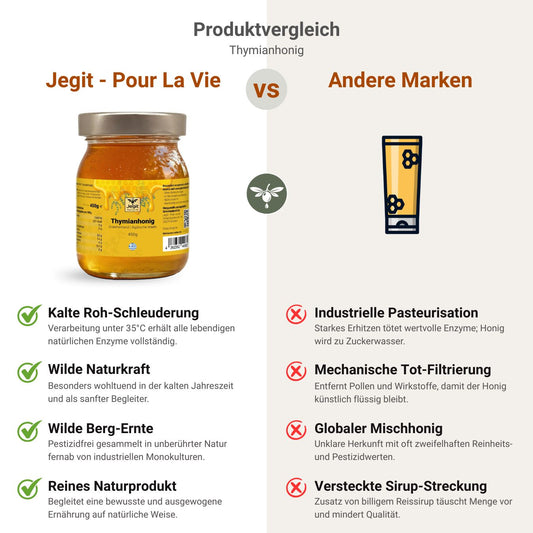
The catch is that not all honey is equal. Heavily processed, pasteurised supermarket honey is heated and ultra-filtered, which strips out the natural enzymes, pollen and aroma that make honey worth eating in the first place. Our thyme honey is raw and unprocessed – cold-spun, never heated, and left unfiltered – so what is in the jar is exactly what the bees made. That is honey built to last, and worth storing well.
Why your thyme honey crystallises (and why it is a good sign)
Crystallisation is simply the natural glucose in honey turning from liquid to tiny crystals over time. Every raw honey does it eventually – the speed depends on the ratio of sugars, the temperature and how the honey was handled. Far from being a flaw, crystallisation is one of the clearest signs that a honey is genuine, raw and unheated. Honey that stays perfectly clear and runny for years has usually been heavily processed to stop it setting.
Our Greek thyme honey crystallises for all the right reasons: it is cold-spun by hand, never pasteurised, and bottled unfiltered, so it keeps the natural enzymes and the intense, peppery-floral aroma of wild Mediterranean thyme. When it sets, it does not mean the honey is past it – it means you bought the real thing. If your jar has gone solid and flavourless rather than solid and fragrant, though, it was probably never that pure to begin with. Taste the difference a genuinely raw thyme honey makes here.
How to gently bring crystallised honey back to liquid
If you prefer your honey runny, bringing it back is easy – the golden rule is gentle, low heat, because high heat destroys the very enzymes and aroma you are paying for.
- Warm-water bath. Stand the open jar in a bowl of warm water (around 40°C – comfortable to the touch, never hot). Stir occasionally and top up the water as it cools. Within 15–30 minutes the crystals melt back to liquid.
- Be patient with large jars. A bigger jar simply needs a few changes of warm water. Resist the urge to rush it on the hob.
- Avoid the microwave. Microwaving overheats honey unevenly, scorches the sugars and strips the aroma. For a raw honey, it is the one thing not to do.
Honestly, many people grow to love crystallised thyme honey exactly as it is – spreadable, creamy and easy to swirl onto bread or yoghurt. There is no need to re-liquify it at all unless you want to.
How to store thyme honey properly
Store honey well and it will reward you for a very long time:
- Keep the lid tight. Honey is hygroscopic – it draws moisture from the air, which is the one thing that can eventually ferment it. A tightly sealed jar is your best protection.
- Cool, dark cupboard. Store at room temperature away from direct sunlight and the hob. Steady, moderate warmth is ideal.
- Never the fridge. Cold speeds up crystallisation. The cupboard, not the fridge, is honey's home.
- Use a clean, dry spoon. Every crumb or drop of water you introduce shortens the honey's life. A dry spoon – or better, an olive wood honey dipper – keeps the jar pristine.
Do all of that with an ordinary honey and you will preserve an ordinary flavour. Do it with a raw, aromatic one and you will have something special on hand for months. Stock your cupboard with our raw Greek thyme honey and give it the storage it deserves.
How to tell if honey has genuinely gone off
True spoilage is rare, but here is when to be cautious. If honey has taken on moisture – from a damp spoon or a loose lid – it can begin to ferment, giving off a sour, yeasty or alcoholic smell and a fizzy, bubbly look. That honey is best discarded. Visible mould (only possible if water got in) is another clear sign. But a honey that is merely crystallised, thicker, or a shade paler than when you bought it is completely fine – eat and enjoy it.
The simplest way to always have honey worth eating is to start with honey worth keeping. Before you shop, know this: pale, grainy and fragrant is good; sour and fizzy is not. Begin with a jar of our raw, cold-spun thyme honey and you will rarely reach that back-of-the-cupboard moment of doubt again.
Frequently asked questions
Is crystallised honey still safe to eat?
Yes, completely. Crystallisation is a natural change in the sugars and a sign of raw, unprocessed honey. It changes the texture, not the safety or quality. Our raw thyme honey crystallises precisely because it has never been pasteurised.
How long does thyme honey last once opened?
Kept in a cool, dark cupboard with the lid tightly closed and a dry spoon used each time, an opened jar of pure thyme honey will keep for a very long time – well beyond the best-before date. It may crystallise along the way, which is perfectly normal.
Why is my supermarket honey still runny after a year?
Honey that never sets has usually been pasteurised and ultra-filtered to keep it clear on the shelf – a process that also strips much of the aroma and natural enzymes. A honey that crystallises, like our cold-spun Greek thyme honey, is showing you it is the genuine, raw article.
Our Product Tip
Greek Thyme Honey 450g
Raw, cold-spun and unfiltered – rich in natural enzymes with the intense, peppery-floral aroma of wild Mediterranean thyme. The honey that crystallises because it is the real thing.
Shop Thyme HoneyGood honey is a small daily luxury that, stored well, lasts and lasts. Choose one made the honest way – raw, cold-spun and full of aroma – and taste Pour La Vie in every spoonful. Bring home our Greek thyme honey today.

Thyme Honey vs Manuka Honey: Which Is Really Worth It?
Thyme honey vs manuka honey compared: taste, MGO, purity and price. Why pure Greek thyme honey is the everyday Mediterranean honey worth...

Aleppo Soap vs Curd Soap (Kernseife): Which Natural Bar Is Better for Skin, Hair and Home?
Aleppo soap or curd soap (Kernseife)? Compare how each natural bar cleans skin, hair and laundry — and why an olive-and-laurel Aleppo...

Is Aleppo Soap Vegan? The Honest Answer — and Why This Olive-and-Laurel Bar Belongs in a Vegan Routine
Is Aleppo soap vegan? Yes — ours is made from just olive oil and laurel oil, with no animal ingredients or additives....