Peloponnese Olive Oil: What Makes This Greek Extra Virgin So Special

Ask anyone who cooks seriously with olive oil where they would look for a truly good bottle, and sooner or later the conversation turns to Greece – and, more often than not, to one particular corner of it. The Peloponnese, the great hand-shaped peninsula that forms the southern tip of the Greek mainland, has been pressing olives for thousands of years. Its oils have quietly earned a reputation for being some of the most fragrant, well-balanced and genuinely characterful in the Mediterranean. But what actually sets Peloponnese olive oil apart? And how do you make the most of a bottle once it is in your kitchen? Here is everything worth knowing.
Where the Peloponnese sits – and why it matters
Olive trees are shaped by their surroundings as surely as vines are, and the Peloponnese offers close to ideal conditions. Long, hot, dry summers and mild winters let the fruit ripen slowly and evenly. Poor, stony, well-drained hillside soils stress the trees just enough to concentrate flavour rather than encourage watery growth. Sea breezes and high sunshine keep the groves healthy. The result is fruit with a naturally low acidity and a deep reserve of the aromatic and antioxidant compounds – the polyphenols – that give great olive oil its backbone and its lingering, peppery finish.
This is not a new discovery. The region has been synonymous with olive cultivation since antiquity, and many groves are still worked by families who have tended the same terraces for generations. When you taste a good Peloponnese oil, you are tasting a landscape and a long inheritance of know-how at once – the story behind the bottle, not just the liquid inside it.
The role of the olive variety
Much of the Peloponnese’s reputation rests on its olive varieties, above all the Koroneiki – a small, hardy olive prized across Greece for oil-making. Koroneiki fruit is modest in size but exceptionally rich in oil and polyphenols, which is why oils from these groves so often show that signature combination of fruitiness up front and a gentle, throat-catching pepperiness at the back. It is the same variety that dominates the Peloponnese’s most celebrated growing areas, and it is a large part of why the region’s oil tastes the way it does.
What “extra virgin” really means
“Extra virgin” is the highest grade of olive oil, and it is a precise term rather than a marketing flourish. To qualify, the oil must be produced purely mechanically – pressed or centrifuged without heat or chemical solvents – and must meet strict limits on free acidity, along with passing a taste-and-aroma panel free of defects. In practice this means the fruit has to be handled with care and pressed quickly, before it can oxidise or ferment.
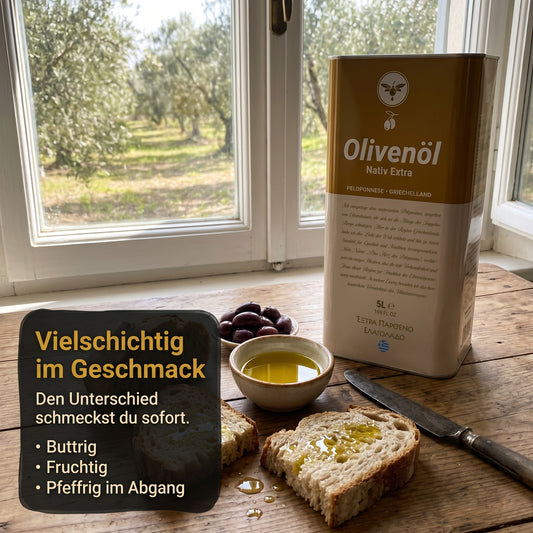
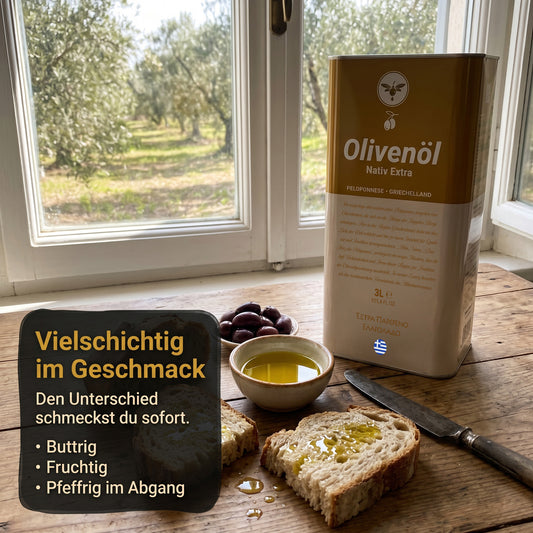
Our own extra virgin olive oil from the Peloponnese is hand-harvested and mechanically extracted in exactly this traditional way, then laboratory-tested for low acidity, a high polyphenol content and freedom from mineral-oil residues. It is left naturally cloudy and unfiltered, which keeps more of the fruit’s aroma and gives it that full, spicy, buttery and peppery flavour. Filtering can strip away some of the tiny fruit particles that carry flavour; leaving the oil unfiltered is a choice in favour of taste and authenticity.
How to read quality for yourself
You do not need to be an expert to judge a good oil. A few honest signals go a long way. Look for a stated harvest or origin and, ideally, evidence of testing. Trust your senses: fresh extra virgin oil should smell green and lively – of cut grass, tomato leaf or artichoke – never greasy, flat or musty. On the palate it should taste fruity, with a clean bitterness and a peppery catch at the back of the throat. That peppery kick is not a fault; it is the taste of the polyphenols, and a sign the oil is fresh and alive.
Cooking and serving with Peloponnese olive oil
One of the most persistent myths about extra virgin olive oil is that it is too precious, or too delicate, to cook with. In reality a good, polyphenol-rich oil is remarkably stable and stands up well to everyday cooking temperatures. Ours holds its own comfortably at the heat of normal pan-frying, sautéing and roasting. That makes it genuinely versatile: the same bottle can dress a salad and roast a tray of vegetables.
Where a fine Peloponnese oil really sings, though, is raw or barely warmed, so its aroma survives intact. Drizzle it over warm bread, a bowl of thick yoghurt, or a plate of ripe tomatoes. Finish a soup, a plate of grilled fish or a dish of braised greens with a generous last-minute pour. Whisk it into a simple lemon dressing. Spoon it over a wedge of feta with a little oregano. In each case the oil is not hiding in the background – it is one of the flavours you actually taste.
Keeping your oil at its best
Extra virgin olive oil is a fresh product, and its two great enemies are light and heat. Keep the bottle tightly closed, in a cool, dark cupboard, away from the hob and out of direct sun. Use it within a few months of opening, while its aromas are at their peak, and avoid decanting it into clear glass that sits on a sunny counter. Treated well, a good oil rewards you every single time you reach for it.
Our product tip
Extra Virgin Olive Oil from the Peloponnese (500 ml)
Hand-harvested, unfiltered and laboratory-tested – a fragrant, spicy-buttery oil straight from the Greek south.
Shop Peloponnese Olive OilFrequently asked questions
What makes Peloponnese olive oil different from other Greek olive oils?
It comes down to place and variety. The Peloponnese combines a hot, dry climate, stony hillside soils and a long olive-growing heritage with the prized Koroneiki olive, which is naturally rich in oil and polyphenols. Together these give the region’s oils their characteristic balance of fruitiness and a lively, peppery finish, along with a naturally low acidity.
Can I fry and roast with extra virgin olive oil, or only use it raw?
You can absolutely cook with it. A good, polyphenol-rich extra virgin oil is stable enough for everyday frying, sautéing and roasting. Its finest aromas do come through most clearly when it is used raw or only gently warmed, so many cooks keep one bottle for cooking and save a little for finishing dishes at the table.
Why is your Peloponnese olive oil cloudy?
Because it is unfiltered. Leaving the oil naturally cloudy keeps more of the tiny fruit particles that carry aroma and flavour, rather than stripping them out for the sake of a clear appearance. A little cloudiness, or a fine sediment at the bottom of the bottle, is a sign of an authentic, minimally processed oil.
Pour La Vie
A truly good olive oil is one of the simplest luxuries in any kitchen – a single ingredient that makes almost everything it touches taste better. The Peloponnese has spent millennia learning how to make it, and a well-made bottle carries all of that sunlight, stone and tradition to your table. Discover our hand-harvested extra virgin olive oil from the Peloponnese, and taste the difference a real origin makes – Pour La Vie.

Can You Wash Your Hair with Aleppo Soap? A Natural Hair-Washing Guide (and How to Avoid the Waxy Feeling)
Yes, you can wash your hair with Aleppo soap. Here's how to do it right, why hair can feel waxy, and the...

Can You Eat Olives Straight From the Tree? Why Raw Olives Are So Bitter — and How They Become the Olives You Love
Can you eat olives straight off the tree? Here is why raw olives are so bitter, whether they are safe, and how...

Thyme Honey vs Manuka Honey: Which Is Really Worth It?
Thyme honey vs manuka honey compared: taste, MGO, purity and price. Why pure Greek thyme honey is the everyday Mediterranean honey worth...