How Aleppo Soap Is Made: Inside the Traditional Craft (and Why You Can't Rush the Curing)

Few beauty products carry as much history as Aleppo soap. Made from just three natural ingredients and cured for years before it ever reaches your hands, it is often called the oldest hard soap in the world. If you have ever wondered how Aleppo soap is made — or whether you could make it yourself at home — this guide walks you through the traditional method step by step, and explains why the slow, patient craft is exactly what makes a real bar so gentle.
What Aleppo soap is made of
Authentic Aleppo soap has a remarkably short ingredient list: olive oil, laurel (bay) berry oil, water and lye. That is it — no synthetic detergents, no fragrance, no colourants, no palm oil. The olive oil forms the mild, moisturising base, while the laurel oil gives the soap its faint green colour, its earthy scent and its reputation for soothing sensitive and reactive skin. The percentage of laurel oil is what distinguishes one bar from another: more laurel means a richer, more cleansing soap, which is why our own Aleppo soap with 40% laurel oil and 60% olive oil sits at the higher, more prized end of the scale.
How Aleppo soap is made, step by step
The traditional process has barely changed in a thousand years. It unfolds over the cooler months and then a long, quiet stretch of curing.
1. Cooking the olive oil and lye
In a huge in-ground vat, olive oil is combined with water and lye (an alkaline solution) and heated. Over about three days, the mixture is stirred continuously as saponification takes place — the chemical reaction in which the oil and lye transform into soap and natural glycerine. Masters judge readiness by eye, touch and taste, not by a timer.
2. Adding the laurel oil
Only at the very end is the precious laurel berry oil stirred in. Because it is added last, it keeps its beneficial properties rather than cooking away. This is the moment that defines the character of the batch and its laurel percentage.
3. Pouring and levelling
The hot liquid soap is poured out across a large sheet of waxed paper on the floor and spread into an even layer, usually a few centimetres thick. It is left to firm up for a day.
4. Cutting by hand
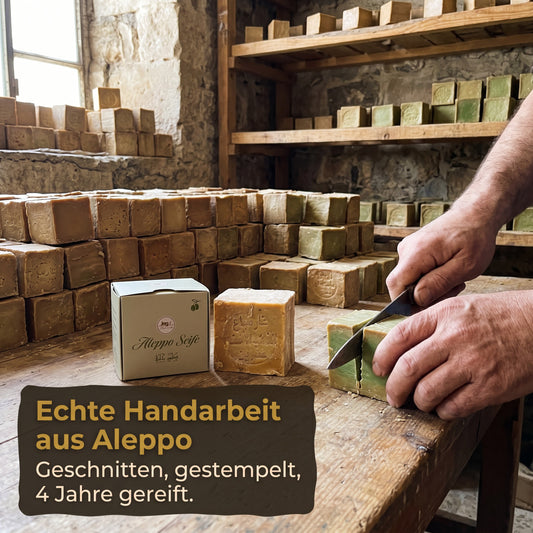
Once set but still soft, the sheet is scored and cut into the signature cubes with a rake-like tool and a hand blade. Every bar is cut by hand, which is why no two are exactly alike, and each is stamped with the maker's seal.
5. Curing for years
The freshly cut cubes are stacked in open, staggered towers so air can circulate on every side, then left in cool storerooms to cure. During this time the surface oxidises to a golden-brown while the inside stays olive green, the pH mellows, and the bar becomes harder, milder and longer-lasting. Good Aleppo soap is cured for at least a year; the finest is aged far longer. Ours is matured for four years before we offer it.
Can you make Aleppo soap at home?
You can make an Aleppo-style soap at home, and many soap makers do. The method is cold-process soap making: carefully weigh olive oil and laurel oil, prepare a lye solution, blend the two to "trace", pour into a mould, cut after a day, and — crucially — cure for several weeks to months before use. If you want to experiment, a common starting ratio is roughly 80% olive oil to 20% laurel oil, with the standard water and lye for saponification.
Two honest cautions, though. First, making soap means handling lye (sodium hydroxide), which is caustic and demands goggles, gloves and real care; this is not a casual kitchen project, and you should always run any recipe through a reliable lye calculator. Second, a home bar will never quite match a traditionally cured one. The depth, hardness and mildness of authentic Aleppo soap come from years of ageing that a few weeks simply cannot reproduce. Home-made is a rewarding hobby; the traditional bar is a different thing entirely.
Our product tip
Aleppo Soap — 40% Laurel Oil & 60% Olive Oil
Traditionally hand-cut and matured for four years for a genuinely gentle bar — for face, body, hair and even laundry.
Shop the Aleppo soapWhy the slow method matters
It is tempting to think of soap as a quick commodity, but the traditional Aleppo process is a lesson in patience. Cooking over days rather than minutes protects the natural glycerine that mass-produced soaps often strip out and sell separately — glycerine that draws moisture to the skin. Cutting by hand keeps the craft human and the bars irregular in the best way. And curing for years is what turns a soft, high-pH block into a hard, skin-friendly bar that lasts for weeks in your shower. Every step trades speed for quality, which is precisely the point.
Frequently asked questions
How long does traditional Aleppo soap take to make?
The cooking and cutting take only about a week, but the curing is the long part. A minimum of one year is standard, and premium bars are aged for several years. In total, a genuinely mature bar has spent far longer resting in a storeroom than it ever did being cooked.
Why is Aleppo soap green inside and brown outside?
The green comes from the olive and laurel oils. As the cut bars cure in the air, only the outer surface oxidises and turns golden-brown, while the protected interior keeps its olive-green colour. Slicing a bar open is the classic way to see whether it is authentic and well cured.
Is one laurel oil percentage better than another?
It depends on your skin and your purpose. Lower-laurel bars are milder and gentler on very sensitive skin; higher-laurel bars, such as a 40% blend, are richer, more cleansing and especially prized for the face, hair and problem skin. There is no single "best" — only the right one for you.
Pour La Vie
Understanding how Aleppo soap is made is really about appreciating patience: three pure ingredients, an age-old method, and years of quiet curing that no shortcut can imitate. Whether you try your hand at a home batch or reach for a traditionally aged bar, that is the spirit worth keeping — natural, unhurried and made to last. Pour La Vie.

Can You Wash Your Hair with Aleppo Soap? A Natural Hair-Washing Guide (and How to Avoid the Waxy Feeling)
Yes, you can wash your hair with Aleppo soap. Here's how to do it right, why hair can feel waxy, and the...

Can You Eat Olives Straight From the Tree? Why Raw Olives Are So Bitter — and How They Become the Olives You Love
Can you eat olives straight off the tree? Here is why raw olives are so bitter, whether they are safe, and how...

Thyme Honey vs Manuka Honey: Which Is Really Worth It?
Thyme honey vs manuka honey compared: taste, MGO, purity and price. Why pure Greek thyme honey is the everyday Mediterranean honey worth...