Authentic Greek Salad Dressing: The Olive Oil and Red Wine Vinegar Recipe
There is a reason a simple Greek salad tastes so much better in a seaside taverna than it does at home, and nine times out of ten it is the dressing. An authentic Greek salad dressing is almost shockingly simple: good olive oil, red wine vinegar, dried oregano and a little salt. No mustard, no sugar, no bottled emulsifiers. Which means there is nowhere to hide. The difference between a flat, oily dressing and one that makes you want to mop the bowl with bread comes down almost entirely to the olive oil you reach for. Start with our extra virgin olive oil from the Peloponnese and you are already most of the way to taverna quality.
Why the olive oil is the whole secret
In a dressing with only four ingredients, the olive oil is not a background player, it is the dish. A supermarket oil that has been heavily filtered, blended from several countries and left under shop lighting for a year will taste exactly like what it is: flat and faintly greasy. A living, peppery extra virgin oil does the opposite. It carries the oregano, rounds out the sharp vinegar and leaves that gentle, throat-catching pepperiness at the back that tells you the polyphenols are still intact.
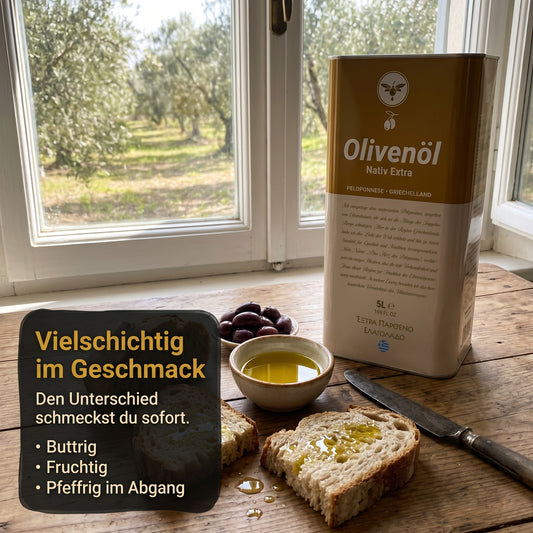
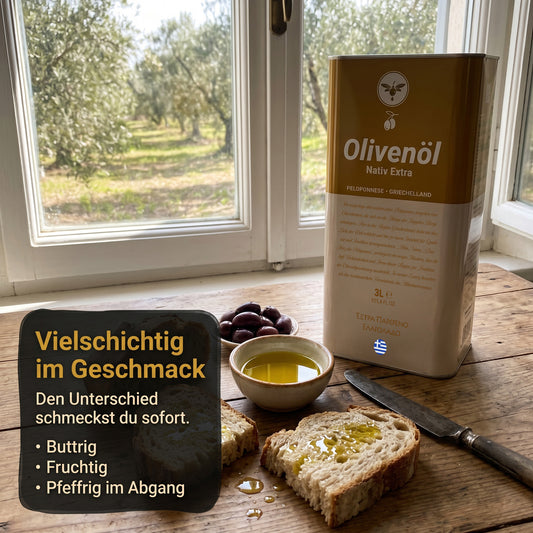
Our Extra Virgin Olive Oil from the Peloponnese is built for exactly this job. It is traditionally hand-harvested and extracted by cold mechanical pressing, then independently lab-tested: low in acidity, rich in polyphenols and verifiably free of mineral-oil residues. The flavour is spicy, buttery and peppery, which happen to be the three notes a raw dressing needs most, because nothing is cooked to soften them. With an ordinary bottle your dressing tastes thin; with this one it tastes finished. Secure a bottle for your kitchen today and you will taste the gap in the very first spoonful.
Ingredients
Makes enough to dress one large Greek salad (serves four):
- 6 tablespoons extra virgin olive oil from the Peloponnese (the hero, do not economise here)
- 2 tablespoons red wine vinegar
- 1 teaspoon dried Greek oregano (rigani), plus extra to finish
- ½ teaspoon fine sea salt
- ¼ teaspoon freshly ground black pepper
- Optional: ¼ teaspoon honey, to take the edge off a very sharp vinegar
- Optional, to serve: a handful of black Kalamata olives for the finished salad
That is the whole list. Because there are so few ingredients, each one has to earn its place, which is exactly why we keep coming back to the same point: the oil is the one to invest in. Get the Peloponnese olive oil here.
How to make it, step by step
- Measure the red wine vinegar, salt and pepper into a small bowl or a clean jar. Stir (or shake) until the salt has dissolved into the vinegar. Dissolving the salt first means it seasons evenly instead of settling at the bottom.
- Add the dried oregano and let it sit for a minute in the vinegar. This tiny pause wakes the herb up and draws out its aroma before the oil goes in.
- Pour in the extra virgin olive oil in a slow stream, whisking (or screwing the lid on and shaking hard) until the dressing turns glossy and slightly cloudy. It will not emulsify like a mustard vinaigrette, and it is not meant to; a good Greek dressing stays loose and rustic.
- Taste on a piece of bread or a cucumber slice. Adjust: more salt for depth, a drop more vinegar for lift, a little honey only if the vinegar is aggressive.
- Pour over your salad at the very last moment, scatter with a little extra oregano, and finish with a final thread of raw olive oil straight from the bottle.
The classic 3:1 ratio and how to adjust it
The backbone of a Greek dressing is three parts olive oil to one part red wine vinegar. That ratio is what makes it taste rounded rather than sour, and it is why the quality of the oil matters so much: at three-to-one, the oil is literally the majority of what you are tasting. If you prefer things sharper, move towards 2.5 to 1; for a mellow, oil-forward dressing over ripe summer tomatoes, push towards 3.5 to 1. Whatever you choose, keep the oil in the lead. A thin, neutral oil at this ratio simply tastes greasy, whereas a peppery, polyphenol-rich Peloponnese oil turns the same three spoonfuls into the best part of the plate.
How to use your Greek dressing
The obvious home is a classic horiatiki: ripe tomatoes, cucumber, green pepper, red onion, a slab of feta and plenty of Kalamata olives, dressed and tossed just before serving. But this dressing is far more versatile than one salad. Spoon it over warm roasted vegetables, drizzle it on grilled halloumi or fish, use it as a marinade for chicken, or simply pour a little into a shallow dish with the oregano and use it for dipping warm bread. Each of these uses puts the raw oil front and centre, so each one is another reason to keep a genuinely good bottle within arm's reach.
Common mistakes that ruin a Greek dressing
Even with four ingredients, there are a few easy ways to go wrong. The first is reaching for a cheap, neutral oil to "save" the good stuff for later; in a raw dressing that is precisely backwards, because the oil is most of the flavour. The second is over-whisking in search of a thick, creamy emulsion: a Greek dressing is meant to stay loose and split slightly, and forcing it tight only mutes the oil. The third is dressing the salad too early, which draws water out of the tomatoes and dilutes everything into a watery pool at the bottom of the bowl. Dress at the table, not in the kitchen. The fourth is skimping on salt, which is what carries the flavour of both the vinegar and the oil. Fix those four habits, pour with a confident hand, and a simple bowl of vegetables turns into something people remember. The one that matters most, though, is still the bottle you pour from. Reach for our Peloponnese olive oil and most of the work is already done.
Before you scroll to the questions below, remember the single upgrade that matters most: swap in a genuine, polyphenol-rich Peloponnese olive oil and this four-ingredient dressing goes from fine to unforgettable.
Frequently asked questions
What kind of vinegar goes in an authentic Greek salad dressing?
Red wine vinegar is the classic choice and the one used in most Greek homes and tavernas. It is bright but not harsh, and it sits well under the oregano. Some cooks add a squeeze of fresh lemon alongside it for extra lift, but you do not need balsamic, which is sweeter and darker than a traditional Greek dressing calls for.
Why does my homemade dressing taste flat?
Almost always, it is the olive oil. A dressing is not cooked, so a tired, over-refined oil has nowhere to hide and the whole thing tastes dull and oily. Switching to a fresh, peppery extra virgin oil, such as our hand-harvested Peloponnese oil, is usually the single change that fixes a flat dressing instantly.
How long does Greek salad dressing keep?
Because it is just oil, vinegar, herbs and salt, it keeps well. Store it in a sealed jar in a cool, dark cupboard for up to a week, or in the fridge for up to two. The olive oil may thicken or turn cloudy in the fridge, which is completely normal; simply let it come back to room temperature and shake before using.
Our product tip
Extra Virgin Olive Oil from the Peloponnese
Hand-harvested, naturally cloudy and lab-tested, low in acidity and rich in polyphenols: the peppery, buttery heart of an authentic Greek dressing.
Taste the difference nowMake this dressing once with a flat supermarket oil and once with a real extra virgin oil, and you will never go back. The recipe is the easy part; the soul of it is in the bottle. Bring home our Peloponnese olive oil, pour it with a generous hand, and taste Greece the way it was meant to be: pure, peppery and Pour La Vie.