Peloponnese Olive Oil: A Buyer's Guide to Greek Extra Virgin
If you have started reading olive oil labels, you have probably noticed how often one Greek region comes up: the Peloponnese. This sun-drenched peninsula in southern Greece produces some of the most sought-after extra virgin olive oil in the world — but what actually makes Peloponnese olive oil special, and how do you choose a good one? This buyer's guide walks you through the region, the olives, the label and the practical tests that separate a truly excellent oil from an ordinary one.
Where Is the Peloponnese — and Why Does It Matter for Olive Oil?
The Peloponnese is the large peninsula that forms the southern tip of mainland Greece, joined to the rest of the country by the narrow Isthmus of Corinth. Its combination of long, hot summers, mild winters, poor rocky soils and cooling sea breezes creates near-perfect conditions for olive trees. Stress the tree a little — lean soil, plenty of sun — and it rewards you with intensely flavoured fruit.
Olive growing here is not a modern industry bolted onto the landscape; it is a way of life stretching back thousands of years. Many groves are still farmed by families who have tended the same terraces for generations, which is part of why the region's oils carry such a strong sense of place.
What Makes Peloponnese Olive Oil Special
The olive variety
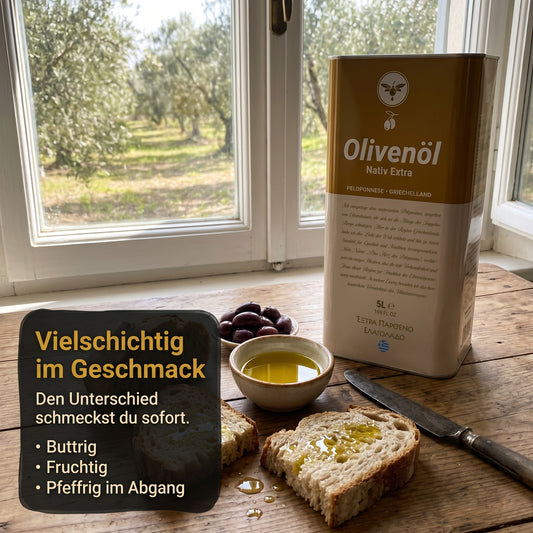
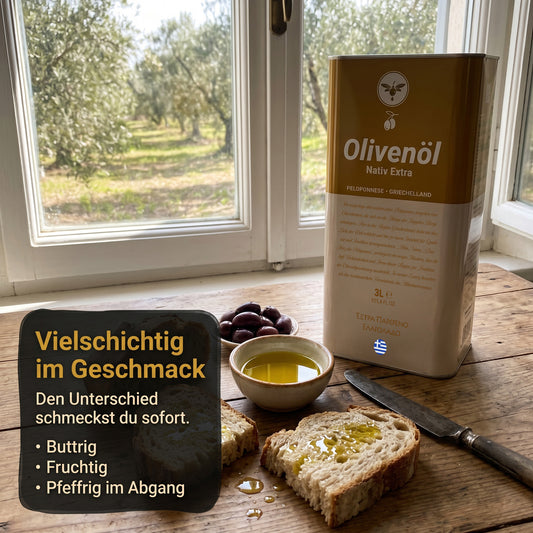
Much of the region's finest oil comes from the Koroneiki olive, a small, hardy variety prized for its high yield of aromatic, polyphenol-rich oil. Koroneiki oils are typically green and lively, with notes of fresh grass and green fruit, a peppery kick at the back of the throat and a clean, buttery body. That peppery tingle is a good sign: it points to the natural antioxidant compounds a fresh oil should contain.
Hand-harvesting and cold extraction
Quality is decided as much in the harvest as in the grove. The best Peloponnese oils are hand-harvested and pressed quickly, so the fruit does not sit and ferment. Cold mechanical extraction — pressing the olives without heat or chemicals — preserves the delicate aromas and the beneficial compounds that heat would destroy. It is slower and more expensive than industrial methods, which is exactly why it produces a better oil.
How to Read the Label
A few terms tell you most of what you need to know before you buy.
Extra virgin
“Extra virgin” is the top grade. It means the oil was produced purely by mechanical means, meets strict quality standards and has no sensory defects. Anything labelled simply “olive oil” or “pure olive oil” has usually been refined and is a step down in both flavour and character.
Acidity
Free acidity is a key measure of quality, and lower is better. Extra virgin oil must have a free acidity of no more than 0.8%, but the best oils sit well below that. A low figure indicates healthy fruit that was pressed promptly and handled with care.
Polyphenols
Polyphenols are the natural antioxidant compounds responsible for that characteristic peppery, slightly bitter finish. A higher polyphenol content generally signals a fresher, more robust oil. If a producer publishes lab results for acidity and polyphenols, take it as a good sign of transparency.
Harvest date and origin
Look for a harvest date, not just a best-before date, and buy the most recent harvest you can. Olive oil is a fruit juice, not a wine — it does not improve with age. A clear single origin (a named region such as the Peloponnese) is more reassuring than a vague blend of oils from several countries.
Filtered vs Naturally Cloudy Oil
Some premium oils are left unfiltered, which gives them a naturally cloudy appearance and a fuller, fruitier taste. The tiny suspended particles carry extra flavour, though they also mean an unfiltered oil is best enjoyed relatively fresh. A little cloudiness is not a fault — in a young oil it is often a mark of minimal processing.
How to Choose a Good Peloponnese Olive Oil
When you are standing in front of the shelf — or a webshop — run through this quick checklist:
- It says extra virgin and names a clear origin such as the Peloponnese.
- It shows a recent harvest date and, ideally, published lab values for acidity and polyphenols.
- It is sold in dark glass or tin that protects the oil from light.
- It smells and tastes fresh and green, with a peppery finish rather than a greasy or musty note.
Our own extra virgin olive oil from the Peloponnese is made exactly this way: hand-harvested, cold-extracted, unfiltered and lab-tested for low acidity and a high polyphenol content — with the spicy, buttery, peppery flavour the region is known for.
How to Store and Use It
Treat good olive oil like any fresh ingredient. Keep it in a cool, dark cupboard away from the hob, seal it tightly after use, and try to finish an opened bottle within a couple of months while it is at its best. For tasting and finishing — drizzled over salads, warm bread, grilled vegetables or a bowl of skordalia — use it raw so its aromas shine. It is also stable enough for everyday cooking and gentle frying, making a single good bottle genuinely versatile in the kitchen.
Frequently Asked Questions
Why is Peloponnese olive oil more expensive than supermarket blends?
Quality costs more to produce. Hand-harvesting, prompt cold extraction, single-origin sourcing and lab testing all add cost compared with large industrial blends made from oils of several origins. What you gain is a fresher, more flavourful oil with a clear provenance.
What does the peppery, throat-catching sensation mean?
That gentle sting at the back of the throat comes from the oil's natural polyphenols. Far from being a flaw, it is one of the hallmarks of a fresh, well-made extra virgin oil — the reason tasters sometimes cough on the very best examples.
Can I cook with extra virgin olive oil, or only use it raw?
You can do both. Extra virgin olive oil is perfectly suitable for everyday cooking and gentle frying, and it is more heat-stable than many people assume. That said, its finest aromas are best appreciated raw, so save a little to drizzle over the finished dish.
Our product tip
Extra Virgin Olive Oil 500ml from the Peloponnese
Hand-harvested, cold-extracted, unfiltered and lab-tested — low in acidity and rich in polyphenols.
Shop the olive oilChoosing a good Peloponnese olive oil comes down to a few simple habits: look for extra virgin, a recent harvest, a clear origin and honest lab values, then trust your own nose and palate. Get those right and every meal is a little richer for it — Pour La Vie.