Olive Oil from the Peloponnese: Why Greece's Southern Peninsula Makes Exceptional Extra Virgin
Ask anyone who cooks seriously with olive oil where the great Greek oils come from, and the same answer keeps returning: the Peloponnese. This large peninsula in southern Greece, joined to the mainland by a slender isthmus, is one of the most celebrated olive-growing regions on earth. Its oils are prized for their fresh, green, peppery character and their remarkable quality — and once you understand why, it is hard to go back to anonymous supermarket blends.
This guide explains what makes olive oil from the Peloponnese special: the landscape, the olive variety behind it, the way it is harvested, and how to recognise real extra virgin quality when you taste it. Whether you are new to Greek olive oil or simply want to buy better, here is what to look for.
Where Is the Peloponnese — and Why Does It Matter?
The Peloponnese sits at the southern tip of mainland Greece, a sun-drenched region of mountains, coastline and ancient olive groves. Names you may recognise — Kalamata, Messenia, Laconia, Corinth — all belong here. Olives have been cultivated on this land for thousands of years, and in many groves the trees are older than living memory, gnarled and silver-leaved, rooted in stony, mineral-rich soil.
Terroir matters for olive oil just as it does for wine. The Peloponnese offers an almost ideal combination: hot, dry summers, mild winters, sea breezes and hillside groves that drain well and bask in long hours of Mediterranean sun. These conditions let the olives ripen slowly and evenly, concentrating flavour and the natural compounds that give good oil its character. It is no accident that this corner of Greece produces some of the country's most sought-after extra virgin.
The Koroneiki Olive: The Heart of the Flavour
If one thing defines Peloponnese olive oil, it is the Koroneiki olive. This small, hardy variety is the backbone of Greek oil production, and it thrives in the southern Peloponnese. The olives themselves are tiny — you would barely look twice at them on the tree — but they yield an oil of exceptional aroma and stability.
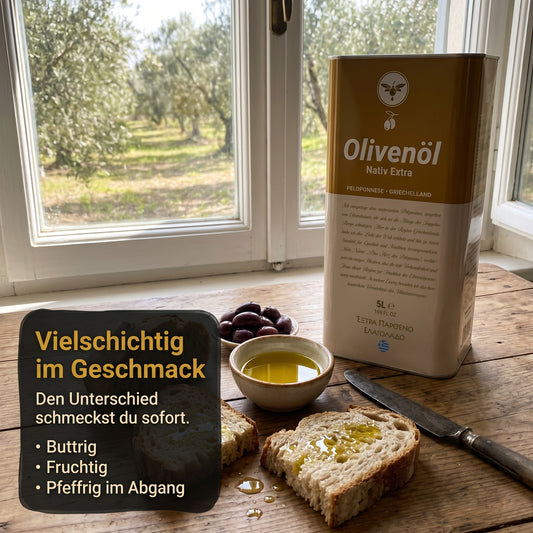
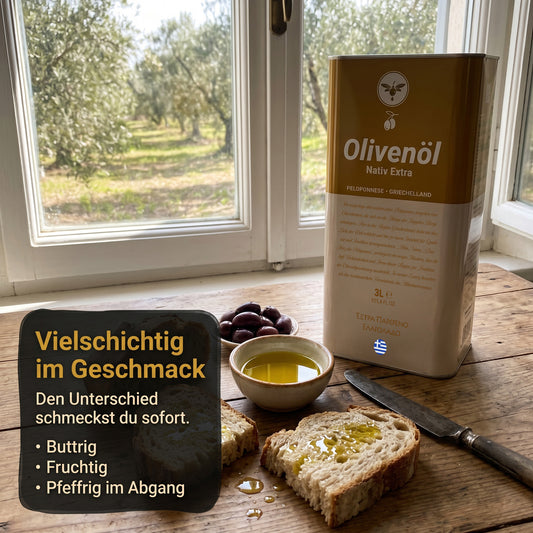
Koroneiki oil is known for its bright, grassy, herbaceous notes, a pleasant peppery bite at the back of the throat, and a naturally high level of the antioxidants that help the oil stay fresh. That characteristic peppery tingle is not a flaw; it is a sign of a lively, freshly pressed oil rich in natural polyphenols. When people describe a Greek oil as "spicy", "buttery" and "peppery" all at once, they are usually describing well-made Koroneiki extra virgin from a region like the Peloponnese.
What Makes It Exceptional: Harvest and Extraction
Great oil is made in the grove and the mill, not marketed into existence. Three things separate a truly fine Peloponnese oil from a mediocre one.
Early, careful harvesting
The best oils come from olives picked relatively early, while still green to violet rather than fully black. Early-harvest olives yield less oil per kilo, but that oil is greener, more aromatic and higher in natural antioxidants. Traditional producers still hand-harvest, combing the olives gently from the branches so the fruit arrives at the mill undamaged.
Speed from tree to mill
Once picked, olives begin to oxidise. The finest producers press within hours of harvest, before the fruit can ferment or heat up. That freshness is exactly what you taste in a green, vibrant oil.
Cold mechanical extraction
"Extra virgin" means the oil is extracted purely by mechanical means — crushing and pressing — without heat or chemicals, and meets strict standards for low acidity and flavour. Cold extraction protects the delicate aromas and the natural compounds that would otherwise be lost. Our own extra virgin olive oil from the Peloponnese is hand-harvested and mechanically extracted in exactly this traditional way, then laboratory-tested for low acidity.
How to Recognise Real Extra Virgin Quality
You do not need to be an expert to judge olive oil. Trust your senses. Good extra virgin should smell alive — of fresh-cut grass, green tomato leaf, artichoke or herbs — never musty, greasy or like nothing at all. On the palate it should feel fresh and fruity, with a gentle bitterness and that signature peppery catch at the back of the throat. Colour, by the way, tells you little; a naturally cloudy, unfiltered oil can be superb, while a bright golden one can be dull.
A few practical signs of quality: a harvest or best-before date on the bottle (fresher is better), dark glass or tin that protects the oil from light, a named region or estate rather than a vague "product of several countries" blend, and honest information about acidity. A low free-acidity figure is a hallmark of careful production.
How to Use Peloponnese Olive Oil
A lively extra virgin like this deserves to be tasted, not hidden. Use it raw where its flavour shines: drizzled over a Greek salad, swirled into fava or melitzanosalata, poured onto warm bread, or finishing grilled vegetables and fish. Its peppery backbone lifts simple food beautifully.
Good Greek oil is also robust enough for everyday cooking. Contrary to old myths, quality extra virgin is well suited to sauteing, roasting and even shallow frying at normal kitchen temperatures, thanks to its stable structure and natural antioxidants. For pouring at the table you might keep a smaller bottle to hand, while a larger tin for daily cooking makes sense if olive oil is your everyday fat.
Frequently Asked Questions
Why is Peloponnese olive oil often peppery or slightly bitter? That peppery, sometimes bitter sensation comes from natural polyphenols — antioxidant compounds that are most abundant in fresh, early-harvest oil. Far from being a defect, it is one of the clearest signs that you are tasting a genuine, high-quality extra virgin.
Is cloudy, unfiltered olive oil lower quality? No. Cloudiness simply means the oil has not been filtered to remove tiny fragments of olive fruit and water. Many people prize unfiltered oil for its fuller, fresher flavour. It may settle a little over time, which is completely natural.
How should I store olive oil to keep it fresh? Keep it away from heat, light and air. Store the bottle in a cool, dark cupboard, keep the cap closed, and use it within a few months of opening. Buying a size you will actually finish while it is fresh beats hoarding a huge bottle that slowly fades.
Our product tip
Extra Virgin Olive Oil 500 ml from the Peloponnese
Hand-harvested, naturally cloudy and unfiltered, laboratory-tested for low acidity — spicy, buttery and peppery in the glass.
Shop the olive oilOlive oil from the Peloponnese is more than a cooking ingredient; it is the taste of a landscape, a variety and a way of working the land that goes back millennia. Choose a fresh, honestly made bottle, taste it properly, and you will understand at once why this southern corner of Greece has earned its reputation. Pour La Vie.