Mild vs Robust Olive Oil: Which Extra Virgin Should You Actually Buy?
Stand in front of a supermarket shelf and the labels all blur together: extra virgin, cold-pressed, mild, intense, classic. One word quietly does more than any other to tell you how a bottle will taste — and most shoppers walk straight past it. That word is the strength of the oil: mild or robust. Get it right and every salad, every drizzle, every dish improves. Get it wrong and you've either overpowered a delicate plate or, far more often, paid for an oil with almost no character at all. If you'd rather skip the guesswork, our Peloponnese extra virgin olive oil is a naturally robust, polyphenol-rich oil you can taste the difference in from the very first spoonful.
This guide explains what mild and robust really mean, how to taste the difference yourself, and which one belongs in your kitchen. By the end you'll buy olive oil with confidence instead of crossing your fingers at the till.
What 'mild' and 'robust' actually mean
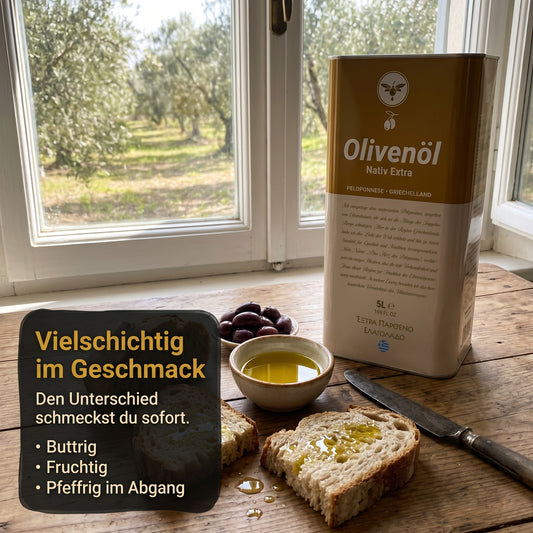
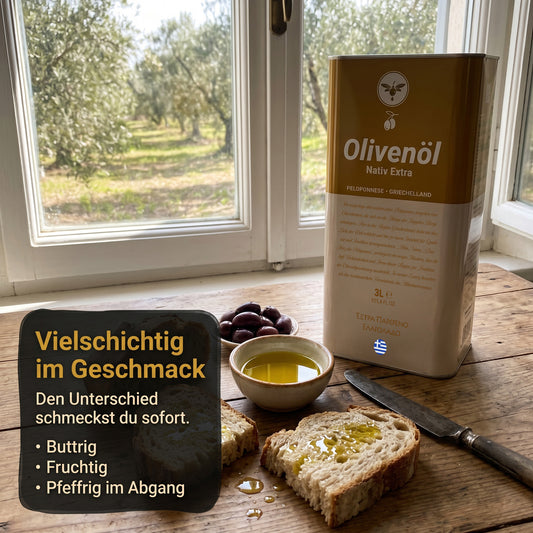
Strength in olive oil isn't marketing fluff — it describes how much flavour and aroma the oil carries. A robust (or intense) extra virgin olive oil is green, grassy and peppery, with a bitterness that lingers pleasantly at the back of the throat. A mild (or delicate) oil is softer, rounder and more buttery, with far less of that green bite.
Here's the part the labels won't tell you: a genuinely mild extra virgin can be lovely — but 'mild' is also the word often used to disguise an oil that's simply old, tired, or heavily refined and blended until almost nothing is left. The real skill is telling a naturally gentle oil apart from a lifeless one. That comes down to what you're actually tasting.
The three things you're really tasting
Professional tasters judge every extra virgin on three qualities. Once you know them, you'll notice them in every bottle:
- Fruitiness — the aroma of fresh olives, from grassy and green to ripe and buttery. The hallmark of oil made from healthy fruit, pressed quickly.
- Bitterness — a clean, pleasant bitterness on the tongue, strongest in oils from green, early-harvest olives.
- Pungency — the peppery catch at the back of the throat that can make you cough. Far from a fault, it's one of the best signs of a fresh, lively oil.
A robust oil scores high on all three; a mild oil sits lower. Crucially, bitterness and pungency are the taste of polyphenols — the natural antioxidants that olives develop and that a careful, cold extraction preserves. Our Peloponnese extra virgin is lab-tested for exactly these high polyphenol levels, which is why it tastes so alive. Taste it for yourself.
Why a peppery kick is a good sign
If a new bottle makes you cough slightly on the first taste, don't send it back — celebrate it. That peppery sensation is a reliable signal that the oil is fresh and rich in the compounds that give extra virgin its backbone. By contrast, an oil with no bitterness and no pepper at all is often telling you that its character has faded, or that it was never there to begin with. 'Smooth' and 'mild' sound appealing on a label, but with olive oil a complete absence of bite usually means a complete absence of personality.
When mild wins, and when robust is the right call
Neither style is 'better' — they suit different jobs.
Reach for a milder oil when you don't want the oil to dominate: delicate fish, light cakes and bakes, a soft mayonnaise, or cooking for children who find pepper too much.
Reach for a robust oil for almost everything else, and especially when the oil is meant to be tasted: drizzled raw over salads, soups, grilled vegetables, warm bread, feta and tomatoes, or stirred into dressings and dips. This is where a flat, mild oil disappears and a robust one makes the whole plate sing. For most home cooks who want one bottle that truly earns its place, a quality robust extra virgin is the smarter buy — and ours is built for exactly that.
Can you cook with a robust oil?
Yes. A persistent myth says intense extra virgin oils are 'only for drizzling'. In fact a fresh, polyphenol-rich oil is remarkably stable in the pan. Ours stays composed up to 180°C, so you can roast, sauté and even shallow-fry with it and still keep a wonderful bottle for finishing. One oil, both jobs.
How to taste olive oil like a pro (at home)
- Pour a tablespoon into a small glass and cup it in your hand to warm it for a minute.
- Swirl, then sniff deeply — you're looking for fresh, green, grassy or fruity aromas, never anything musty or greasy.
- Take a small sip and 'slurp' air across it, then let it coat your mouth.
- Note the three qualities: fruitiness up front, bitterness in the middle, a peppery finish.
Do this once with a cheap supermarket 'mild' oil and once with a fresh robust extra virgin, side by side, and you'll never be fooled by a label again. If you'd like a proper benchmark to taste against, start with our Peloponnese extra virgin.
Why naturally cloudy and unfiltered matters
You may notice a truly robust, fresh oil looks slightly cloudy rather than crystal clear. That's a feature, not a flaw. Our oil is naturally cloudy and unfiltered, which keeps more of the fine olive particles — and the flavour and polyphenols they carry — in the bottle. It's hand-harvested, cold-extracted, laboratory-tested for low acidity and for freedom from mineral-oil residues, and it comes straight from Peloponnese groves with a real story behind it. That's the honest version of 'quality olive oil', and it's what you taste in every drop. See the difference here.
Frequently asked questions
Is mild olive oil lower quality than robust?
Not necessarily. A naturally mild extra virgin can be excellent and is ideal for delicate dishes. The problem is that 'mild' is also used to describe oils that have lost their character through age or refining. The test is taste: a good mild oil still smells fresh and fruity, while a tired one tastes of almost nothing.
Why does good olive oil taste peppery or bitter?
Because of polyphenols, the natural antioxidants that fresh, well-made extra virgin olive oil carries. Bitterness and a peppery finish are signs of freshness and quality, not faults — which is why our polyphenol-rich Peloponnese oil has that lively kick.
Which should I buy if I only want one bottle?
For most kitchens, a quality robust extra virgin is the most versatile choice: it shines drizzled raw and holds up to cooking. Keep a milder oil as a second bottle only if you regularly make very delicate dishes.
Our product tip
Peloponnese Extra Virgin Olive Oil (500ml)
Hand-harvested, naturally cloudy and lab-tested for high polyphenols — a robust, peppery oil you can taste from the very first drop.
Shop Olive OilStop gambling on vague labels. Choose an oil whose strength, freshness and origin you can actually trust — and taste the difference the moment it hits the plate. Order our Peloponnese extra virgin olive oil today and bring real Mediterranean flavour home, Pour La Vie.