Is Aleppo Soap Banned? The Truth Behind the Rumour and What EU Rules Really Say
Search for Aleppo soap online and you will quickly stumble on an unsettling word: banned. Rumours that this ancient olive-and-laurel soap has been outlawed — in Germany, in the EU, or somewhere — surface again and again. If you love the soap, or are thinking about buying your first bar, it is a fair question to ask. So let us clear it up plainly.
The short version: no, Aleppo soap is not banned. You can buy it legally in Germany and across the EU, and we sell it here every day. But the rumour did not appear from nowhere, and understanding where it comes from tells you a great deal about how to choose a good, trustworthy soap.
The short answer: Aleppo soap is not banned
Aleppo soap — traditionally made from olive oil, laurel (bay) oil, water and a natural alkali — is a cosmetic product like any other bar of soap. There is no law in the EU or in Germany that prohibits it as a product. It is sold in pharmacies, health shops and online stores throughout Europe, including here. If it were genuinely outlawed, none of that would be possible.
So why the persistent talk of a “ban”? The answer lies not in the soap itself, but in the paperwork that surrounds every cosmetic sold in Europe.
Where the “Aleppo soap is banned” rumour comes from
EU cosmetics rules, explained simply
Every cosmetic placed on the EU market — soap included — has to meet the requirements of the EU Cosmetics Regulation, Regulation (EC) No 1223/2009. In practice, that means a product needs a designated “Responsible Person” based in the EU, a documented safety assessment, correct labelling, and notification in the EU’s central portal (the CPNP) before it can be sold. These rules exist to protect consumers, and they apply equally to a mass-market shower gel and to a handmade bar of Aleppo soap.
None of this bans Aleppo soap. It simply means that whoever imports and sells it has to do the compliance work. A traditional soap made in a workshop in Syria or Turkey is perfectly legal to sell in the EU — once a European seller has registered and documented it correctly.
Why some products get withdrawn (and others do not)
Here is the root of the confusion. From time to time, individual batches of imported soap have been stopped at customs or withdrawn from sale because they were brought in without meeting those administrative requirements — no EU safety assessment, no CPNP notification, or incomplete labelling. When a specific product is pulled for reasons like these, word spreads quickly and hardens into “Aleppo soap has been banned.”
The reality is far narrower: a non-compliant listing can be withdrawn, while the very same type of soap, sold by a compliant seller, stays on the shelf. It is a paperwork issue, not a verdict on the soap.
What makes a compliant, trustworthy Aleppo soap
Rather than worrying about a ban that does not exist, it is far more useful to know what a properly sold Aleppo soap looks like. A trustworthy bar should have:
- a clear ingredient list (INCI), typically led by olive oil (Olea Europaea Oil) and laurel oil (Laurus Nobilis Oil);
- a named seller or Responsible Person you can actually contact;
- honest labelling about origin, weight and shelf life;
- and no exaggerated medical promises — good soap is sold as soap, not as a cure.
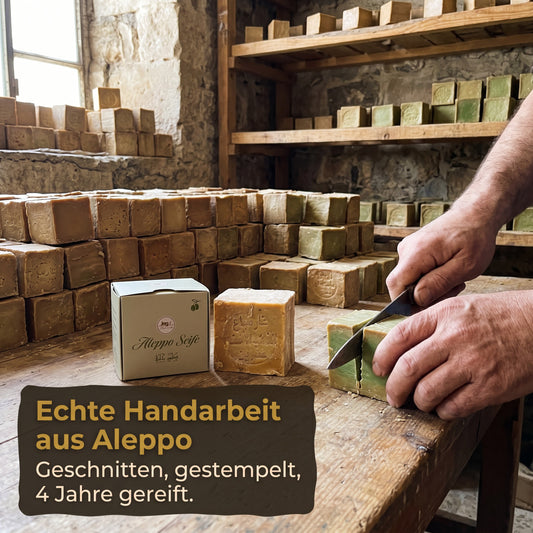
Our own Aleppo soap with 60% olive oil and 40% laurel oil is made in the traditional way — hand-cut and patiently matured — and sold in full compliance with EU cosmetics rules, so you can enjoy it with complete peace of mind.
How to buy Aleppo soap with confidence
Buy from a seller who is transparent about what is in the bar and where it comes from, who provides proper labelling, and who is reachable if you have a question. A higher laurel oil percentage tends to make a richer, more prized (and more expensive) soap, while a higher olive oil share is milder and better for everyday use. Neither is “banned” — the choice is simply about your skin and your budget.
Frequently asked questions
Is Aleppo soap legal in Germany and the EU?
Yes. There is no ban on Aleppo soap in Germany or the wider EU. It must meet the standard EU cosmetics requirements — safety assessment, labelling and CPNP notification — but as a product it is entirely legal to sell and to use.
Why did I read that Aleppo soap was withdrawn from sale?
Almost always because a specific imported product did not meet the EU’s administrative requirements — for example, it lacked a safety assessment or proper notification. That leads to that particular listing being withdrawn, not to Aleppo soap as a whole being outlawed.
Is Aleppo soap safe to use?
Aleppo soap has been made and used for centuries and, like any soap, is intended for external cleansing. If you have very sensitive skin or a known allergy, read the ingredient list and patch-test first, as you would with any new cosmetic.
Our product tip
Original Aleppo Soap – 60% Olive Oil & 40% Laurel Oil
Traditionally hand-cut and patiently matured — a pure, EU-compliant olive-and-laurel soap for face, body and hair.
Shop Aleppo soapThe bottom line: Aleppo soap is not banned — it is one of the world’s oldest and most loved natural soaps, still made the traditional way. Choose a transparent, compliant seller and enjoy it exactly as generations have before you. Pour La Vie.