How to Make Crystallised Honey Liquid Again: The Gentle Way That Keeps Every Bit of Flavour

You reach for the honey jar, and instead of a golden pour you find a grainy, cloudy, almost solid mass. Before you throw it out, stop: crystallised honey is not spoiled, and it is certainly not a fault. In fact, it is one of the clearest signs that you are holding real, raw, unprocessed honey rather than a heat treated syrup. The good news is that bringing it back to a smooth, liquid state is easy, as long as you do it gently. Taste what real, naturally crystallising thyme honey should be: discover ours here.
Is crystallised honey still good? Yes, and here is why
Crystallisation is a completely natural process. Honey is a super saturated sugar solution, and over weeks or months some of its natural glucose separates out and forms fine crystals. Nothing has gone off, nothing has been lost, and the honey is just as delicious and just as good for sweetening, spreading and cooking as the day it was jarred. Many people actually prefer the thick, creamy, spreadable texture of crystallised honey on warm toast.
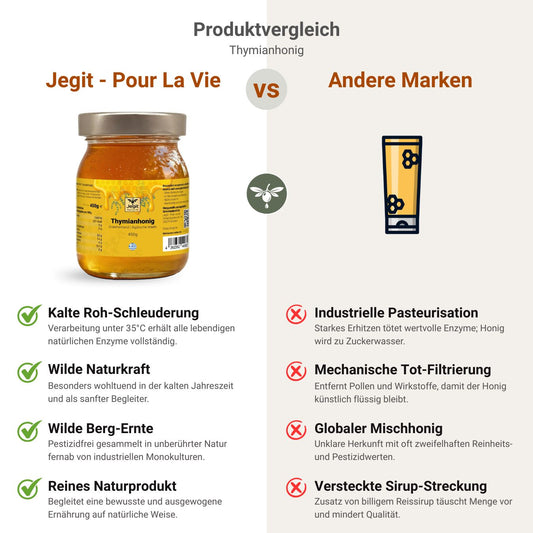
Here is the part worth knowing: the honeys that crystallise most readily are usually the natural, raw ones that have not been aggressively heated or ultra filtered. Supermarket honeys that stay perfectly clear for years are often pasteurised and micro filtered to delay it, a process that can also flatten the aroma and strip the delicate character that makes good honey worth buying. So a jar that sets is not a problem. It is a quality signal. That is exactly why our raw Greek thyme honey crystallises: taste the real thing.
Why does honey crystallise?
Three things speed it up: a high natural glucose content, cooler storage temperatures (crystallisation runs fastest around 10 to 15 degrees Celsius, which is why honey often sets in a cold winter cupboard), and the fine particles of pollen and wax that raw honey keeps, which give the crystals something to form around. In other words, everything that makes honey natural and alive is also what makes it set. If you want to understand what separates a genuine, characterful honey from a bland one, our guide to what makes Greek thyme honey special is a good place to start.
How to make crystallised honey liquid again, step by step
The method that works every time is a simple warm water bath. It is slow, but it protects everything that makes your honey worth eating.
- Loosen the lid. Open the jar, or at least loosen the lid, so pressure can escape as the honey warms.
- Warm some water, do not boil it. Heat water to roughly body temperature, warm to the touch but never hot, ideally around 35 to 40 degrees Celsius. If you can comfortably hold a finger in it, it is right.
- Stand the jar in the water. Place the jar in a bowl or pan of the warm water so the water comes up around the honey level. Make sure no water gets into the honey.
- Wait and stir. Leave it for 15 to 30 minutes, stirring gently now and then and refreshing the water as it cools. For a fully set jar, repeat with fresh warm water until the crystals have melted and the honey runs clear and smooth again.
- Use it or store it. That is it. Your honey is back to liquid gold, with its aroma and natural enzymes intact.
Gentle, patient, and completely foolproof. Keep a jar of proper thyme honey on hand: shop ours here.
The one rule: keep it gentle
Honey is heat sensitive. Push it past about 40 degrees Celsius and you begin to drive off the volatile aromas that give thyme honey its intense, herbal, mediterranean character. Go hotter still and you start to degrade the natural enzymes and delicate compounds that raw honey is prized for. A warm bath takes a little longer than a blast of heat, but it is the difference between honey that still tastes of a Greek hillside and honey that tastes of, well, sugar. Our own thyme honey is cold spun and never heated in production, so it only makes sense to treat it the same way at home.
What not to do
- Do not microwave it. The microwave heats unevenly, scorches parts of the honey, and rapidly destroys aroma and enzymes. It is the fastest way to turn good honey into ordinary sweetener.
- Do not boil it or put it on direct heat. A pan straight on the hob or boiling water will overheat the honey in seconds.
- Do not add water. Diluting honey can cause it to ferment. Keep every drop of water out of the jar.
- Do not refrigerate honey. The fridge is the perfect temperature to speed up crystallisation, not slow it.
How to slow crystallisation in the first place
You cannot stop a natural honey from ever setting, nor would you want to, but you can slow it down. Store your jar sealed, at a steady room temperature of around 20 to 21 degrees Celsius, away from the cold and out of direct sunlight. Use a clean, dry spoon every time so you do not introduce moisture or stray crystals. And buy honey in sizes you will actually get through: a jar in regular use rarely has time to set hard. For plenty of ways to work through a jar, see our ideas for cooking with thyme honey, from tea to baking.
Why our thyme honey crystallises, and why that is a good thing
Our Thyme Honey from Greece is exactly the kind of honey that will crystallise over time, and we are proud of it. It is pure and unprocessed, naturally rich in enzymes, cold spun and only gently filtered, so nothing is heat treated out of it. The nectar comes from wild, flowering thyme, which gives it an intense, almost peppery mediterranean aroma that a pasteurised honey simply cannot match. When it sets, it is telling you the truth about what is in the jar. Warm it gently, as above, and it returns to a glorious golden pour, ready to drizzle over yoghurt, whisk into a dressing, or melt over baked camembert. Taste honey the way it is meant to be: order ours now.
Frequently asked questions
Can I eat honey that has crystallised without warming it?
Absolutely. Crystallised honey is perfectly good to eat straight from the jar. Many people love its thick, creamy texture on toast or stirred into porridge. Warming it back to liquid is purely about preference and convenience, not safety.
Will crystallised honey ever go bad?
Pure honey is one of the longest lasting foods there is, and crystallisation does not change that. Kept sealed and dry, it stays good for a very long time. The only thing that can spoil honey is added moisture, which is why you should never add water and always use a dry spoon.
Does crystallised honey mean it is fake or has added sugar?
It is the opposite. Crystallisation is typical of real, raw honey. Many heavily processed or adulterated honeys are treated specifically to stay clear and runny, so a jar that sets naturally is a reassuring sign of an authentic product.
Our product tip
Thyme Honey from Greece
Pure, unprocessed and cold spun, naturally rich in enzymes with an intense mediterranean thyme aroma. The real thing, which is exactly why it crystallises, and why a gentle warm bath brings it right back.
Shop the thyme honey nowPour La Vie
A jar of honey that sets is not a problem to solve, it is a promise kept: real honey, with nothing added and nothing cooked out. Treat it gently, warm it slowly, and it rewards you with the same golden, aromatic spoonful it started as. That respect for natural products, from the hillside to your table, is the heart of everything we do at Jegit. Bring home honey worth warming gently, and taste Pour La Vie.

Mediterranean Secret Santa & Wichtel Gifts: Small, Edible Presents People Actually Love
Stuck for a Secret Santa or Wichtel gift under budget? These small, edible Mediterranean presents feel generous, never end up in a...

Olive Oil for Skin and Hair: The Simple, Natural Mediterranean Beauty Ritual
How to use extra virgin olive oil for skin and hair: a gentle, natural Mediterranean beauty ritual for face, body, hands and...

Olive Oil Test Winners Explained: How to Spot a Genuinely Top Extra Virgin Oil (Not Just a Label)
What olive oil tests really measure, the criteria every test-winning extra virgin oil shares, and how to recognise a genuinely top oil...