How to Choose a Good Olive Oil: A Simple Buyer's Guide to Extra Virgin
Standing in front of a shelf of olive oil can feel like reading a foreign language. Extra virgin, cold-pressed, first press, single origin, testsieger, best in test — the bottles compete for your attention with words that sound impressive but rarely explain themselves. Meanwhile the prices swing from a couple of euros to well over twenty for what looks like the same green liquid. So how do you actually choose a good olive oil?
The good news is that a handful of simple checks will tell you far more than any front-of-label slogan. Once you know what to look for on the back label, how to read the taste and how to spot the warning signs of a tired or adulterated oil, you will never again buy blind. This guide walks you through it, so your next bottle is one you genuinely enjoy pouring. Pour La Vie.
Start With the Grade: What Extra Virgin Really Means
Olive oil is sorted into grades, and the grade is the single most important thing on the label. Extra virgin olive oil is the highest grade. It is made purely by mechanical means — no heat above gentle limits, no chemical solvents — and it must pass both a laboratory test and a taste panel. To qualify, its free acidity must be no higher than 0.8 grams per 100 grams, and it must be free of defects in flavour and aroma.
Below that sits virgin olive oil, which is still mechanically pressed but allowed more acidity and minor flavour faults. Then comes plain "olive oil" (sometimes labelled "pure"), which is a blend of refined oil and a little virgin oil. Refined oil has been stripped and neutralised, losing most of its aroma and beneficial compounds. If a bottle simply says "olive oil" without "extra virgin," it is a lower grade, whatever the pretty branding suggests. For flavour and for the polyphenols that make olive oil worth eating, extra virgin is the one to reach for.
Read the Back Label, Not the Front
The front of the bottle is marketing. The back is where the truth lives. Look for a harvest date, not just a best-before date. Olive oil is a fresh juice, not a wine — it does not improve with age. The best oils are consumed within 18 to 24 months of harvest, and the fresher the better. A stated harvest date is a strong sign of a producer who has nothing to hide.
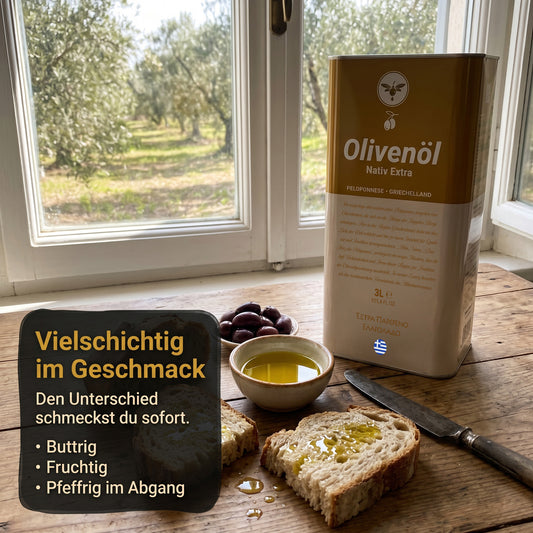
Next, look for origin. "Bottled in" is not the same as "grown in." Many cheap oils are blends from several countries, printed in tiny type as "a blend of EU olive oils." A single country, region or even estate of origin tells you the producer is proud of where the olives came from. Our extra virgin olive oil from the Peloponnese, for example, comes from a single Greek region with a long olive-growing tradition, and it is lab-tested for low acidity and a high polyphenol content.
Mind the Packaging
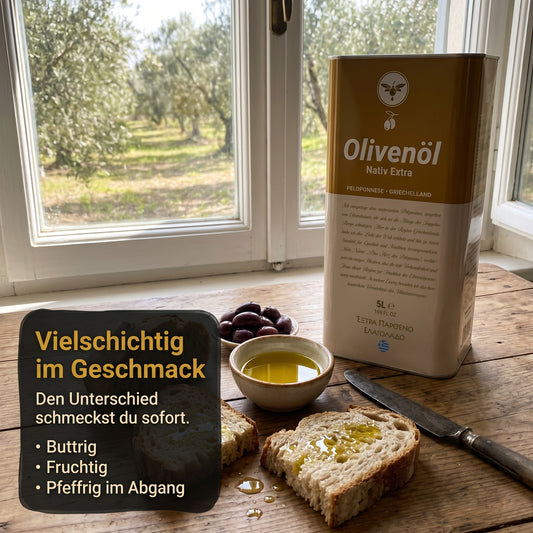
Light and air are the enemies of fresh olive oil. Both trigger oxidation, which turns a lively oil flat and eventually rancid. That is why good oil is sold in dark glass or an opaque tin rather than a clear bottle sitting under supermarket lights. If you can see the oil glowing green through clear glass on a bright shelf, it has probably already begun to degrade.
At home, the same rules apply. Keep your oil in a cool, dark cupboard, tightly closed, away from the hob. If you buy in a larger, economical size, decant a week's worth into a small dark bottle or a stoneware pourer and keep the rest sealed. This keeps your everyday oil at its peak while protecting the reserve from light and air.
Trust Your Taste: How Good Olive Oil Should Feel
You do not need to be an expert taster to judge an oil. Pour a little into a small glass, cup it in your hand to warm it, swirl, and take a sip, drawing in a little air. A good extra virgin oil has three positive qualities:
- Fruitiness — aromas of fresh olives, green grass, tomato leaf or almond.
- Bitterness — a pleasant, clean bitterness on the tongue, a sign of healthy polyphenols.
- Pungency — a peppery catch at the back of the throat that can make you cough. This is a good thing.
That gentle throat-tickle is one of the clearest signs of a fresh, polyphenol-rich oil. Flavours to avoid are musty, greasy, fusty or winey notes, or a flat oil that tastes of nothing at all. A quality oil should taste alive.
Why Cheap Supermarket Oil Often Disappoints
Very cheap extra virgin oil is not impossible, but it is unlikely. Growing, hand-harvesting and carefully pressing olives costs money, and the maths rarely works at rock-bottom prices. Bargain bottles are often blends of oils from different harvests and countries, kept in bulk storage for a long time before bottling. They may still be labelled extra virgin, yet taste tired and lack the peppery kick of a fresh, single-origin oil. Paying a little more for a dated, traceable bottle is almost always worth it.
How to Spot a Fake or Tired Oil
Adulteration — cutting olive oil with cheaper oils, or passing off lower grades as extra virgin — is a real problem in the industry. You cannot run a lab test at home, but a few habits protect you. Buy oils with a clear harvest date and named origin. Be sceptical of "extra virgin" at an implausibly low price. Choose dark glass or tin. And once opened, trust your senses: if the oil smells of crayons, putty or stale nuts, or tastes greasy and dull, it is past its best, regardless of what the label promised.
One common myth worth retiring: the fridge test, where solid oil supposedly proves purity, is unreliable. Whether an oil clouds or solidifies when chilled depends on the olive variety, not on quality or authenticity. Ignore it and rely on harvest date, origin, packaging and taste instead.
Match the Oil to the Job
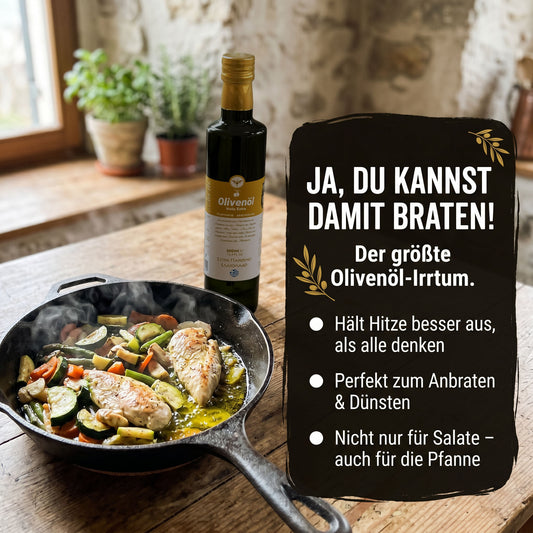
A characterful extra virgin oil shines raw — drizzled over salads, soups, grilled vegetables and warm bread, where its aroma is on full display. A robust, peppery oil like a good Greek extra virgin also stands up well to everyday cooking; contrary to old kitchen lore, quality extra virgin is stable for roasting and pan-frying at normal cooking temperatures, thanks to its antioxidants. If you cook and finish dishes with olive oil daily, buying a larger, economical format keeps good oil within easy reach, while a smaller bottle is perfect for trying a new oil before committing.
Frequently Asked Questions
Is more expensive olive oil always better?
Not automatically, but genuine quality does cost more to produce. What you are really paying for is a fresh harvest, careful mechanical pressing, single origin and proper packaging. A mid-priced oil with a clear harvest date and named region usually beats both the cheapest bottle and an over-styled premium one. Judge value by the back label and the taste, not the price alone.
How long does olive oil keep once opened?
Use an opened bottle within about two to three months for the best flavour, and always within the best-before date. Keep it tightly sealed in a cool, dark place. Buying a size you will realistically finish in that window, or decanting from a larger container, keeps every pour tasting fresh rather than flat.
What does "cold-pressed" or "cold-extracted" mean?
It means the oil was produced without heating the olive paste above roughly 27°C, which protects the delicate aromas and polyphenols. For modern extra virgin oils, "cold-extracted" is the accurate term, as most are made in a continuous centrifuge rather than a traditional press. Either phrase signals gentle processing, which is what you want in a good oil.
Our Product Tip
Extra Virgin Olive Oil from the Peloponnese
Single-origin Greek extra virgin, hand-harvested and lab-tested for low acidity and high polyphenols.
Shop Olive OilChoosing a good olive oil comes down to a few reliable habits: reach for extra virgin, check the harvest date and origin, favour dark glass or tin, and trust an oil that tastes fresh, fruity and peppery. Prefer to start small? Our 500 ml bottle is an easy way to taste the difference before you commit to a larger size. Buy with confidence, pour generously, and let good oil do what it does best. Pour La Vie.