Why You Can't Eat Olives Straight From the Tree: How Olives Are Cured
Pick an olive straight from the branch, bite into it, and you will spit it out immediately. Raw olives are astonishingly, mouth-puckeringly bitter — so bitter they are practically inedible. And yet the Kalamata olives in your salad and the green olives on your mezze board are deeply savoury and delicious. The transformation between those two states has a name: curing. It is one of the oldest food preservation techniques in the Mediterranean, and understanding it will change the way you shop for and enjoy olives.
In this guide we explain why raw olives are inedible, what curing actually does, the main methods used around the Mediterranean, and how our own Greek olives are cured the natural way.
Why a raw olive is inedible
The bitterness of a fresh olive comes mainly from a natural compound called oleuropein, concentrated in the fruit and its skin. It is so intensely bitter that no amount of ripening on the tree will make a raw olive pleasant to eat. Curing is, at its heart, the process of drawing out or breaking down that bitterness until the fruit becomes palatable — and, as a happy side effect, preserving it so it keeps for months.
This is why every culture that grew olives, from ancient Greece onward, developed a way to cure them. Without curing there would be no table olives at all — only olive oil, which is pressed from the same fruit but escapes the bitterness problem because the compounds largely stay behind in the paste and water.
What curing actually means
Curing simply means removing the bitter oleuropein and, usually, fermenting or salting the fruit so it is both edible and stable. Different methods pull the bitterness out at different speeds and leave behind different flavours and textures. Some produce a firm, bright, tangy olive; others a soft, wrinkled, intense one. There is no single “correct” method — each tradition suits particular olive varieties and tastes.
The main olive-curing methods
Water curing
The gentlest and slowest method. The olives are soaked in plain water, which is changed daily or every few days over one to several weeks, gradually leaching out the bitterness. Once mild enough, they are transferred to a light brine for storage. Water curing keeps the flavour clean and the olive relatively delicate.
Brine curing
The most common traditional method, and the one behind most Greek table olives. The olives are submerged in a salt-water brine, often with a splash of vinegar, where they slowly ferment over weeks or months. Natural lactic-acid fermentation removes the bitterness and develops that complex, savoury, slightly tangy flavour we associate with a really good olive. Brine-cured olives keep their bite and their character, which is why the method is so prized.
Dry salt curing
Ripe black olives are packed in coarse salt, which draws out moisture and bitterness at the same time. The result is the wrinkled, intense, almost meaty olive you often see labelled “dry-cured” or “oil-cured.” They are lower in moisture, richer in flavour and are frequently finished in a little olive oil and herbs.
Lye curing
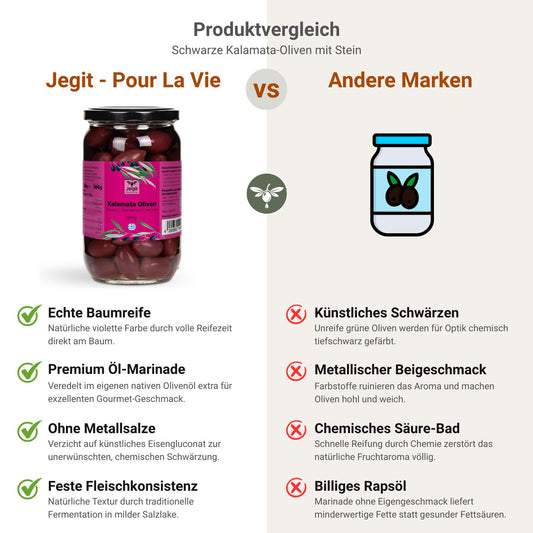
The fast, industrial method used for many mass-market green olives. A food-grade alkaline solution (lye) is used to neutralise the bitterness in a day or two rather than weeks, after which the olives are thoroughly rinsed and brined. It is efficient, but it tends to flatten the flavour compared with slow natural fermentation, which is why traditional producers often avoid it.
How long does curing take?
It depends entirely on the method and the olive. Lye curing can be done in a couple of days. Water and brine curing take anywhere from a few weeks to several months, and dry-salt curing usually needs a few weeks. Naturally fermented olives are the slowest of all — and that patience is exactly what gives them their depth. Good olives, like good wine, are not rushed.
How our Greek olives are cured
At Jegit we choose the slow, natural route because it makes a genuinely better olive. Our black Kalamata olives are naturally ripened and cured in brine, with nothing but salt, water and time — no artificial additives and no colourings. That traditional fermentation is what gives them their smooth, rich, faintly winey flavour and their signature deep colour.
Our Greek green olives from Chalkidiki are naturally fermented too, using only brine and a little vinegar. The slow process preserves their crisp bite and their fresh, mild, fruity character. In both cases the aim is the same: to honour the fruit and let nature do the work, so what reaches your table is pure and authentic — nothing added, nothing rushed.
How to enjoy and store cured olives
Once cured, olives are ready to eat straight from the jar. Keep them submerged in their brine in the fridge once opened, and they will stay fresh for weeks. Serve them simply — warmed gently with citrus zest, garlic and herbs — or fold them into salads, breads, tapenade and slow-cooked dishes. A bowl of good olives, a little olive oil and fresh bread is a complete pleasure in itself.
Frequently asked questions
Can you eat olives straight from the tree?
No. Raw olives contain high levels of oleuropein, which makes them intensely bitter and unpleasant to eat. They must be cured — in water, brine or salt — before they become the table olives we know.
Are naturally cured olives better than lye-cured ones?
They usually taste better. Slow natural fermentation in brine develops a deeper, more complex, savoury flavour, whereas fast lye curing neutralises bitterness quickly but tends to give a flatter taste. This is why traditional Greek producers favour natural brine curing.
Why are some olives black and others green?
Colour mostly reflects ripeness at harvest: green olives are picked earlier and firmer, black olives later and fully ripe. The curing method then shapes the final flavour and texture. Variety matters too — Kalamata olives, for example, are prized for their rich, dark character.
Our product tip
Black Kalamata Olives with pit
Naturally ripened and brine-cured with nothing but salt, water and time — pure Greek olives with a smooth, rich character.
Shop Kalamata olivesNext time you enjoy an olive, remember the quiet weeks or months of curing that made it possible. That patience — salt, water and time, and nothing artificial — is exactly what separates a truly good olive from an ordinary one. Pour La Vie.