Greek Thyme Honey: What Makes It Special and How to Use It
Not all honey is created equal. Taste a spoonful of Greek thyme honey next to an ordinary supermarket blend and the difference is impossible to miss: a deep amber colour, an intense herbal-floral aroma, and a warm, faintly resinous sweetness that lingers. It is one of the most prized honeys in the Mediterranean — and once you have tried the real thing, it is hard to go back.
But what exactly makes thyme honey special, how do you tell a genuine one from an imitation, and how should you actually use it? This is our plain-spoken guide to understanding, choosing and enjoying Greek thyme honey — Pour La Vie.
What Is Thyme Honey?
Thyme honey is a monofloral honey, which means the bees have gathered their nectar mainly from the flowers of a single plant — in this case, wild thyme. Across the sun-baked hillsides of Greece, wild thyme blooms in the height of summer, and for a few short weeks the bees work those tiny purple flowers almost exclusively. The result is a honey that carries the character of the herb itself: aromatic, complex and unmistakably Mediterranean.
Because thyme flowers for such a limited window and grows on rugged, hard-to-reach terrain, true thyme honey is produced in relatively small quantities. That scarcity, together with its remarkable flavour, is why it has been treasured since antiquity — the honey of Mount Hymettus near Athens was famous throughout the ancient world.
Why Greek Thyme Honey Stands Out
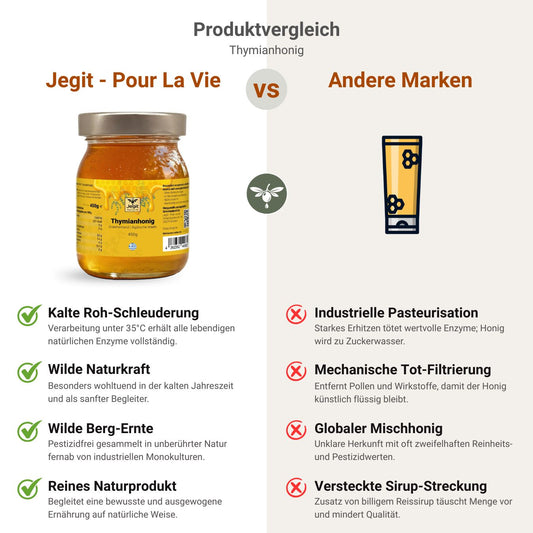
Greece has an unusually high proportion of wild, uncultivated land carpeted in aromatic herbs, and a beekeeping tradition that stretches back thousands of years. The dry climate and biodiverse landscape give Greek thyme honey its concentrated aroma and its characteristically slow crystallisation. Our own Thyme Honey 400g from Greece is raw and unheated, gently harvested by hand so that its natural enzymes and delicate aromatics are preserved rather than cooked away by industrial processing.
That word — raw — matters. Much commercial honey is pasteurised and finely filtered to look uniform and pour easily on the shelf, a process that strips away some of what makes honey interesting in the first place. Raw honey keeps its full flavour, its pollen and its living enzymes intact.
How to Tell Good Thyme Honey From an Imitation
The market is full of honey labelled “with thyme” or blended to mimic the real thing. Here is what to look for in a genuine bottle:
- Origin and floral source. A real product will state that it is thyme honey from a specific country or region — not simply “blend of EU and non-EU honeys.”
- Aroma. Genuine thyme honey has a powerful, herbal-floral scent the moment you open the jar. If it smells faintly of nothing, be suspicious.
- Raw and unheated. Look for wording such as raw, unheated or cold-extracted, which indicates the honey has not been processed at high temperatures.
- Texture over time. Pure honey naturally crystallises. A honey that stays perfectly clear and runny for years may have been heavily processed or adulterated.
- A long finish. Good thyme honey leaves a warm, slightly spicy aftertaste rather than a flat, one-note sweetness.
What Does Thyme Honey Taste Like?
Thyme honey is bolder and less sugary-tasting than mild honeys such as acacia or clover. Expect a rich amber colour, a thick pour, and a flavour that is floral and herbaceous with a gentle savoury, almost peppery edge. It is this savoury complexity that makes it as at home drizzled over cheese and roasted vegetables as it is stirred into tea. Serve it with a proper olive wood honey dipper and you will lift clean, unbroken ribbons of it without a sticky mess.
How to Use Greek Thyme Honey
Thyme honey shines in both sweet and savoury settings. A few of our favourite ways to enjoy it:
- With cheese. Drizzle it over fresh goat’s cheese, feta or a warm baked camembert — the savoury note pairs beautifully with salty, creamy cheeses.
- Over yoghurt. Thick Greek yoghurt with a spoon of thyme honey is a classic for a reason.
- As a glaze. Brush it over roasting chicken, pork or root vegetables in the last minutes of cooking for a fragrant, glossy finish.
- In dressings. Whisk a little into a lemon-and-olive-oil dressing to balance sharp leaves like rocket.
- In warm drinks. Stir into herbal tea once it has cooled slightly — adding honey to very hot liquid dulls its delicate aroma.
- Simply on bread. On warm, crusty bread with a little butter, it needs no help at all.
One small tip: to protect the flavour and natural enzymes, avoid stirring raw honey into boiling-hot food or drink. Let things cool a touch first.
How to Store Thyme Honey (and Why It Crystallises)
Honey is one of the few foods that essentially never spoils. Keep your jar tightly closed at room temperature, away from direct sunlight, and use a dry spoon to avoid introducing moisture. There is no need to refrigerate it — in fact, the cold speeds up crystallisation.
If your honey turns cloudy, grainy or solid over time, do not worry: that is crystallisation, a completely natural sign of pure, raw honey rather than a fault. To return it to a liquid state, stand the jar in a bowl of warm (not hot) water and let it soften gently. Avoid the microwave and boiling water, which can damage the aromatics you paid for in the first place.
Frequently Asked Questions
Why is thyme honey more expensive than ordinary honey?
Thyme blooms for only a short period each summer and grows on wild, rugged terrain, so the harvest is limited. Genuine raw thyme honey is also produced with far more care than mass-market blends. The price reflects both its scarcity and its concentrated flavour.
Has my thyme honey gone off because it has crystallised?
No. Crystallisation is natural and is actually a good sign that the honey is pure and raw. Simply warm the jar gently in a bowl of warm water to make it runny again; the flavour is unaffected.
Is thyme honey suitable for cooking and baking?
Yes. Its bold, herbal character holds up well in glazes, dressings and bakes. For the fullest aroma, though, it is best added towards the end of cooking or used raw as a finishing drizzle rather than boiled for long periods.
Our Product Tip
Thyme Honey 400g from Greece
Raw, unheated and hand-harvested in Greece — an intensely aromatic thyme honey with a warm, herbal finish.
Shop the thyme honeyGreat thyme honey is a small luxury that turns everyday moments — a slice of bread, a bowl of yoghurt, a wedge of cheese — into something quietly special. Choose one that is raw, honestly labelled and full of aroma, store it with a little care, and it will reward you spoonful after spoonful. Pour La Vie.