Greek Thyme Honey: Taste, Benefits and How to Use It
Dip a spoon into a jar of Greek thyme honey and you understand at once why it holds such a place at the Mediterranean table. It is darker and bolder than the mild blossom honeys most of us grow up with — amber-gold, intensely aromatic, with a warm, almost herbal depth and a lingering, gently peppery finish. This is honey with a sense of place.
If you have been curious about thyme honey — what it tastes like, how it is made and how to use it — here is everything you need to know, along with how to pick a jar worth its price.
What is thyme honey?
Thyme honey is a monofloral honey: the bees gather their nectar mainly from the tiny flowers of wild thyme. Around the Mediterranean, and especially in Greece, thyme carpets sun-baked hillsides and rocky islands, flowering in the heat of high summer. When bees forage those slopes, the result is a honey that carries the character of the landscape itself — concentrated, aromatic and unmistakably savoury-sweet.
Because wild thyme flowers only briefly and yields relatively little nectar, thyme honey is prized and produced in far smaller quantities than common blossom or flower honeys. That scarcity is part of why a genuine jar of Greek thyme honey is treated as a delicacy.
What does Greek thyme honey taste like?
The first thing you notice is the aroma — floral and herbal at once, like a warm hillside in July. On the palate it is richly sweet but never one-dimensional: there is a resinous, herby note from the thyme, a whisper of dried herbs, and a distinctive peppery tingle at the back of the throat that lingers pleasantly after each spoonful.
Set beside a mild acacia or clover honey, thyme honey is bolder, deeper in colour and far more aromatic. It is the sort of honey you can taste entirely on its own and genuinely savour, rather than simply using it to sweeten.
How real thyme honey is made
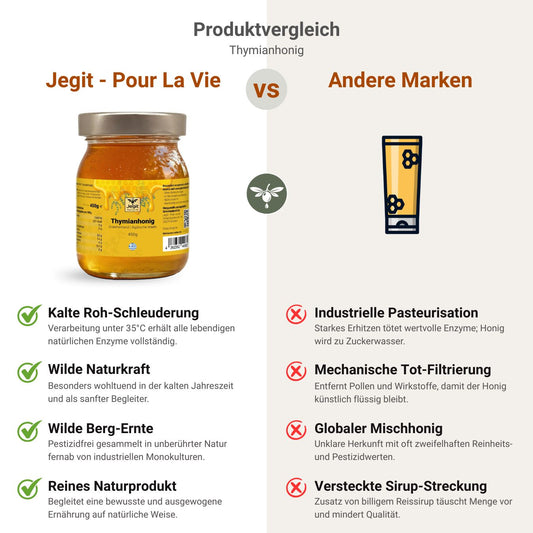
The best thyme honey is raw and unheated. Once the bees have capped the honeycomb, the honey is gently spun out, lightly filtered and jarred without pasteurisation or hard heating. Keeping it raw preserves the delicate aromatic compounds and the natural enzymes that give thyme honey its living, complex character. Our Greek thyme honey is hand-crafted this way — unheated and sustainably harvested from wild Mediterranean thyme — so that what reaches your spoon is as close as possible to what the bees made.
Why raw matters
When honey is heated hard for easy bottling, its aroma flattens and its enzymes diminish. Raw honey keeps more of the fragrance and the subtle flavour notes intact. It is also why raw honey — thyme honey included — will naturally crystallise over time. That is a sign of an unprocessed, genuine product, not a fault.
How to use thyme honey
Thyme honey is wonderfully versatile, at home in both sweet and savoury cooking. A few favourite ways to enjoy it:
- Over Greek yoghurt. The classic — a generous spoonful over thick strained yoghurt for a simple Greek breakfast or an effortless dessert.
- With cheese. Drizzle over feta, fresh goat's cheese or a hard sheep's cheese; the honey's herbal bite is a natural partner to salty cheese.
- As a glaze. Brush over roast chicken, pork or root vegetables in the last minutes of cooking for a fragrant, caramelised finish.
- In dressings. Whisk a little into a dressing of extra virgin olive oil and lemon for a sweet-sharp balance over salads and grilled vegetables.
- In warm drinks. A comforting way to sweeten herbal tea or a mug of warm water with lemon.
- Over breakfast. On toast, porridge or drizzled across warm flatbread.
One tip: to keep the aroma and raw qualities intact, add thyme honey towards the end of cooking, or once a hot drink has cooled slightly, rather than boiling it.
How to choose a good thyme honey
Not every jar labelled "thyme honey" is the real thing. Here is what to look for:
- Origin. Greece is renowned for exceptional thyme honey thanks to its wild island and hillside thyme. A clear country of origin is a good sign.
- Raw and unheated. Choose honey that is unpasteurised and gently handled, so the aroma and enzymes survive the journey to the jar.
- Aroma and colour. Genuine thyme honey is amber, deeply fragrant and herby. A pale, near-odourless honey is unlikely to be true monofloral thyme.
- Minimal processing. The shorter the journey from hive to jar, the better. Small-batch, hand-harvested honey tends to keep far more character.
Our Thyme Honey 400g from Greece ticks each of these boxes: single-origin, raw, unheated and hand-crafted from wild Mediterranean thyme.
How to store thyme honey
Keep honey in a sealed jar at room temperature, away from direct sunlight and heat. Avoid the fridge, which only speeds up crystallisation, and always use a dry, clean spoon so no moisture gets in. Stored well, honey keeps for a very long time. If it does crystallise and turn grainy, it has not spoiled — simply stand the jar in a bowl of warm (not boiling) water and stir gently until it turns smooth and pourable again.
Frequently asked questions
Why is thyme honey more expensive than ordinary honey?
Wild thyme flowers only briefly and produces little nectar, so thyme honey is harvested in much smaller quantities. Combined with careful, raw handling, that relative scarcity is reflected in the price of a genuine jar.
Does thyme honey crystallise?
Yes. Like most raw honeys it can crystallise over time, especially in cooler conditions. This is a natural sign of an unheated, unprocessed honey, and gentle warming returns it to a smooth, pourable state.
Is thyme honey suitable for cooking and baking?
Absolutely. Its bold, herbal flavour shines in glazes, dressings, marinades and baking. To preserve its aroma and raw qualities, add it near the end of cooking rather than exposing it to prolonged high heat.
Our product tip
Thyme Honey 400g from Greece
Raw, unheated Greek thyme honey with a bold, aromatic sweetness — a true Mediterranean treasure.
Shop Thyme HoneyA jar of real Greek thyme honey is a small luxury that turns everyday breakfasts, cheese boards and roasts into something memorable. Taste the Mediterranean hillside, one golden spoonful at a time. Pour La Vie.