Extra Virgin Olive Oil Explained: What "Extra Virgin", the Grades and the Labels Really Mean

Stand in front of a shelf of olive oil and you are met with a wall of words: extra virgin, native, cold-extracted, first press, refined, pure, light. Most of them sound premium. Very few of them are regulated, and the gap between a true extra virgin olive oil and a cheap blend dressed up in flattering language is enormous — in taste, in quality, and in what you are actually paying for. This guide decodes the grades and the label terms so you can buy with confidence and never overpay for a pretty bottle again. And if you'd rather skip straight to an oil that ticks every box, our hand-harvested, lab-tested Peloponnese extra virgin olive oil is a safe place to start.
The Olive Oil Grade Ladder, From Best to Worst
Olive oil grades are legally defined, and understanding the ladder is the single most useful thing you can learn as a shopper. Here is the hierarchy in plain English.
1. Extra virgin olive oil (the top grade)
This is the gold standard. Extra virgin olive oil — natives Olivenöl extra in German — is made purely by mechanical means (pressing or spinning the olives), with no heat or chemicals, and must have a free acidity of no more than 0.8%. It also has to pass a sensory panel with zero defects and a genuine fruitiness. In short: it is pure olive juice, and it should taste alive — grassy, peppery, sometimes bitter in the best way.
2. Virgin olive oil
Also mechanically produced, but held to a looser standard: acidity up to 2% and a few minor sensory flaws permitted. It is still real olive oil, but a clear step down in quality and flavour from extra virgin.
3. Lampante and refined olive oil
Lampante is virgin oil that failed to make the grade — too acidic or too flawed to sell as is. It is then refined using heat and industrial processing to strip out the defects, which also strips out most of the flavour, aroma and beneficial compounds.
4. "Olive oil" (plain)
A bottle simply labelled "olive oil" (sometimes "pure" or "classic") is usually a blend of refined oil with a splash of virgin or extra virgin added back for flavour. It is neutral, inexpensive, and a world away from the top grade.
5. Olive-pomace oil (the bottom)
Extracted from the leftover olive paste using solvents and heat, then refined. It is the lowest grade and is best avoided for anything where taste matters.
The takeaway is simple: if you want flavour and quality, you want extra virgin — and ideally one that proves it. See a true extra virgin olive oil here.
What "Acidity" Actually Means (It's Not About Taste)
One of the most misunderstood terms on the label is acidity. A low free-acidity figure — such as the sub-0.8% required for extra virgin — does not mean the oil tastes sour. It is a chemical measure of how much the olives' fats have broken down, which happens when fruit is bruised, stored too long, or pressed too late. A low acidity is a sign of fresh, carefully handled, promptly pressed olives. Our Peloponnese oil is hand-harvested and quickly cold-extracted precisely to keep acidity low and quality high.
Decoding the Label Terms That Actually Matter
Cold-extracted / cold-pressed
This means the oil was produced below 27°C, protecting its delicate aromas and polyphenols. It is a meaningful term — heat is the enemy of good olive oil.
First press
A traditional phrase that today mostly signals mechanical extraction. With modern centrifuge mills there is only one extraction anyway, so treat it as reassuring but not decisive.
Naturally cloudy / unfiltered
An unfiltered oil keeps tiny fruit particles that carry extra flavour and antioxidants, giving it a naturally cloudy look. It is a hallmark of a minimally processed, artisan oil — we explain the trade-offs fully in our guide to naturally cloudy, unfiltered olive oil.
Origin and harvest date
A single, named origin (a specific region or estate) and a recent harvest date are two of the strongest quality signals on any bottle. Vague "produced in the EU" blends and missing dates are red flags.
Our product tip
Peloponnese Extra Virgin Olive Oil 500ml
Hand-harvested and lab-tested — low in acidity, rich in polyphenols, free of mineral-oil residues and heat-stable to 180°C. Everything this guide tells you to look for, in one bottle.
Shop the Peloponnese EVOO nowHow to Tell a Good Oil Once It's Open
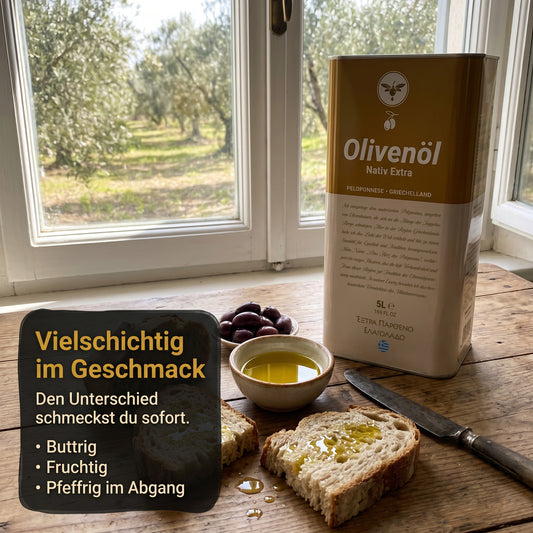
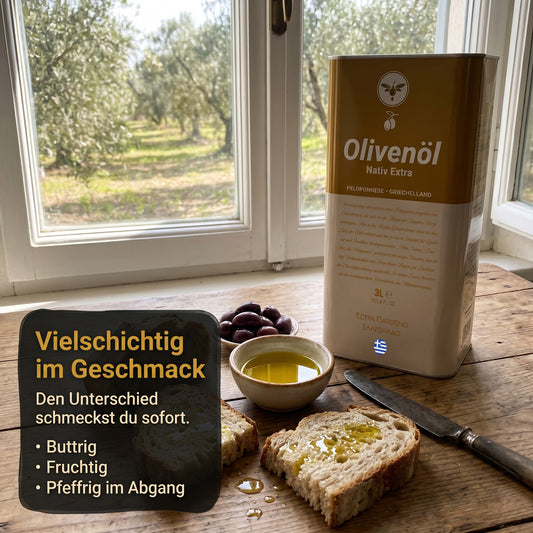
The label gets you most of the way; your senses do the rest. Pour a little into a small cup, warm it in your hand, and smell: you want fresh, green, fruity aromas — cut grass, tomato leaf, artichoke. Then taste. A fine extra virgin is often pleasantly bitter and finishes with a peppery kick at the back of the throat. That peppery sting is not a flaw; it is the taste of polyphenols, the very antioxidants that make great olive oil so prized. If you'd like to go deeper on that, our explainer on high-polyphenol olive oil is well worth a read.
By contrast, a tired or low-grade oil smells flat, greasy or faintly of crayons and old nuts, and tastes of very little. Once you have tasted the difference side by side, you cannot unlearn it — and you will understand instantly why the grade on the label matters so much.
How to Choose a Bottle Worth Buying
Put it all together and your shopping checklist is short: look for the words extra virgin (or natives Olivenöl extra), a named single origin, a recent harvest date, cold extraction, and ideally lab or quality verification. A dark glass or tin to protect the oil from light is a bonus that tells you the producer cares. Price is a clue too — genuine extra virgin from a named origin simply cannot be made for the price of a supermarket blend.
Our Peloponnese extra virgin olive oil was built around exactly this checklist: a single Greek origin, hand-harvested fruit, cold mechanical extraction, lab-tested low acidity and high polyphenols, naturally cloudy and unfiltered, and verified free of mineral-oil residues. It is also heat-stable to 180°C, so it is as happy in the pan as it is over a salad. Once you have one honest bottle like this on the counter, everything you cook tastes better. Try it here and taste the top grade for yourself.
Frequently Asked Questions
Is "pure" or "light" olive oil healthier?
No. "Pure", "classic" and "light" olive oils are refined blends. "Light" refers only to a lighter colour and milder taste, not fewer calories. Extra virgin is the least processed and richest in beneficial compounds.
Does a higher price always mean better olive oil?
Not always, but genuine extra virgin from a named origin has real costs behind it — careful harvesting, quick pressing, testing. A suspiciously cheap "extra virgin" is the bottle to be wary of. Look for the quality signals, not just the price.
Can I cook with extra virgin olive oil?
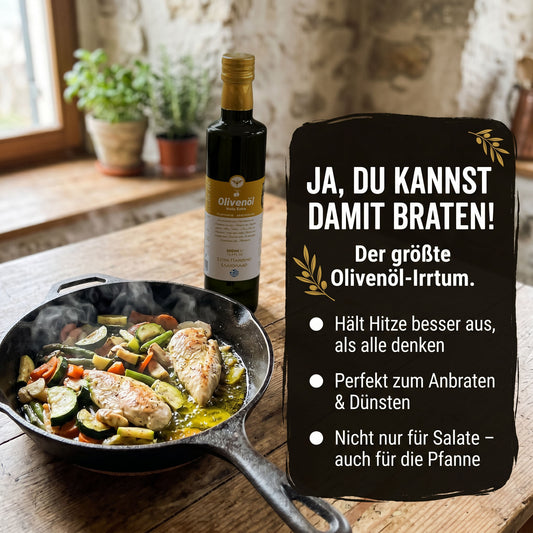
Yes. Despite the myth, a good extra virgin is stable for everyday cooking; ours is heat-stable to 180°C. For the full picture, see our guide on whether you can fry with olive oil, and our pick of the best olive oil for salads and dressings.
The Takeaway
The label is not just marketing — it is a map, once you know how to read it. Reach for extra virgin, check for a named origin, a recent harvest, cold extraction and proof of quality, and you will buy brilliantly every single time. Life is too short for flavourless oil. Put a genuine, lab-tested extra virgin on your table and taste what olive oil is meant to be. Order our Peloponnese extra virgin olive oil now — Pour La Vie.

New-Harvest Olive Oil: Why This Year's Freshly Pressed, Naturally Cloudy Oil Is the Best You'll Buy — and How to Choose It
New-harvest olive oil is the freshest, most flavourful oil of the year. Here's why freshly pressed olio nuovo tastes best in autumn...

Mediterranean Olive Oil Gift Sets: How to Choose a Foodie Gift That Actually Gets Used This Christmas
How to choose a Mediterranean olive oil gift set that actually gets used. What makes a great one, who it suits, and...

Aleppo Soap for Your Face: A Gentle, Natural Cleanse for Oily and Blemish-Prone Skin
Can you wash your face with Aleppo soap? Here is how this simple olive-and-laurel bar suits oily and blemish-prone skin — and...