Does Olive Oil Go Bad? How to Tell If It's Rancid, How Long It Lasts, and How to Store It

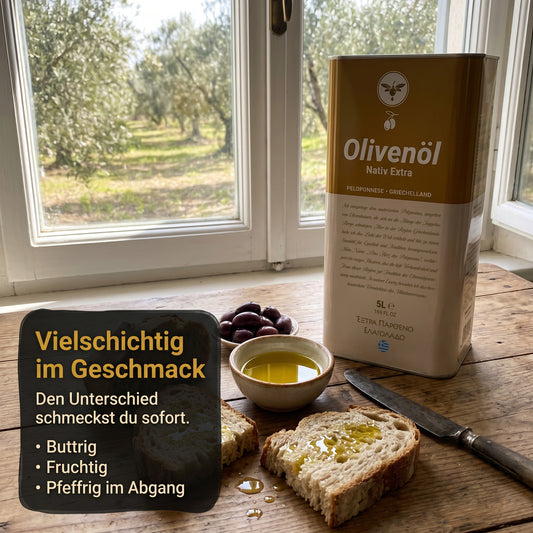
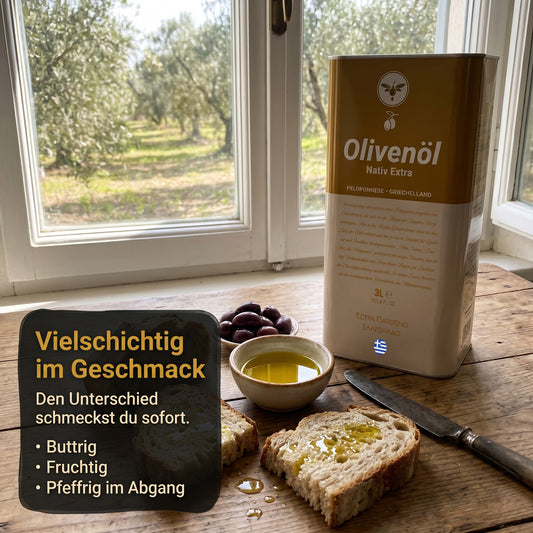
You reach for the bottle at the back of the cupboard, take a sniff, and something is off — waxy, a little like old crayons or stale nuts. So the question lands: does olive oil go bad? The short answer is yes. Olive oil is a fresh-pressed fruit juice, not a preserve, and it does not improve with age the way wine does. The good news is that spotting a rancid bottle, knowing how long yours should last, and storing it properly are all easy once you know what to look for — and it starts with buying an oil that was genuinely fresh in the first place, like our hand-harvested Peloponnese extra virgin.
Does olive oil go bad? The short answer
Olive oil does not “spoil” in a way that will make you ill the way spoiled milk might. What happens instead is rancidity: over time, exposure to oxygen, light and heat breaks the oil down, and its fresh, fruity, peppery character fades into something flat, greasy and stale. It is still technically edible, but it has lost everything that made it worth buying — the flavour and the aromatic compounds. Think of it less as “safe or dangerous” and more as “alive or tired.” The whole game is keeping your oil on the lively side for as long as possible.
How to tell if your olive oil has gone rancid
You do not need a laboratory — your nose and tongue are the best tools you have.
Smell it
Fresh extra virgin olive oil smells green, grassy, sometimes a little like fresh tomato leaf or artichoke. Rancid oil smells dull and waxy — people describe it as crayons, putty, old walnuts or stale peanuts. If the lively green aroma is gone, the oil is on its way out.
Taste it
Put a little on a spoon. A good oil tastes fruity and finishes with a peppery catch at the back of the throat — that gentle sting is actually a sign of freshness and a high polyphenol content. Rancid oil tastes flat, greasy and sometimes faintly sour, with none of that pepper. If there is no life to it, it is past its best.
What is NOT a sign of a bad oil
Two things worry people unnecessarily. First, cloudiness: a naturally cloudy, unfiltered oil (like ours) is simply unfiltered, not spoiled — it is a mark of a minimally processed oil. Second, solidifying in the cold: if your oil turns thick or forms white clumps in the fridge or a cold pantry, that is normal, and it clears again at room temperature. Neither means your oil has gone bad.
How long does olive oil actually last?
As a rule of thumb, an unopened bottle of good extra virgin olive oil keeps its quality for around 18–24 months from pressing, if it is stored in a cool, dark place. Once opened, the clock speeds up: oxygen is now getting in every time you pour, so aim to use it within about two to three months for the best flavour — and certainly within a few months rather than leaving it half-finished for a year.
One tip that matters more than any printed date: look for a harvest date, not just a “best before.” A best-before date can be two years after pressing and tells you little about freshness. An oil with a recent harvest and honest sourcing is one you can trust — which is exactly why we are transparent about our Peloponnese oil being hand-harvested, cold-extracted and lab-tested.
The four enemies of fresh olive oil: light, heat, air and time
Rancidity is not random — it is driven by four things. Light (especially sunlight) accelerates breakdown, which is why good oil comes in dark glass or tins. Heat does the same, so the worst place for a bottle is right next to the hob. Air (oxygen) oxidises the oil a little more every time the bottle is open. And time simply lets all of the above add up. Control these four and your oil stays fresh for months; ignore them and even a brilliant oil can turn in weeks.
How to store olive oil so it stays fresh
The rules are refreshingly simple:
- Cool and dark. A closed cupboard away from the oven and any window is perfect. Room temperature is fine — you do not need the fridge.
- Keep it sealed. Close the cap firmly after every use to keep oxygen out.
- Away from heat. Never store it beside the stove, on a sunny windowsill or above the oven, however convenient that looks.
- Buy a size you will finish. A 500 ml bottle you use within a couple of months will always taste better than a bargain 3-litre tin that sits open for a year.
- Decant small amounts. If you keep a little cruet by the stove for convenience, refill it from the main bottle and keep the big one in the dark.
Follow those and you will taste the difference right to the last pour. And if your current bottle has already gone flat, there is no better excuse to replace it with one that was fresh to begin with — treat yourself to the Peloponnese extra virgin here.
Freshness starts long before your kitchen
How long an oil lasts is decided before you ever open it. An oil that was harvested late, pressed slowly or cut with cheaper refined oil starts tired and goes downhill fast. Ours starts at the other end of the scale. Our extra virgin olive oil from the Peloponnese is traditionally hand-harvested and extracted by cold mechanical pressing, it is naturally cloudy and unfiltered, and it is lab-certified for low acidity, a high polyphenol content and no detectable mineral oil residues. Those natural polyphenols are not just the source of its peppery flavour — as natural antioxidants, they also help the oil hold on to its freshness for longer. Buy it fresh, store it well, and it rewards you every single time you reach for it.
Our product tip
Extra Virgin Olive Oil 500ml from the Peloponnese
Hand-harvested, cold-extracted and lab-certified for low acidity and a high polyphenol content — a 500 ml size you will actually finish while it is still fresh and peppery.
Shop the Peloponnese olive oilFrequently asked questions
Can I still use olive oil that has gone slightly rancid?
It will not harm you, but it will not do your food any favours either — rancid oil tastes flat and faintly stale, and it drags down everything you cook with it. For dressings and finishing especially, it is simply not worth it. If a bottle has clearly turned, retire it and open a fresh one.
Should I keep olive oil in the fridge?
You do not need to. A cool, dark cupboard away from the oven is ideal, and the fridge can make the oil cloudy and thick (which is harmless but inconvenient). Refrigeration only really makes sense if your kitchen is very warm and you want to slow down a large quantity you cannot finish quickly.
My olive oil looks cloudy — is it off?
Almost certainly not. A naturally cloudy, unfiltered oil like our Peloponnese extra virgin is cloudy by design, because it has not been stripped by heavy filtering. Judge it by smell and taste, not by clarity: if it smells green and tastes peppery, it is in great shape.
Olive oil is at its best when it is fresh, well stored and used with enthusiasm — so trust your nose, keep it cool and dark, and do not let a good bottle sit half-forgotten. When it is time for a new one, start with an oil that was fresh from the very first pressing. Order your Peloponnese extra virgin here and taste what fresh really means. Pour La Vie.

High-Polyphenol Olive Oil: What Polyphenols Actually Are, Why the Peppery Kick Matters, and How to Choose an Oil That Has Them
High-polyphenol olive oil explained: what polyphenols are, why the peppery kick matters, and how to choose an extra virgin oil that truly...

The Best Olive Oil for Salads and Dressings: How to Choose One (and Why Cheap Oil Ruins a Good Salad)
How to choose the best extra virgin olive oil for salads and dressings - and why a naturally cloudy, polyphenol-rich Peloponnese oil...

Best Olive Oil in November 2026
Looking for the best olive oil in November 2026? A buyer's guide to extra virgin: acidity, polyphenols, harvest, origin and how to...