Cretan Thyme Honey: What Makes Greek Thyme Honey So Special — and How to Spot the Real Thing

Ask anyone who has spent a summer in Greece what they smuggled home in their suitcase, and sooner or later someone will say thyme honey — ideally from the sun-baked hillsides of Crete. Dense, amber and almost savoury in its intensity, Cretan and Greek thyme honey is one of the most sought-after honeys in the world, and once you have tasted the real thing, the pale, watery jars on the supermarket shelf are hard to go back to. But what actually makes it so special, why does Crete keep coming up, and how do you make sure the jar in your basket is the genuine article? Here is everything worth knowing — and if you already want to taste it, you can try our naturally raw Greek thyme honey here. Pour La Vie.
What is thyme honey — and why do Crete and Greece own it?
Thyme honey is made by bees that forage on wild Mediterranean thyme as it flowers through the hot, dry summer. Greece, and Crete in particular, is tailor-made for it: thousands of hectares of rocky, uncultivated hillside carpeted in wild thyme, relentless sunshine, and a beekeeping tradition that reaches back thousands of years. The thyme flowers only briefly and yields very little nectar per plant, so true thyme honey is always produced in modest quantities — which is precisely why genuine Greek thyme honey earns the price and the reputation it enjoys. When people search for “thyme honey from Crete”, this is what they are chasing: a honey with a real sense of place.
What makes Greek thyme honey so special
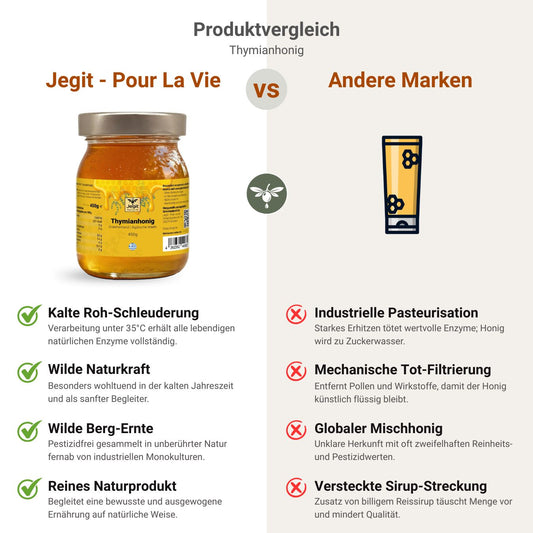
Three things set a great Greek thyme honey apart. First, the aroma: warm, herbal and floral, with a distinctive, almost resinous note of wild thyme that lingers long after the spoon is gone. Second, how it is handled. Our Greek thyme honey is naturally raw and cold-spun — never heated or ultra-filtered — which preserves its natural enzymes, its aroma and the fine, living character that only gentle processing protects. Third, purity: it is bottled pure and unprocessed, with nothing added and nothing taken away. That combination of wild origin, careful harvesting and raw handling is what you are paying for, and what you can taste in the very first spoonful. Secure a jar of the real thing here.
What does Greek thyme honey taste like?
Expect a deep amber colour and a thick, slow pour. The flavour is far less one-dimensionally sweet than ordinary blossom honey — there is a herbal, almost savoury edge, a hint of warm spice and a long, aromatic finish. It is intense enough to stand up to strong cheeses and roasted meats, yet still beautiful stirred into a cup of tea. If you have only ever had mild, mass-produced honey, that depth can be a genuine revelation.
How to spot authentic thyme honey (a quick buying guide)
Not every jar labelled “thyme honey” is the real deal. Here is how to separate genuine Greek thyme honey from the blends:
- Check the origin. Genuine thyme honey names its region — Greece, and often specifically Crete or the Peloponnese. A vague “blend of EU and non-EU honeys” label tells you almost nothing about what is inside.
- Look for raw and unheated. Raw, cold-spun honey keeps its aroma and natural enzymes; heavily heated, ultra-filtered honey loses much of what makes thyme honey worth buying in the first place.
- Trust the aroma and texture. Real thyme honey is intensely aromatic and pours thick. Over time it may crystallise — a sign of a natural, unprocessed honey, not a fault.
- Be realistic about price. Thyme yields very little nectar, so authentic thyme honey is never the cheapest jar on the shelf. If it looks suspiciously cheap, it is almost certainly a blend.
Our Greek thyme honey ticks every box: single-origin from Greece, naturally raw, cold-spun and bottled pure. Buy authentic Greek thyme honey here.
How to use Greek thyme honey
This is where thyme honey really earns its place in your cupboard. Drizzle it over creamy feta or fresh goat’s cheese for an instant Greek meze. Spoon it over thick Greek yoghurt with a few walnuts, or stir it into porridge. Its savoury depth makes it a superb glaze for roast chicken, pork or halloumi, and it brings a grown-up sweetness to a sharp salad dressing whisked with good olive oil. And of course, a spoonful stirred into warm tea is a Mediterranean ritual in itself — a natural olive-wood honey dipper makes it that bit more special. Start with a jar of the real thing here.
Our product tip
Thyme Honey 450g from Greece
Naturally raw and cold-spun, pure and unprocessed — a single-origin Greek thyme honey with an intense, herbal Mediterranean aroma you can taste in the first spoonful.
Taste it nowFrequently asked questions
Is Cretan thyme honey better than other Greek thyme honey?
Crete has an exceptional reputation for thyme honey thanks to its vast wild-thyme hillsides and long beekeeping heritage, but outstanding thyme honey is produced right across Greece, including the Peloponnese. What matters most is that it is genuine single-origin Greek thyme honey, raw and unprocessed, rather than a nondescript blend.
Why has my thyme honey crystallised?
Crystallisation is completely natural and a reassuring sign that your honey is raw and unprocessed. To bring it back to a runny texture, simply stand the jar in warm (not hot) water. Avoid boiling or microwaving it, which would damage the aroma and the natural enzymes.
How should I store thyme honey?
Keep it in a sealed jar at room temperature, away from direct sunlight. Honey is naturally long-keeping, so there is no need to refrigerate it — in fact, the fridge only speeds up crystallisation.
Great thyme honey is one of those small luxuries that quietly upgrades everything it touches — a drizzle over cheese, a spoon in your tea, a glaze on a Sunday roast. Once you have the real, raw Greek version in your cupboard, you will keep finding excuses to reach for it. Treat yourself to authentic Greek thyme honey here. Pour La Vie.

Olive Oil Test Winners Explained: How to Spot a Genuinely Top Extra Virgin Oil (Not Just a Label)
What olive oil tests really measure, the criteria every test-winning extra virgin oil shares, and how to recognise a genuinely top oil...

Mediterranean Gift Ideas for Her: Natural Olive Oil and Skincare Gifts She'll Actually Love
Stuck on a Christmas gift for her? Skip the clichés. Here are natural, Mediterranean gift ideas for women, built around real olive...

What to Use Olive Oil For: 12 Everyday Ways to Cook, Finish and Flavour with Extra Virgin
One good bottle of extra virgin olive oil, twelve everyday uses from frying to finishing, and the one rule that decides whether...