Black Kalamata Olives: The Complete Guide to Greece's Most Famous Table Olive
Ask someone to picture a Greek olive and they will almost certainly picture a Kalamata: almond-shaped, deep purple-black, glossy, with a firm bite and a flavour that is fruity and slightly winey rather than merely salty. It is the olive on the Greek salad, in the tapenade, on the meze platter.
It is also one of the most misunderstood olives on the shelf. A great deal of what is sold as "black Kalamata" is neither black in the way you think nor Kalamata at all. This guide explains what the name actually means, how the olive gets its colour and flavour, and what separates a good jar from a disappointing one.
What Kalamata Actually Refers To
Kalamata is not a colour or a curing style — it is a cultivar. The tree, Olea europaea var. Kalamon, is grown principally in the southern Peloponnese, around the city of Kalamata in Messenia. The variety produces a distinctive fruit: elongated, pointed at one end, with a relatively small stone and a high flesh-to-stone ratio.
The name matters commercially. Within the EU, "Elia Kalamatas" carries Protected Designation of Origin status, which ties the name to olives of the Kalamon variety grown and processed in the Messenia region. In practice, though, olives of the Kalamon cultivar grown elsewhere in Greece are widely and legitimately sold as "Kalamata-type" or "Kalamon" olives — and a lot of product simply borrows the word because it sells.
The Peloponnese Connection
There is a reason the same corner of Greece produces both the country's most celebrated table olive and some of its best oil. Messenia and the wider Peloponnese offer a long, dry summer, mild winters, and hillside soils that stress the trees just enough. Stressed trees make smaller, more concentrated fruit.
Kalamon trees are also awkward to harvest mechanically — the fruit bruises easily, and a bruised table olive is a ruined table olive. Serious producers still pick by hand, which is slow, expensive, and the reason genuine Kalamata olives cost more than the anonymous black olives in a tin.
Why They Are Black — and Why That Is Not the Whole Story
Here is the most useful thing to know about olives generally: colour indicates ripeness, not variety. Every olive starts green and darkens through purple to black-purple as it ripens on the tree. Green olives and black olives can come from the same branch, picked weeks apart.
Kalamon olives are picked late, when they have turned a deep purple-black naturally on the tree. That late harvest is what gives them their softer flesh, their higher oil content, and their fruity, almost wine-like flavour. The colour is earned.
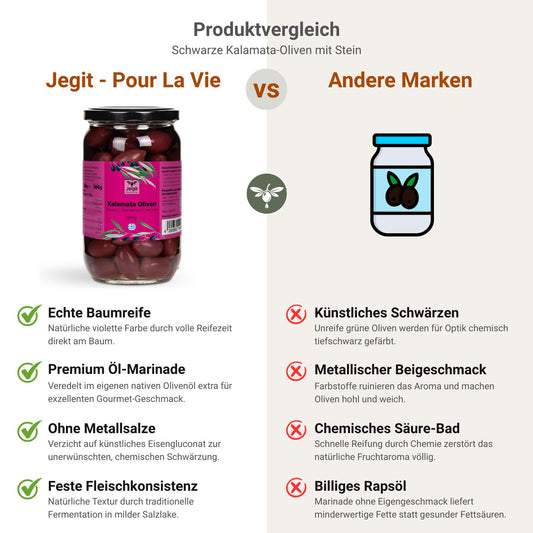
This is not true of all black olives you will encounter. Many cheap black olives — particularly the uniformly matte, perfectly round ones in tins — are green olives picked early and turned black industrially: treated with lye and aerated, then fixed with ferrous gluconate, an iron salt. It is legal and it is declared on the label, but the result is an olive that is black without ever having ripened. It tastes flat, because it is.
How to Spot the Difference
- Look at the shape. Genuine Kalamata olives are almond-shaped and pointed, not spherical.
- Look at the colour. Naturally ripened olives vary — some are more purple, some nearly black, some mottled. Perfect, identical, matte black across every olive in the jar is a warning sign.
- Read the ingredients. Olives, water, salt, vinegar, perhaps olive oil. If you see ferrous gluconate (E579), you are looking at colour-fixed olives.
- Check for the stone. Olives with the pit intact hold their texture and flavour better than pitted ones, which lose brine into the hollow and soften.
Our black Kalamata olives with the pit are naturally harvested and cured, with no artificial additives and no colourants — which is why they are not all the same shade of black.
How Kalamata Olives Are Cured
Raw olives are inedible. The culprit is oleuropein, a bitter phenolic compound, and every curing method is essentially a way of removing it.
Kalamon olives are traditionally brine-cured. They are slit or left whole and submerged in salt water for weeks or months, during which fermentation slowly leaches the bitterness out and develops flavour. Many producers finish them in a mixture of brine and red wine vinegar, which is where the characteristic tang comes from.
The alternative — lye curing — is faster, taking days rather than months, and is common for green olives. It is efficient. It also strips out a good deal of the complexity along with the bitterness. The slow route costs more and tastes better, which is a fairly consistent rule in this category.
What Curing Does to Nutrition
Kalamata olives are, like all olives, mostly monounsaturated fat — the same fat that makes olive oil what it is. They also carry polyphenols, iron and vitamin E. Naturally fermented olives retain more of their phenolic content than lye-treated ones, since the compounds are not being aggressively washed out.
They are, however, salty. That is unavoidable in a brine-cured product, and worth bearing in mind if you are watching sodium. A brief rinse before serving takes the edge off without noticeably harming flavour.
Buying and Storing
A few practical points:
- With the pit, when you can. Better texture, better flavour, and the pit is a decent signal that the olive was handled properly.
- In brine, not vacuum-dry. Brine-packed olives stay plump; long-stored dry-packed ones can go leathery.
- Keep them submerged. Once opened, olives above the brine line will discolour and spoil. If the level drops, top up with a light salt solution — one teaspoon of salt to 200 ml of water.
- Refrigerate after opening and use within a few weeks. They will keep longer, but the texture drifts.
- Serve at room temperature. Cold mutes the fruitiness entirely. Take them out half an hour before.
Where They Belong in the Kitchen
Kalamata olives are assertive, so they work best where that is the point. They are essential in a proper horiatiki, where they sit alongside tomato, cucumber and feta without any lettuce to dilute them. They are the backbone of tapenade. They are excellent baked into bread, tossed through pasta with garlic and chilli, or simply served whole with a piece of feta, a drizzle of good extra virgin olive oil from the Peloponnese and some oregano.
What they are not is a neutral garnish. Do not treat a Kalamata like a tinned black olive — it will take over anything mild you put it next to.
Our product tip
Black Kalamata Olives with pit
Naturally harvested and cured, with the pit intact — no colourants, no artificial additives, just the olive.
Discover the Kalamata olivesFrequently Asked Questions
Are black Kalamata olives the same as ordinary black olives?
No. Kalamata refers to a specific cultivar, harvested late and cured in brine, which is naturally dark purple-black. Most inexpensive black olives are a different variety, picked green and blackened industrially with lye and an iron salt. They look similar in a photograph and taste nothing alike.
Why are some Kalamata olives more purple than black?
Because they ripened naturally, and natural ripening is uneven. Fruit on the sunny side of a tree darkens sooner than fruit in the shade. Variation across a jar is a sign that no colourant was used — it is a feature, not a defect.
Should I buy Kalamata olives with or without the stone?
With the stone, if you have the choice. Pitting is done mechanically and damages the flesh; the hollow then fills with brine, which softens the olive and dilutes its flavour. Pitted olives are more convenient for cooking, but for eating and for salads, whole olives are noticeably better.
Pour La Vie
A Kalamata olive is a small thing that carries a lot: a specific tree, a specific hillside, a late harvest, and months in brine while somebody waited. None of that can be shortcut, and all of it is tasteable.
We source things that were made the slow way and left alone — nothing added, nothing dyed, and an origin we can point to on a map. Taste the real thing — Pour La Vie.