Best Thyme Honey in August 2026: A Buyer's Guide to Greece's Golden Honey
Greek thyme honey is one of the Mediterranean's quiet luxuries: amber-gold, intensely aromatic, with a warm herbal note that ordinary blended honey simply cannot match. It is prized across Greece for drizzling over yoghurt and cheese, sweetening tea, and glazing roasted vegetables and meat. But thyme honey is also one of the most imitated honeys on the shelf, so it pays to know what you are buying. Here is how to choose the best thyme honey this August.
What Makes Thyme Honey Special?
Thyme honey is a monofloral honey, meaning the bees gather nectar predominantly from wild flowering thyme. In Greece, thyme grows abundantly across sun-baked hillsides and islands, and the honey made from it is deep gold, slow to crystallise and full of a distinctive resinous, herbal aroma. Because thyme flowers briefly and yields relatively little nectar, genuine thyme honey is scarcer and more valued than mass-market flower honeys — which is exactly why cheaper jars are so often blended or mislabelled.
The Five Things to Check Before You Buy
1. Is it raw and unheated?
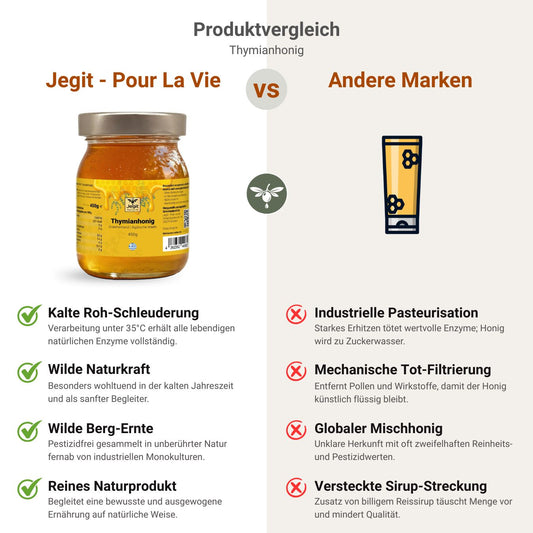
Much supermarket honey is pasteurised and finely filtered for a uniform look and long shelf life — a process that strips out much of the honey's natural aroma and character. The best thyme honey is raw and cold-extracted, so its full flavour and natural enzymes are preserved. Look for words such as "raw", "unheated" or "cold-extracted".
2. A single, honest ingredient
Real thyme honey contains one thing: honey. Beware jars labelled "blend of honeys", "with added glucose syrup", or vaguely as "table honey". These are often stretched with cheaper syrups. The label should say thyme honey and nothing else.
3. Aroma and flavour
Genuine thyme honey has an unmistakable warm, herbal, slightly resinous aroma and a lingering, complex sweetness — not just plain sugar. If you can smell the thyme before you taste it, that is a very good sign.
4. Colour and crystallisation
Thyme honey is typically a rich amber-gold and crystallises slowly compared with many other honeys, often staying liquid for a long time. Very pale, watery honey or honey that has set rock-hard almost immediately may not be what it claims. Note that natural crystallisation itself is not a fault — it is simply a normal behaviour of pure honey and can be gently reversed in warm water.
5. Clear origin
Because Greek thyme honey commands a premium, provenance matters. A clearly stated Greek origin, ideally naming a region or island, is a strong indicator of authenticity. Vague "produce of EU and non-EU countries" labelling usually signals a blend.
How to Use Thyme Honey
Thyme honey shines where its aroma can be tasted rather than cooked away. Spoon it over thick Greek yoghurt with walnuts, drizzle it across warm feta or fresh goat's cheese, or trickle it over a slice of olive-oil cake. It makes a fragrant glaze for roasted carrots, chicken or halloumi, and it turns a simple herbal tea into something special. Because the flavour is concentrated, you need less of it than ordinary honey.
Our Pick for August 2026
Weighed against every point above, our recommendation this month is our own Thyme Honey from Greece. It is a pure, raw, cold-extracted Greek thyme honey with a single ingredient and no added syrups — gathered from wild flowering thyme and bottled to keep its natural enzymes and intense aroma intact. Rich, gold and fragrant, it is as good over a spoonful of yoghurt as it is glazing a Sunday roast.
Storing Thyme Honey
Keep honey in a sealed jar at room temperature, away from direct sunlight, and use a dry spoon each time. Do not refrigerate it — cold speeds up crystallisation. If your honey does crystallise, stand the jar in a bowl of warm (not boiling) water and stir gently until it turns clear again; high heat would harm the very aroma and enzymes you paid for. Stored well, pure honey keeps almost indefinitely.
Frequently Asked Questions
How can I tell if thyme honey is genuine?
Look for a single ingredient (honey), a clear Greek origin, and "raw" or "unheated" on the label. Genuine thyme honey has a strong herbal aroma, a rich amber-gold colour and a lingering, complex sweetness rather than a flat, sugary taste.
Why has my honey crystallised — is it still good?
Yes. Crystallisation is a natural behaviour of pure honey and a sign it has not been over-processed. Simply warm the jar gently in warm water to return it to a liquid state; avoid high heat, which damages the aroma and natural enzymes.
Is thyme honey worth the higher price?
Thyme yields little nectar and flowers only briefly, so genuine thyme honey is naturally scarcer and more aromatic than everyday flower honey. If you value that intense flavour and buy a pure, raw Greek honey, most people find it well worth it — and a little goes a long way.
Our Product Tip
Thyme Honey from Greece
Pure, raw and cold-extracted from wild Greek thyme — rich, golden and intensely aromatic.
Shop the thyme honeyThe best thyme honey is simply pure honey from wild Greek thyme, gathered gently and left as nature made it. Choose one that is raw, single-origin and honestly labelled, and every spoonful will taste of the Mediterranean hillside it came from. Pour La Vie.