Best Aleppo Soap in August 2026: A Buyer's Guide to Genuine Laurel Soap
Aleppo soap has never been more popular than it is in 2026. As more people move away from synthetic cleansers towards simple, natural bars, this centuries-old olive-and-laurel soap has found a whole new audience. But that popularity has a downside: the market is now full of bars that borrow the name without the substance. So how do you find the best Aleppo soap this August? This guide walks you through exactly what to look for.
Rather than ranking dozens of near-identical bars, we focus on the handful of factors that actually determine quality — and show you how to judge them for yourself, whichever brand you are holding.
What Makes a Great Aleppo Soap in 2026?
At its heart, real Aleppo soap is disarmingly simple: olive oil, laurel berry oil, water and a natural alkali, aged until mild. There are no synthetic fragrances, dyes or preservatives. That simplicity is exactly why quality varies so much — with so few ingredients, the origin of the oils, the ratio between them and the length of the curing all make an outsized difference. A great bar is mild, long-lasting and honestly labelled; a poor one is rushed, padded with cheaper oils or dressed up with added perfume.
The Five Things to Check Before You Buy
1. Laurel oil percentage
Laurel berry oil is the signature ingredient and usually the most expensive, so its percentage is the single most telling number on the label. Common grades run from around 20% up to 40% and beyond. A higher percentage means a stronger aroma and a richer, more characterful bar; a lower one is milder. If a bar hides its laurel percentage entirely, treat that as a warning sign.
2. Curing and ageing
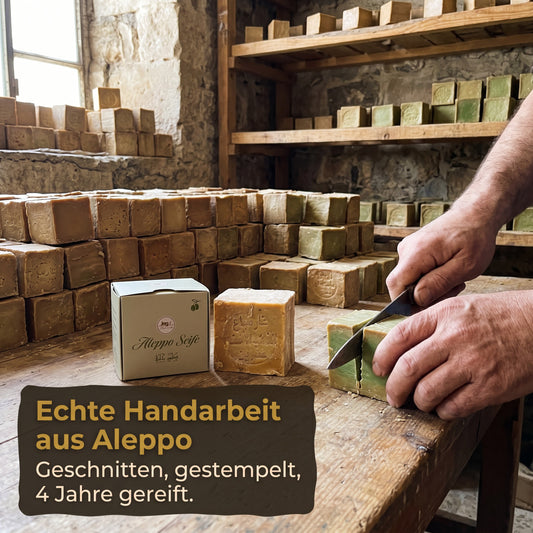
Traditional Aleppo soap is aged for months or even years. During this time water evaporates, the bar hardens, and the soap becomes progressively milder as the surface oxidises to its familiar golden-brown. A well-aged bar lasts far longer in the shower and is gentler on the skin. Look for makers who state their ageing time; the best bars are matured for several years.
3. A short, honest ingredient list
The whole appeal of Aleppo soap is what it leaves out. A genuine bar lists only olive oil, laurel oil, water and the alkali — nothing else. If you see "parfum", added colourants, palm oil or synthetic foaming agents such as SLS, you are no longer looking at authentic Aleppo soap.
4. Colour, scent and feel
Cut a genuine bar open and it should be green inside, with an oxidised golden-brown skin. The scent is earthy, woody and natural — never perfumed. The bar should feel hard and dense rather than soft and soapy. These simple sensory checks catch most imitations.
5. Origin and craftsmanship
Traditional bars are cut and stamped by hand, which is why edges are slightly irregular and no two are identical. That handmade character is a sign of authentic production rather than mass moulding, and it usually goes hand in hand with better oils and proper ageing.
Which Laurel Percentage Is Right for You?
There is no single "best" percentage — it depends on your skin and how you plan to use the bar. A lower laurel content is milder and a good match for the face or for sensitive skin. A higher content, around 40%, gives a stronger aroma and a richer feel that many people prefer for the body, for hair, and for oily or blemish-prone skin. If you want one bar that does almost everything well, a balanced 40% laurel / 60% olive oil is the classic all-rounder: characterful enough to feel special, yet mild enough for daily use from head to toe.
Our Pick for August 2026
Measured against every point above, our recommendation this month is our own Aleppo soap with 40% laurel oil and 60% olive oil. It hits the balanced 40% laurel grade, contains nothing but the four traditional ingredients, and is cut by hand and matured for at least four years before it reaches you — so it arrives properly mild and long-lasting. It works as a face and body bar, a shampoo bar and even a gentle shaving soap, which makes it an easy one-bar choice for anyone simplifying their routine.
How to Get the Most from Your Bar
However good your soap, a little care makes it last. Keep the bar on a well-draining dish so it dries fully between uses — sitting in water is what makes any natural soap dissolve quickly. Store spare bars somewhere airy; Aleppo soap actually improves and hardens further with age. And give a new bar a use or two to develop its soft, creamy lather, which is naturally gentler than the big bubbles of synthetic soaps.
Frequently Asked Questions
What is the best laurel percentage for Aleppo soap?
It depends on your skin. Lower percentages are milder and suit the face and sensitive skin, while around 40% gives a richer, more aromatic bar popular for the body and hair. A 40% laurel / 60% olive oil bar is a well-balanced all-rounder for daily use.
How can I tell if an Aleppo soap is genuine?
Check that the ingredient list contains only olive oil, laurel oil, water and a natural alkali, with no perfume or dyes. A real bar is green inside, golden-brown outside, smells earthy rather than perfumed, feels hard and dense, and is hand-cut with slightly irregular edges.
Does more expensive always mean better?
Not necessarily, but genuine laurel oil and long ageing both cost money, so extremely cheap "Aleppo" soap is often low in laurel or poorly cured. Judge value by the laurel percentage, the ageing time and the purity of the ingredients rather than by price alone.
Our Product Tip
Aleppo Soap — 40% Laurel Oil & 60% Olive Oil
The balanced all-rounder: four natural ingredients, hand-cut and matured for at least four years — for head, body and even shaving.
Shop our Aleppo soapThe best Aleppo soap is not about clever marketing — it is about honest oils, a sensible laurel ratio and the patience to let the bar age. Choose on those terms and you will end up with a soap that lasts for months and treats your skin gently every day. Pour La Vie.