Are Olives Healthy? Calories, Nutrition and the Real Benefits of Green and Kalamata Olives

Olives are one of those foods that feel like an indulgence but belong to one of the healthiest eating patterns on earth. If you have ever wondered how many calories are really in a bowl of olives, what nutrients they bring to the table, or whether green or Kalamata olives are the better choice, this is your straightforward guide. And if it leaves you craving a proper bowlful, our naturally fermented Greek green olives are ready when you are.
The short answer: yes, olives are a genuinely nutritious food — a cornerstone of the Mediterranean diet, rich in heart-friendly monounsaturated fats and plant antioxidants. The longer answer, below, explains the numbers and, just as importantly, why the quality of the olive changes what you get.
How many calories are in olives?
Olives are surprisingly light for how satisfying they are. As a rough guide, most table olives contain around 115 to 145 kcal per 100 g, which works out at only about 5 to 7 kcal per olive — a handful is a modest snack, not a splurge. Green olives and black Kalamata olives sit in a similar range; the bigger differences come from how they are prepared.
What drives the number up is added oil and stuffing. Olives packed in oil, or stuffed with cheese, carry more calories than ones simply cured in brine. This is one reason we keep ours pure: our green Chalkidiki olives are made with nothing but brine and vinegar — no oil-loading, no additives. Try them here and taste how clean a real olive can be.
What is actually inside an olive?
Olives earn their place in a healthy kitchen because of what comes with those calories:
- Monounsaturated fats. The majority of an olive's fat is monounsaturated — the same kind that makes extra virgin olive oil a staple of the Mediterranean diet.
- Antioxidant polyphenols. Olives are naturally rich in plant compounds such as polyphenols, which give them their characteristic taste and are a signature of the Mediterranean way of eating.
- Vitamin E and iron. Black Kalamata olives in particular are a useful source of iron and antioxidants.
- Fibre. They add a little fibre to a snack or a salad, which helps them feel satisfying.
One honest caveat: because they are cured in brine, olives are naturally salty, so they are best enjoyed in sensible portions as part of a balanced diet rather than by the jarful. Nutrition is about the whole picture, not a single food.
Green vs Kalamata: is one healthier?
Green and black olives usually come from the same tree — green ones are picked earlier, black ones (like Kalamata) are left to ripen fully. Nutritionally they are close cousins. Riper black olives such as Kalamata tend to be a touch higher in oil and in iron, with a deeper, winey flavour, while green olives are firmer, milder and a little more bitter. Neither is dramatically "healthier" than the other — so the best choice is simply the one you will happily eat. Our tip? Keep both in the fridge.
Why quality changes the nutrition
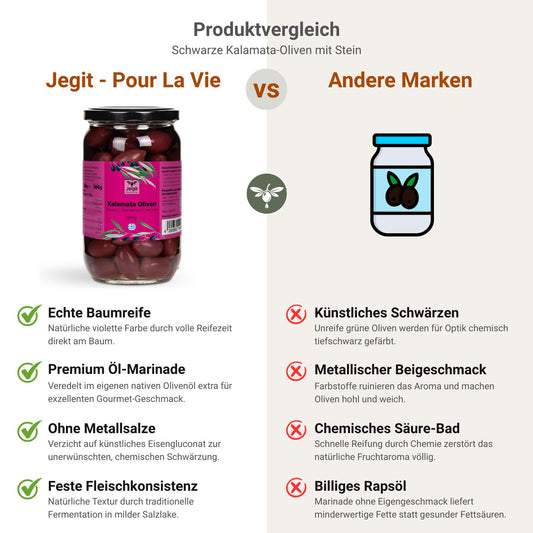
Here is what the supermarket shelf rarely tells you: not all olives are equal. Cheap olives are often chemically treated to speed up curing, dyed to fake a uniform black colour, or loaded with stabilisers. That processing strips away the living character — and some of the goodness — of the fruit. A naturally cured olive is a different food altogether.
Our olives are made the slow, traditional way:
- Naturally fermented, preserving a living, fresh aroma rather than a flat, processed taste.
- Hand-harvested Greek quality, picked at the right moment rather than stripped early.
- Free from artificial additives and colourants — our Kalamata olives get their deep black from ripening, not dye.
- Only brine and vinegar in the green olives — nothing you cannot pronounce.
If you are going to eat olives for the goodness as well as the taste, it is worth eating good ones. Shop our naturally cured Kalamata olives and skip the dyed, over-processed sort for good.
How to enjoy olives (the delicious way)
Olives are the easiest healthy habit to keep because they ask for no cooking. Scatter them over a salad, fold them through a grain bowl, add them to a traybake in the last minutes, or simply serve a bowl with a drizzle of good olive oil as a Mediterranean snack. For a crowd, build an antipasti board around a mix of green and black. Stock up on green olives here and you will always have a wholesome bite within reach.
Frequently asked questions
How many olives can I eat a day?
There is no fixed rule, but a sensible snack portion is around 8 to 10 olives. Because they are cured in brine and naturally salty, enjoy them as part of a balanced diet rather than in large quantities, and they fit comfortably into most eating patterns.
Are black olives higher in calories than green?
They are very close. Fully ripe black olives such as Kalamata can be slightly higher in oil, and therefore marginally higher in calories, than early-picked green olives — but the difference is small. How they are prepared (plain brine versus oil-packed or stuffed) matters far more.
Are Kalamata olives dyed black?
Genuine Kalamata olives are naturally dark from ripening on the tree, not from dye. Cheaper "black olives" are sometimes colour-treated to look uniform. Our Kalamata olives are naturally cured and free from colourants, so the colour you see is the real thing.
Our Product Tip
Greek Green Olives with Pit (Chalkidiki)
Naturally fermented, hand-harvested and made with only brine and vinegar — mild, fruity and free from additives. A genuinely wholesome Mediterranean snack.
Shop the green olivesSo, are olives healthy? Enjoyed in sensible portions, they are one of the most effortless ways to bring the Mediterranean table into your day — light in calories, rich in monounsaturated fats and antioxidants, and endlessly versatile. The one thing worth being fussy about is quality. Choose naturally cured Greek olives from Jegit and taste the difference real fruit makes. Pour La Vie.

Can You Wash Your Hair with Aleppo Soap? A Natural Hair-Washing Guide (and How to Avoid the Waxy Feeling)
Yes, you can wash your hair with Aleppo soap. Here's how to do it right, why hair can feel waxy, and the...

Can You Eat Olives Straight From the Tree? Why Raw Olives Are So Bitter — and How They Become the Olives You Love
Can you eat olives straight off the tree? Here is why raw olives are so bitter, whether they are safe, and how...

Thyme Honey vs Manuka Honey: Which Is Really Worth It?
Thyme honey vs manuka honey compared: taste, MGO, purity and price. Why pure Greek thyme honey is the everyday Mediterranean honey worth...