Are Kalamata Olives Dyed? How to Tell Real, Naturally Cured Black Olives
It is one of the most common questions shoppers ask at the deli counter: are Kalamata olives dyed? The short answer is reassuring — real Kalamata olives get their deep purple-black colour entirely from nature, not from a bottle. But the question is a fair one, because plenty of cheap “black olives” on supermarket shelves genuinely are colour-treated. Knowing the difference is the key to buying olives that actually taste of something. If you want to skip straight to the real thing, our naturally cured black Kalamata olives are free from additives and colourants — taste the real thing here.
The short answer: real Kalamata olives are not dyed
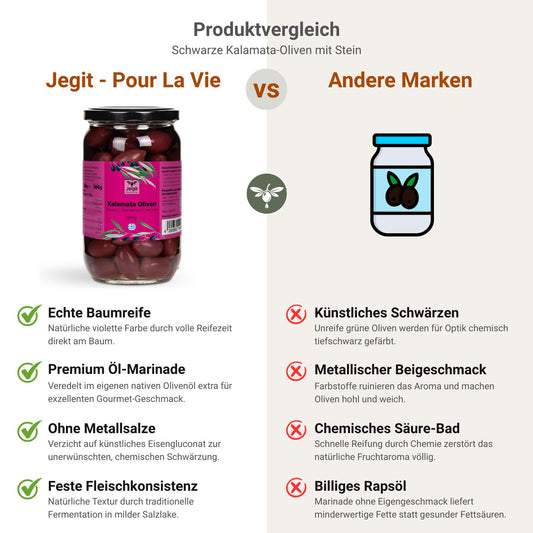
Authentic Kalamata olives are a specific variety grown in the southern Peloponnese. They are left to ripen fully on the tree until they turn a natural dark aubergine-purple, then cured slowly in brine and often a splash of red wine vinegar and olive oil. That deep colour is simply what a ripe Kalamata olive looks like — no dye required. When you see a glossy, almond-shaped, purple-black olive with a genuine fruity-tart flavour, you are looking at nature's own colour.
Why real Kalamata olives are naturally dark
Olives change colour as they ripen, from green through rosy-purple to a deep brown-black. Kalamata olives are harvested late, when they are fully mature, which is exactly why they are so dark and so rich in flavour. Our black Kalamata olives are traditionally hand-picked after the fruit has had its full 100 to 120 days on the branch, then naturally cured — never rushed, never painted. They are free from artificial additives and, crucially, free from colourants, so the colour in the jar is the colour the sun gave them. That matters, because natural ripening is also where the flavour comes from: a properly ripened olive is fruity, meaty and pleasantly tart, not flat and rubbery. Order a jar and compare for yourself.
So which black olives ARE dyed?
Here is where the confusion comes from. The uniformly jet-black, perfectly round, mild “black olives” you often find sliced on pizzas or sold cheaply in cans are frequently not naturally black at all. They usually start life as unripe green olives that are treated with oxygen and an iron-based stabiliser (ferrous gluconate or ferrous lactate, listed as E579 or E585) to turn them uniformly black in a matter of days. It is a legal, regulated process — but it is colour treatment, and it produces an olive that is soft, uniform and largely flavourless.
So the honest picture is this: Kalamata olives are naturally dark, while many generic “black table olives” are artificially blackened. Telling them apart on the shelf is easier than you think once you know what to look for.
How to tell if your black olives are dyed
Use this quick checklist next time you shop:
- Colour uniformity. Naturally cured olives vary in shade — some darker, some with purplish or brownish patches. Suspiciously uniform, inky-black olives that all look identical are a red flag.
- Shape. Real Kalamata olives are almond-shaped and slightly irregular. Perfectly round, uniform olives are often the oxidised kind.
- With or without pit. Artificially blackened olives are usually sold pitted and sliced. Olives sold with the pit, like our Kalamata olives with pit, are far more likely to be naturally cured — and they keep their texture and flavour better, too.
- The ingredient list. This is the decider. Natural olives list only olives, water, salt, maybe vinegar and olive oil. If you see ferrous gluconate, ferrous lactate, E579 or E585, the colour has been fixed artificially.
- Taste and texture. Naturally cured olives are firm, fruity and tangy. Dyed olives tend to be soft, bland and one-note.
Want to take the guesswork out of it completely? Choose olives with a clean label here.
Why naturally cured olives are worth it
Once you taste the difference, it is hard to go back. Naturally ripened, slow-cured Kalamata olives have a depth that colour-treated olives simply cannot fake: a fruity, winey tang, a meaty bite and that unmistakable Mediterranean character. They also carry what nature put there — the heart-friendly monounsaturated fats and the antioxidants and iron that olives are known for — rather than an added stabiliser.
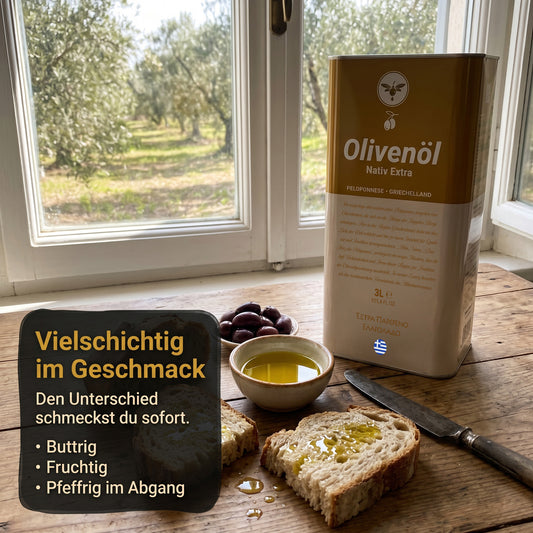
At Jegit, our black Kalamata olives are hand-picked, naturally cured and completely free from artificial additives and colourants — pure Pour La Vie quality. If you prefer something milder and greener, our naturally fermented Greek green Chalkidiki olives are cured with nothing but brine and vinegar, too. Either way, you are tasting real olives, exactly as the Mediterranean intended. Stock your pantry with the real thing.
Frequently asked questions
Are Kalamata olives always naturally black?
Yes. Genuine Kalamata olives get their dark purple-black colour from ripening fully on the tree and slow natural curing. Authentic Kalamata olives, like ours, are not dyed and contain no colourants.
Which olives are artificially coloured?
Usually the cheap, uniformly jet-black, round “black olives” sold pitted or sliced. These are often green olives oxidised and fixed with an iron compound (E579 or E585). Check the ingredient list — real olives don't need it.
How can I be sure the olives I buy aren't dyed?
Read the label and look for only olives, water, salt, vinegar and olive oil. Choose olives with the pit and a natural variation in colour. Our Kalamata olives with pit are naturally cured and free from colourants, so you always know exactly what you are getting.
Our product tip
Black Kalamata Olives with Pit
Traditionally hand-picked, naturally cured and free from artificial additives and colourants — deep, fruity and authentically Greek.
Taste the real thingSo, are Kalamata olives dyed? No — and that is exactly the point. Real olives don't need colour added; they need sun, time and careful curing. Once you have tasted olives made that way, the uniform black supermarket version never tastes quite right again. Choose naturally cured Kalamata olives — Pour La Vie.