How Much Laurel Oil Should Aleppo Soap Have? Why 40% Is the Premier Class
If you shop for authentic Aleppo soap, you will quickly notice the numbers: 12%, 20%, 40%, sometimes even 60% laurel oil. Is more automatically better? Is less not enough? And which bar is really worth it for your skin, hair and face?
The short answer first: 40% laurel oil is the premier class of Aleppo soap. This is where you get the full conditioning power and unmistakable character of laurel – while keeping the mildness you can use every day from head to toe. This guide explains why, and how to recognise a truly high-quality Aleppo soap.
The essentials in 30 seconds
- 12–20%: mild and cheap, but with little laurel character – essentially an olive oil soap.
- 40%: the premier class – maximum laurel care with full everyday suitability for face, body and hair.
- 50–60%+: very intense scent, high price – more of a specialist choice.
What Genuine Aleppo Soap Is Made Of
Traditional Aleppo soap needs only three things: olive oil, laurel (bay) berry oil and an alkali that turns the oils into soap during saponification. No synthetic fragrances, no colourants, no hardeners. Everything else is time – and that is what makes the difference.
The olive oil forms the gentle, cleansing base. The laurel oil is the precious part: it gives the soap its typical earthy, woody scent and its rich, conditioning feel, and it is the reason Aleppo soap has been prized for centuries. Because laurel oil costs many times more than olive oil, the percentage on the label tells you a lot about the grade of a bar.
What the Laurel Oil Percentage Really Means
The percentage tells you how much of the oil content is laurel oil rather than olive oil. A 40% bar is made from roughly 40% laurel oil and 60% olive oil.
Think of it as a dial: olive oil brings mildness and a soft, creamy lather. Laurel oil brings aroma, a more active cleansing feel and the luxurious conditioning quality Aleppo soap is famous for. The art is not to turn the dial all the way up or down – it is to hit the point where both oils give their best. That point is 40%.
The Levels Compared
| Laurel oil | Laurel care | Everyday use | For hair & face |
|---|---|---|---|
| 12–20% | low | yes | limited |
| 40% ★ | high | yes | ideal |
| 50–60%+ | very high | not for everyone | only if you love the intense scent |
Low laurel content (around 12–20%)
These bars are cheap and mild – but strictly speaking they are mostly olive oil soaps with a hint of laurel. What makes Aleppo soap special only just comes through. Fine as a simple body bar, but they lack depth of care for face and hair.
40% laurel oil – the premier class
At 40%, Aleppo soap reaches its full potential. You get a generous, characterful portion of laurel oil with a noticeable conditioning effect and the typical noble scent – while the olive oil keeps the bar mild enough for daily use: on the body, as a facial soap, as a shampoo bar and even for shaving.
That is why connoisseurs regard 40% as the reference class: it is the highest laurel content at which a bar remains fully suitable for everyday use by the whole family. You cannot get more care without making compromises.
→ See our Aleppo soap with 40% laurel oil
Very high laurel content (around 50–60% and above)
These bars have a strong, resinous scent that many people quickly find too intense. They cost considerably more without giving you noticeably more in everyday use – which is why they often end up back in the cupboard after a few washes. A tip: if a bar with a very high laurel content is offered at a surprisingly low price, take a critical look, because genuine laurel oil is an expensive raw material.
Why 40% Is the Best Choice for You
- One bar for everything: face, body, hair, shaving – no need for a shelf full of specialist products.
- Full laurel care: enough laurel oil for the rich skin feel that makes Aleppo soap so special.
- Mild enough for every day: the high olive oil content ensures a gentle, creamy wash.
- Pleasant scent: noticeably earthy and woody, but never overpowering.
- Great value: a high-quality bar of around 200 g lasts remarkably long when stored properly.
Quality Is About More Than the Percentage
The laurel figure matters, but it is not everything. You can also recognise a genuinely good Aleppo soap by these signs:
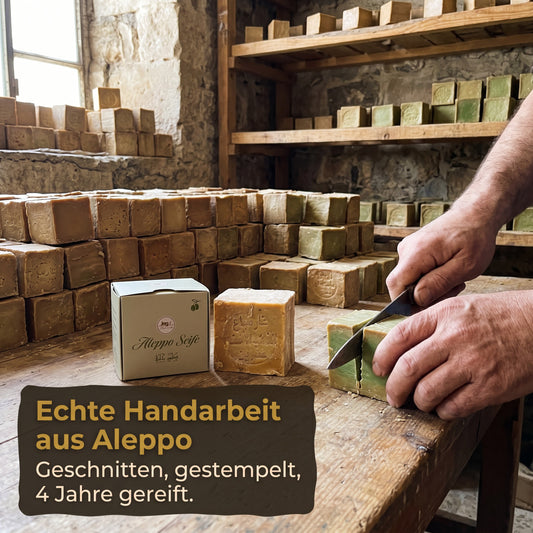
- Maturing time: traditional bars mature for one to four years. The longer, the milder and harder the soap – and the longer it lasts in the shower. Our soap matures for at least four years – the upper end of the traditional range.
- Appearance: golden-brown outside, the typical green of olive and laurel oil inside.
- Handcrafted: traditionally hand-cut – which is why the weight varies slightly between 180 and 220 g.
- Purity: only oils and the saponifying agent, no synthetic fragrances or colourants.
The Aleppo soap from Jegit meets all of these points: 40% laurel oil, 60% olive oil, matured for at least four years, hand-cut and quality-checked several times.
The premier class of Aleppo soap
Aleppo Soap – 40% Laurel Oil & 60% Olive Oil
✓ Matured at least 4 years ✓ Hand-cut ✓ For face, body & hair ✓ No additives
Get your 40% Aleppo soapFrequently Asked Questions
Is a higher laurel oil percentage always better?
No. Above 40%, mainly the scent gets stronger and the price higher – the everyday benefit barely increases. That is why 40% is considered the premier class: maximum laurel care that you can still use every day.
What laurel percentage is best for hair?
40% is ideal for washing hair: enough laurel oil for a rich, conditioning feel, yet mild enough for regular use. Tip: lather the bar directly in wet hair and rinse thoroughly.
Can I use 40% Aleppo soap on my face?
Yes. Thanks to the high olive oil content it is gentle enough for daily facial cleansing – morning and evening.
Why is laurel oil Aleppo soap more expensive than ordinary soap?
Laurel oil is a costly, labour-intensive raw material, and genuine Aleppo soap needs years to mature. In return you get a pure natural soap that is very economical and can replace many separate products.
How long does a bar of Aleppo soap last?
Thanks to the long maturing time the bar is very hard and therefore economical. Let it dry well on a soap dish after use – then a bar of around 200 g often lasts many weeks with daily use.
Conclusion: Choose the Premier Class
If you only buy one Aleppo soap, make it one with 40% laurel oil. It combines the best of both worlds: the care and character of laurel and the mildness of olive oil. One bar for face, body and hair – no additives, no shortcuts, just oil, laurel and time.
That is the philosophy behind Pour La Vie: pure, honest care with a story you can trust.