Aleppo Soap Ingredients: What Is Really Inside the Bar
Turn most soap bars over and the ingredient list runs to fifteen or twenty lines. Turn over a genuine bar of Aleppo soap and you find four. That is not a marketing simplification — it is the recipe, more or less unchanged for centuries.
But four ingredients still leave room for confusion. What exactly is laurel oil? Why does the list mention sodium hydroxide, and should that worry you? What does the green interior actually tell you? This guide walks through the composition of Aleppo soap line by line, so you can read a label and know precisely what you are holding.
The four ingredients of traditional Aleppo soap
An authentic bar contains nothing more than:
- Olive oil — the base of the soap, usually 60–80 percent
- Laurel berry oil — the characteristic ingredient, typically 20–40 percent
- Sodium hydroxide (lye) — the agent that turns the oils into soap
- Water — the medium in which the reaction takes place
On a cosmetics label these appear in their INCI form, which is where people often get confused. A typical honest list reads: Sodium Olivate, Sodium Laurelate (or Laurus Nobilis Fruit Oil), Aqua, Sodium Hydroxide, Glycerin. There is no fragrance, no dye, no preservative and no palm oil. If you see any of those, you are not looking at a traditional bar.
Olive oil: the body of the soap
Olive oil makes up the bulk of every Aleppo bar, and it is what makes the soap so notably mild. Soaps built on olive oil produce a low, creamy lather rather than an aggressive foam — the abundant bubbles most people associate with "clean" usually come from harsher surfactants.
Olive oil also brings squalene, vitamin E and oleic acid into the bar. In practical terms that means the soap cleanses without leaving skin feeling tight and stripped, which is why Aleppo soap has such a following among people with dry or easily irritated skin.
The higher the olive oil share, the gentler and softer the bar — and the faster it will wear down in a wet soap dish.
Laurel oil: the ingredient that defines the bar
Laurel berry oil (Laurus nobilis) is pressed from the berries of the bay laurel tree. It is expensive, scarce and entirely responsible for the deep green colour, the resinous herbal scent and the price difference between one bar and the next.
Laurel oil is where the character sits. It gives the soap a light cleansing quality that olive oil alone cannot provide, and it is the reason so many people use Aleppo soap on hair, on the face, and even for shaving. A bar with 40 percent laurel oil smells distinctly of forest and resin; a bar with 5 percent barely announces itself at all.
What the percentage actually means
The number on the packaging refers to the share of laurel oil in the fat portion of the soap. Higher is not automatically better — it is a question of skin type:
- 5–20 percent — mild, everyday washing, suitable for sensitive skin
- 30–40 percent — the classic all-rounder for body, hair and face
- 50–60 percent — intensive, strongly scented, favoured for oily or blemish-prone skin
Our own Aleppo soap with 40 percent laurel oil and 60 percent olive oil sits at the upper end of the classic range — rich enough to be noticeable on hair and skin, still mild enough for daily use.
Sodium hydroxide: why lye is on the list
This is the ingredient that alarms people, and it should not. Sodium hydroxide is the alkali that triggers saponification — the chemical reaction that converts oil into soap. Without it there is no soap, only oil. This is true of every real soap ever made, from the cheapest supermarket bar to the most artisanal.
Crucially, the lye is consumed during the reaction. In a properly made, fully cured bar, no free sodium hydroxide remains. What remains are the soap salts — sodium olivate, sodium laurelate — plus naturally formed glycerin, which most industrial manufacturers extract and sell separately, and which traditional Aleppo soap keeps.
Traditionally the alkali came from plant ash, which is why old accounts speak of soda ash or barilla. Modern producers use food-grade sodium hydroxide, which is simply a purer, more reliable version of the same thing.
Why the inside is green and the outside is beige
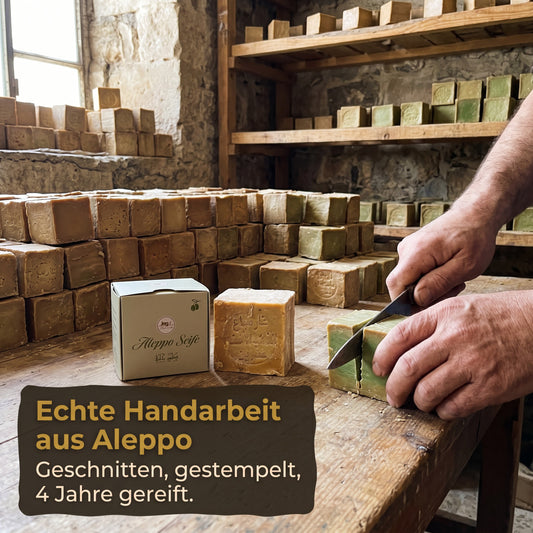
A cut bar of Aleppo soap looks like two different products. The interior is olive green; the outer crust is a dull gold or beige.
That is not a coating and not a trick. It is oxidation. After the soap is poured and cut, it is stacked in towers and left to cure in dry air for months or years. The surface reacts with the air and fades, while the protected core keeps its colour. A well-defined beige crust over a green interior is one of the clearest visual signs of a long, natural maturation — and maturation is what makes a bar mild.
Our bars are cured for at least four years before they are sold.
Red flags on an ingredient list
If a bar sold as "Aleppo soap" lists any of the following, treat the name as decoration rather than description:
- Palm oil (Sodium Palmate) — a cheap substitute for olive oil, common in imitations
- Parfum / Fragrance — real laurel oil needs no help; added fragrance usually masks a very low laurel share
- CI colourants — the green comes from the laurel oil, not from a dye
- Tetrasodium EDTA, preservatives — a cured soap does not need them
- No laurel percentage given at all — producers who are proud of theirs state it
Our product tip
Aleppo Soap — 40% Laurel Oil & 60% Olive Oil
Four ingredients, hand-cut and matured for at least four years — for hair, face, body and even laundry.
Discover the Aleppo soapFrequently asked questions
Is Aleppo soap vegan?
Yes. The traditional recipe contains only plant oils, water and lye — no animal fats, no beeswax, no lanolin, and no honey. Bars that add anything else are departing from the original recipe.
Does Aleppo soap contain palm oil?
A genuine bar does not. Palm oil turns up only in imitations, where it replaces part of the olive oil to cut costs. Check the label for Sodium Palmate — if it is there, the bar is not traditional Aleppo soap.
Can people with sensitive skin use it?
Aleppo soap is generally well tolerated because it is free of fragrance, dyes and preservatives, and because the long curing period makes it mild. Laurel oil is nonetheless a botanical ingredient, so anyone with a known allergy to bay laurel should avoid it, and a small patch test is always sensible with a new product. If you have a persistent skin condition, ask a dermatologist.
Four ingredients, nothing hidden
Aleppo soap is worth understanding precisely because there is so little to understand. Olive oil for mildness, laurel oil for character, lye to make it soap, water to make it happen — then time, and nothing else.
Read the label, look for the percentage, check for the beige crust over a green core. That is all it takes to tell the real thing from the rest. Pour La Vie.