Aleppo Soap and Sensitive Skin: What to Know Before You Switch
Aleppo soap has a reputation for being the gentle option — two ingredients, no synthetic fragrance, no colourants, centuries of use behind it. For most people that reputation holds. But "natural" and "suits everyone" are not the same claim, and if you have sensitive or reactive skin you deserve a straighter answer than the marketing usually gives.
This guide covers what is actually in the bar, how laurel oil behaves on the skin, who should be careful, and how to switch over without a bad fortnight. No promises, no cures — just what the soap is and how to use it sensibly.
What is in the bar — and what is not
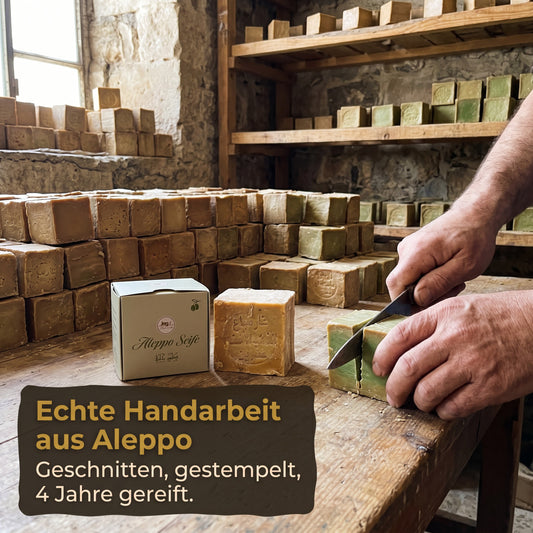
A traditional Aleppo soap contains olive oil, laurel berry oil, water and an alkali, saponified and then cured for years. That is the whole list. Our Aleppo soap with 60% olive oil and 40% laurel oil is cured for at least four years before it is sold, hand-cut, and carries nothing else.
What is absent matters as much for sensitive skin. There is no added perfume, and fragrance is one of the most frequent causes of contact reactions in cosmetics. There are no dyes, no preservatives, no SLS. The green interior is the laurel oil; the beige crust is oxidation from the long cure, not a coating.
Why the cure changes how it feels
A freshly made soap is alkaline and sharp. Time is what softens it. Over months and years the bar hardens, moisture leaves, and the soap becomes noticeably milder on the skin — which is precisely why traditional producers cure for so long rather than selling immediately.
This is worth knowing because a young, cheap Aleppo bar and a four-year bar are genuinely different products, even at the same laurel percentage. If you tried Aleppo soap once, disliked how tight it left you, and wrote it off, the age of that bar may well have been the variable.
The laurel oil question
Laurel berry oil is what distinguishes Aleppo soap from plain olive oil soap. It is also the ingredient most worth thinking about if your skin reacts easily.
Laurel is a botanical, and botanicals can be sensitising for a minority of people. Contact allergy to laurel is uncommon but documented — it is not a theoretical risk. The higher the laurel percentage, the more pronounced everything about the bar becomes: the deep herbal smell, the cleansing feel, and, for the small group who react, the likelihood of a reaction.
Which percentage for reactive skin?
Higher laurel content is often marketed as "stronger" or more premium. For sensitive skin, more is not automatically better. A 40% bar like ours is a considered middle ground: enough laurel to give the soap its character and cleansing quality, balanced by a majority of olive oil, which is the milder, more conditioning half of the recipe.
If you know you are reactive to botanicals generally, starting at 40% rather than 60% or higher is the sensible order of operations.
Always patch test first
This takes two minutes and saves a lot of guesswork.
- Wet the bar and rub a little lather onto the inside of your forearm or behind your ear.
- Leave it for a minute, then rinse and pat dry.
- Wait 24 to 48 hours before using it on your face.
- If you see redness, itching or small bumps, stop — that bar is not for you.
If you have a known laurel or bay leaf allergy, skip the test and skip the soap. If you have a diagnosed skin condition or you are treating your skin with anything prescribed, talk to your doctor or dermatologist before changing your routine. A soap is not a treatment, and nothing here is medical advice.
The tight feeling: what it means
The most common complaint in the first week is tightness after washing. It helps to separate two different causes.
The first is simply that soap — any true soap — is alkaline, while skin sits slightly acidic. Skin restores its own balance within a couple of hours, and a brief tight feeling that fades is normal and not damage.
The second is over-washing. Many people arriving from foaming synthetic cleansers keep the same habits: long lathering, hot water, twice a day, scrubbing. Aleppo soap does not need any of that. Brief contact, lukewarm water, rinse.
If tightness is still there hours later, or your skin flakes and stings, that is your signal to wash less often with it — body only, or every other day — rather than to push through.
How to switch over gently
Give it a fortnight and change one thing at a time.
- Start on your body, not your face. Facial skin is thinner and less forgiving. Learn how the bar behaves elsewhere first.
- Lukewarm, not hot. Hot water strips far more than the soap does.
- Keep contact short. Lather, wash, rinse. There is no benefit to leaving it sitting on the skin.
- Moisturise while damp. Whatever you already use, apply it within a few minutes of towelling off.
- Do not stack changes. If you switch soap, shampoo and cream in the same week and something reacts, you have learned nothing.
Let the bar dry — it matters more than you think
Aleppo soap sitting in a puddle goes soft, mushy and short-lived. A drainage dish that lets air reach all sides, away from the direct spray of the shower, will keep the bar firm and make it last for months. A soft bar is not a faulty bar; it is a wet one.
Frequently asked questions
Can I use Aleppo soap on my face every day?
Many people do, once a day, usually in the evening. If your skin is dry or reactive, start with two or three times a week and see how it settles before going daily. There is no rule that says a natural soap must be used every day to work.
Does Aleppo soap have side effects?
For most people it is well tolerated. The two things reported most often are a temporary tight feeling after washing and, rarely, a contact reaction to laurel oil — redness or itching that appears within a day or two. A patch test identifies the second before it becomes a problem. Anything persistent or painful should be looked at by a doctor rather than managed with a different soap.
Is Aleppo soap suitable for children?
Its short ingredient list and lack of added fragrance make it a common choice for family bathrooms. Children's skin is thinner and more permeable than adult skin, though, so patch test first, keep contact brief and ask your paediatrician if your child has eczema or any diagnosed skin condition.
Our product tip
Aleppo Soap — 40% Laurel Oil & 60% Olive Oil
Two ingredients, cured for at least four years and hand-cut — a balanced starting point if your skin reacts easily.
Discover the Aleppo soapSensitive skin rewards patience and a short ingredient list. Test it, go slowly, and let the bar prove itself. Pour La Vie.