Greek Thyme Honey: What Makes It Special and How to Use It
Not all honey is created equal. Among the world’s great honeys, Greek thyme honey holds a place of quiet legend — amber-gold, intensely aromatic and prized since antiquity. It is the honey that Greek grandmothers stir into herbal tea, drizzle over thick yoghurt and keep in the cupboard as both a treat and a remedy. If you have only ever tasted ordinary blended honey, the first spoonful of real thyme honey is a revelation.
But what actually makes it so special, how does it differ from other honeys, and how do you get the most out of it? This guide covers the origin, the flavour, the qualities to look for and the many everyday ways to enjoy our Greek thyme honey.
What is thyme honey?
Thyme honey is a monofloral honey — meaning bees gather the great majority of their nectar from a single plant, in this case wild thyme (Thymus capitatus). Across the sun-baked hillsides of Greece, wild thyme blooms in high summer, carpeting the landscape in tiny purple flowers. Beekeepers move their hives to these aromatic slopes so the bees can work the thyme in full flower, usually in July and August.
Because thyme nectar is produced only in small quantities and for a short window each year, genuine thyme honey is relatively rare and precious — one reason it has always been more expensive than mass-produced honey.
Why Greek thyme honey is so prized
Greece has an almost perfect combination for exceptional thyme honey: a dry Mediterranean climate, poor rocky soils that thyme loves, thousands of hours of sunshine and a beekeeping tradition that stretches back to ancient times. The result is a honey with an unusually high aromatic intensity and a flavour that speaks clearly of its origin.
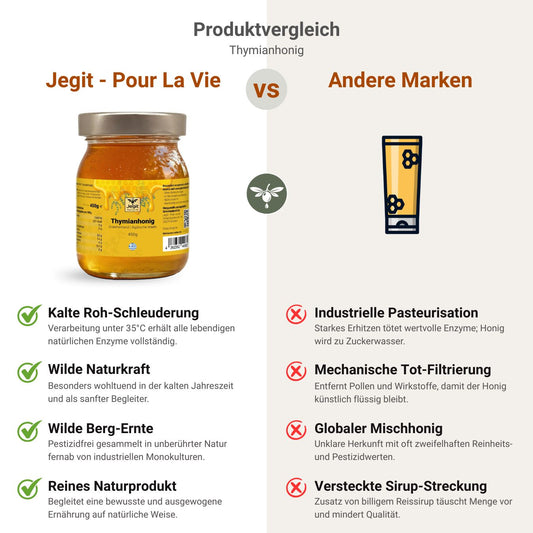
Our thyme honey from Greece is raw and unheated, hand-harvested in the traditional way. Keeping it unheated protects its natural enzymes, delicate aromatics and nutritional value — qualities that are easily lost when honey is pasteurised for supermarket shelves.
What does thyme honey taste like?
Thyme honey has a deep amber colour and a thick, luxurious texture. The flavour is where it truly shines: warm and floral at first, with a distinctive herbal, almost peppery note and a long, slightly resinous finish. It is aromatic without being cloying, and far more complex than a simple sweetness. That savoury edge is exactly why it works so beautifully with cheese, roasted meats and herbs, not just sweet dishes.
Is thyme honey good for you?
Honey has been valued for its natural properties for thousands of years, and thyme honey in particular is often singled out for its rich aromatic compounds and antioxidant content. Raw, unheated honey retains more of its natural enzymes and pollen than processed honey. That said, honey is still a natural sugar, so it is best enjoyed in moderation as part of a balanced diet. It is not a medicine and should not be given to children under one year of age.
How to use Greek thyme honey
Thyme honey is wonderfully versatile, at home in both sweet and savoury cooking:
- With yoghurt and fruit: the classic — a spoonful over thick Greek yoghurt with walnuts or fresh figs.
- On a cheese board: drizzle over feta, aged cheese or creamy goat’s cheese; its herbal note is made for salty cheese.
- As a glaze: brush over roast chicken, lamb or root vegetables in the last minutes of cooking for a fragrant, golden finish.
- In dressings: whisk a little into a vinaigrette with olive oil and lemon for a rounded, aromatic salad dressing.
- In warm drinks: stir into herbal tea (once slightly cooled, to protect its aromatics) or a glass of warm milk.
- Simply on bread: spread over fresh bread or warm toast for the purest pleasure of all.
For serving, a natural olive wood honey dipper makes drizzling clean and effortless — and looks beautiful on the breakfast table.
How to store thyme honey
Store honey at room temperature in a tightly sealed jar, away from direct sunlight. There is no need to refrigerate it. Over time, natural honey may crystallise and turn grainy — this is a sign of purity, not spoilage. To return it to a smooth, runny state, simply place the jar in a bowl of warm (not hot) water and stir gently. Avoid microwaving or overheating, which destroys the very aromas and enzymes that make thyme honey special.
How to spot genuine thyme honey
Real thyme honey should list a clear single origin and, ideally, be raw and unheated. Look for a deep amber colour, a genuinely herbal aroma rather than a flat sweetness, and honesty about where and how it was harvested. Very cheap “thyme” honey is often a blend with only a hint of thyme. Buying from a producer who is transparent about origin — as with our Greek harvest — is the surest way to get the real thing.
Frequently asked questions
Why is thyme honey more expensive than other honey?
Thyme blooms only briefly each summer and yields relatively little nectar, so genuine thyme honey is produced in small quantities. Its rarity, intense aroma and traditional hand-harvesting all contribute to the higher price.
Can I cook and bake with thyme honey?
Yes, though gentle heat is best. Use it as a glaze or stir it into warm (not boiling) dishes to preserve its delicate aromatics. For drizzling and finishing, it is unbeatable straight from the jar.
Does thyme honey crystallise?
It can, like all pure, raw honey. Crystallisation is completely natural and reversible — warm the jar gently in warm water and stir until smooth again.
Our product tip
Thyme Honey 400g from Greece
Raw, unheated and hand-harvested from wild Greek thyme — intensely aromatic and pure.
Shop thyme honeyGreek thyme honey is a small luxury with a long history — a single ingredient that carries the scent of a Mediterranean hillside in high summer. Choose it raw, store it with care, and let its herbal-golden character transform the simplest yoghurt, cheese board or slice of bread. Pour La Vie.